Artificial intelligence (AI) is revolutionizing industries at a breakneck speed. From automating complex calculations to generating creative content, AI has become an indispensable tool. But here’s the exciting part: while AI excels at processing data and identifying patterns, it still struggles to replicate certain deeply human abilities. These are the skills rooted in empathy, creativity, ethical reasoning, trust-building, and continuous learning – the very qualities that will set you apart in the evolving workplace and in your daily life. This comprehensive guide dives deep into seven crucial human skills that AI just can’t replace, at least not yet. We’ll explore why emotional intelligence, creative problem-solving, ethical judgment, relationship building, strategic vision, cultural intelligence, and adaptive learning are becoming more valuable than ever as AI technology advances. You’ll discover practical, actionable strategies to hone each of these essential abilities, boost your career resilience, elevate your leadership potential, and truly prepare for the future of work. Whether you’re a student charting your course, a seasoned professional navigating career shifts, an entrepreneur building your vision, or a lifelong learner committed to growth, mastering these timeless human capabilities will ensure you remain relevant, create significant impact, and thrive in an AI-powered world. Let’s build a future that technology alone cannot construct.
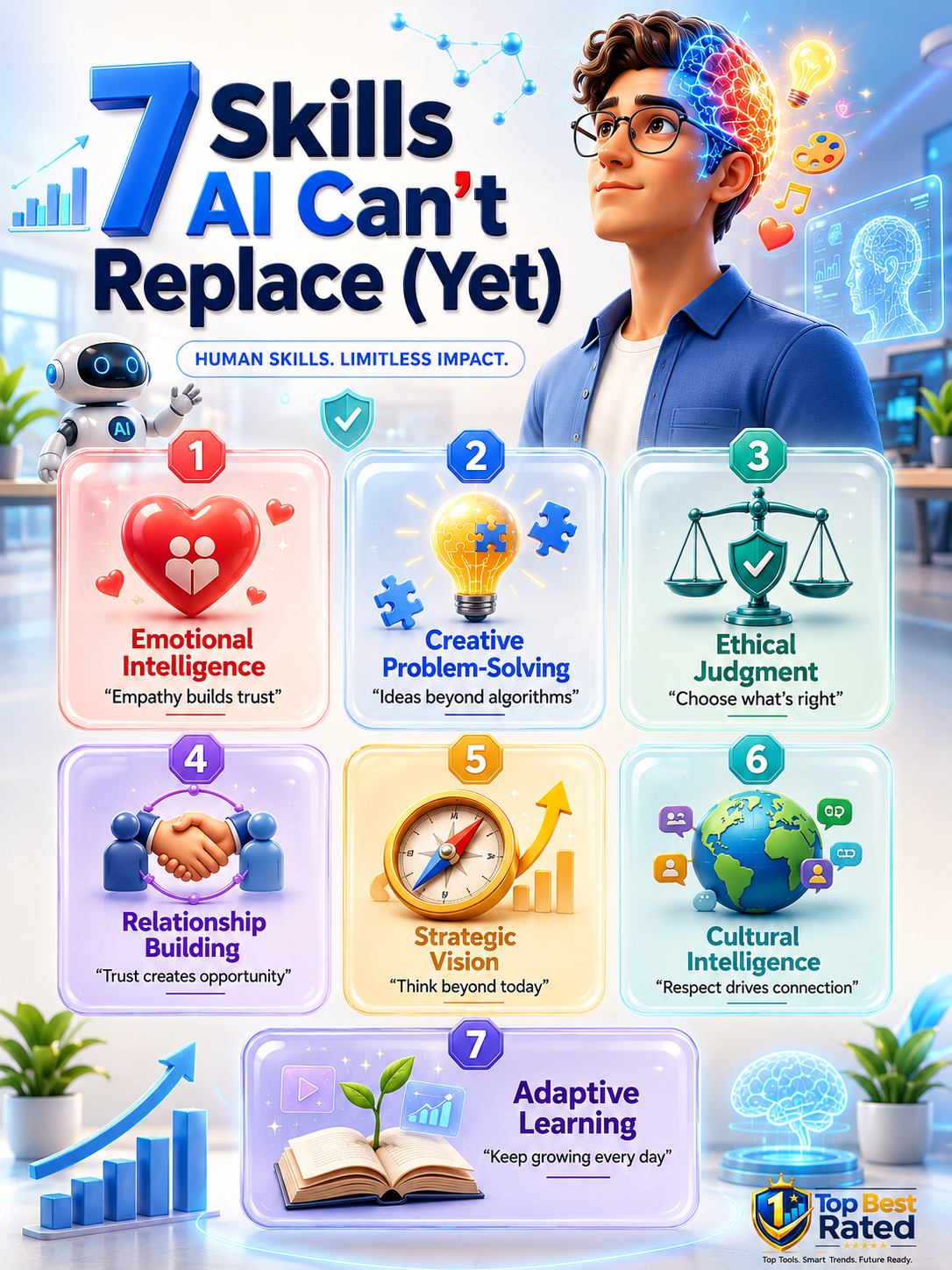
## Which Human Skills Will AI Never Replace? Unpacking the Top 7 Essential Abilities
AI is fundamentally reshaping how we work, connect, and tackle challenges. It’s a powerful ally, assisting with everything from drafting emails to sifting through enormous datasets. Yet, despite its impressive computational power, AI falls short when it comes to replicating the uniquely human traits that fuel innovation, inspire leadership, foster trust, and nurture genuine connections.
The most strategic approach in this AI-driven era isn’t to compete head-on with machines, but to understand and cultivate the human skills that perfectly complement technology. These abilities are your superpower, making you more adaptable, resourceful, and indispensable, no matter how advanced automation becomes.
In this guide, we’re going to explore seven potent human skills that continue to set us apart from algorithms and machines. More importantly, we’ll equip you with practical, actionable strategies to strengthen each one, ensuring your long-term success and relevance.
## 🌟 Why Your Human Skills Are More Critical Than Ever in the Age of AI
As technology takes over more routine and predictable tasks, human efficiency becomes less of a differentiator and more of a baseline. This shift means that organizations and employers are placing an exponentially higher premium on individuals who possess distinctively human capabilities. Think about it: who do you want leading your team?
* **Independent Thinkers:** Those who can analyze complex situations and devise novel solutions, not just follow a script.
* **Authentic Relationship Builders:** People who can forge genuine connections, foster collaboration, and build strong, resilient teams.
* **Navigators of Uncertainty:** Individuals who can remain calm, make sound decisions, and guide others through ambiguous or rapidly changing environments.
* **Ethical Decision-Makers:** Those who can weigh complex moral considerations, ensuring fairness, responsibility, and integrity in every action.
* **Inspiring Leaders:** People who can motivate, influence, and guide others towards a shared vision, fostering a positive and productive culture.
The future doesn’t belong to those who merely use AI; it belongs to those who can skillfully integrate AI tools with their own robust human judgment and capabilities. It’s about synergy, not substitution.
## ❤️ Emotional Intelligence: The Unshakeable Foundation of Human Connection
Emotional intelligence (EQ) is your superpower for understanding and managing emotions – both your own and those of the people around you. While AI can be trained to detect sentiment in text or even vocal tone, it lacks the genuine empathy, intuition, and nuanced understanding that define human connection. It can process data about emotions, but it can’t *feel* them.
### Why EQ is Your Career’s Secret Weapon
Let’s be honest: people gravitate towards individuals who make them feel seen, heard, and understood. Whether you’re navigating a tricky workplace conflict, offering support to a struggling colleague, or managing a challenging client interaction, your ability to connect emotionally builds a bedrock of trust that no algorithm can replicate.
Organizations are increasingly recognizing EQ as a critical driver of success. High emotional intelligence directly contributes to:
* **Seamless Team Collaboration:** Understanding team dynamics and individual needs fosters a more cohesive and productive environment.
* **Effective Leadership:** Empathetic leaders inspire loyalty, boost morale, and guide teams through challenges with greater success.
* **Stronger Customer Relationships:** Connecting with customers on an emotional level builds loyalty and enhances brand reputation.
* **Masterful Conflict Resolution:** The ability to understand different perspectives and manage emotions is key to resolving disagreements constructively.
* **Positive Workplace Culture:** An emotionally intelligent workforce creates a more supportive, respectful, and engaging environment for everyone.
### What AI Can (and Can’t) Do with Emotions
AI systems are getting quite sophisticated in analyzing emotional data. They can:
* Analyze sentiment in written or spoken language.
* Detect keywords associated with specific emotions.
* Recommend potential responses based on sentiment analysis.
* Summarize conversational tone and key emotional points.
However, AI cannot genuinely grasp unspoken cues, understand the weight of personal history, or navigate the intricate, often unspoken, social dynamics that shape human interaction. It lacks the lived experience that informs true empathy.
### How to Supercharge Your Emotional Intelligence
Developing your EQ is a continuous journey, not a destination. Here are practical ways to enhance it daily:
* **Practice Deep Listening:** Focus entirely on what the other person is saying, without formulating your response mid-sentence. Hear their words, their tone, and their underlying message.
* **Observe Non-Verbal Cues:** Pay attention to facial expressions, body language, and micro-expressions. These often communicate more than words.
* **Ask Insightful Questions:** Go beyond surface-level inquiries. Ask follow-up questions that show you’re engaged and seeking deeper understanding.
* **Offer Support Before Solutions:** Sometimes, people just need to feel heard and validated. Offer empathy and support before jumping to advice.
* **Regular Check-ins:** Make it a habit to genuinely connect with colleagues, friends, and family. Ask how they’re *really* doing.
These small, consistent efforts will gradually build your emotional awareness and refine your interpersonal skills, making you a more connected and effective communicator.
## 💡 Creative Problem-Solving: The Spark of Innovation AI Can’t Replicate
Creativity isn’t just about generating novel ideas; it’s about the remarkable human ability to connect seemingly unrelated concepts, leading to truly innovative solutions. AI can churn out ideas by identifying patterns in vast datasets, but groundbreaking innovation often springs from human curiosity, intuition, and a willingness to experiment – elements that AI currently lacks.
### Why Unbridled Creativity Remains Your Competitive Edge
History is littered with examples of world-changing innovations that defied conventional logic. Many of today’s most successful inventions and business models began as unconventional, even eccentric, ideas that challenged the status quo.
Creative thinkers and problem-solvers excel because they possess the unique ability to:
* **Reframe Challenges:** Look at problems from entirely new angles, uncovering hidden opportunities.
* **Imagine Possibilities:** Envision what *could* be, rather than just what *is*.
* **Synthesize Diverse Knowledge:** Draw connections between disparate fields and information sources.
* **Adapt and Iterate:** Modify existing ideas and solutions to fit evolving circumstances and new contexts.
### AI’s Role in Creativity: A Powerful Assistant, Not the Artist
AI can be an incredibly valuable tool in the creative process:
* **Brainstorming Assistance:** Generating a wide array of initial concepts and options.
* **Draft Generation:** Producing initial versions of text, code, or designs.
* **Alternative Suggestions:** Offering variations on existing ideas.
* **Information Organization:** Structuring and categorizing large volumes of creative input.
However, AI struggles to consistently identify those game-changing opportunities that arise from lived human experience, intuition, or a deep understanding of subtle market needs. It can mimic creativity, but it doesn’t possess the spark of original insight.
### How to Ignite Your Creative Problem-Solving Skills
Fueling your creativity is an active process. Try these techniques:
* **Embrace the “What If?”:** Regularly ask speculative questions about your work, your industry, and the world around you.
* **Explore Diverse Interests:** Step outside your primary field. Read widely, take up new hobbies, and expose yourself to different perspectives.
* **Question Assumptions:** Don’t accept conventional wisdom without scrutiny. Ask *why* things are done a certain way.
* **Maintain an Idea Journal:** Capture fleeting thoughts, observations, and inspirations. You never know when they might connect.
* **Experiment Fearlessly:** Allow yourself to try new things without the pressure of immediate success. Failure is often a stepping stone to innovation.
True innovation often begins when we give unconventional ideas the space to breathe and develop before we subject them to critical judgment.
## ⚖️ Ethical Judgment: Navigating Complexity Beyond Code
Ethical judgment is the sophisticated human capacity to navigate situations where clear-cut answers are scarce. It involves weighing principles like fairness, responsibility, compassion, and the long-term impact of decisions. While AI operates based on programmed rules and learned data patterns, humans must grapple with the nuances of morality and values.
### Why Ethical Acumen is Increasingly Crucial
In today’s complex world, businesses and individuals are constantly confronted with intricate ethical dilemmas. These often involve:
* **Data Privacy:** Balancing data utilization with individual rights.
* **Information Security:** Protecting sensitive data from breaches and misuse.
* **Algorithmic Fairness:** Ensuring AI systems do not perpetuate or amplify existing biases.
* **Environmental Sustainability:** Making choices that prioritize long-term ecological health.
* **Responsible Innovation:** Developing and deploying new technologies ethically and thoughtfully.
Strong ethical leadership isn’t just about compliance; it’s about building enduring trust, safeguarding reputations, and ensuring sustainable success in the long run.
### AI’s Limitations in Ethical Decision-Making
AI can certainly assist with ethical considerations:
* **Applying Predefined Rules:** Executing company policies or legal guidelines consistently.
* **Flagging Potential Violations:** Identifying actions that deviate from established norms.
* **Analyzing Compliance Risks:** Highlighting areas where regulations might be breached.
* **Reviewing Historical Decisions:** Learning from past ethical outcomes.
However, AI cannot independently determine moral culpability or make value-based judgments in situations where human values conflict. It lacks the consciousness and moral agency to truly understand right from wrong in a human sense.
### Cultivating Superior Ethical Judgment
Sharpening your ethical compass requires conscious effort:
* **Consider Stakeholder Impact:** Always ask: Who will be affected by this decision, and how?
* **Weigh Long-Term Consequences:** Look beyond immediate gains or losses. Consider the ripple effects over time.
* **Seek Diverse Perspectives:** Engage with individuals who hold different viewpoints to gain a more holistic understanding.
* **Prioritize Transparency:** Be open and honest about your decision-making process whenever possible.
* **Choose Integrity Over Expediency:** Opt for the ethical path, even when it’s more difficult or less convenient.
Ultimately, a strong ethical foundation often becomes a significant competitive advantage, fostering trust and respect in all your professional endeavors.
## 🤝 Relationship Building: The Art of Trust That Endures
In both our professional and personal lives, strong relationships are arguably our most valuable currency. Trust isn’t built overnight; it’s forged through consistent actions, genuine empathy, unwavering reliability, and shared experiences – qualities that technology, no matter how advanced, cannot authentically replicate.
### Why Strong Relationships Are Your Career’s Engine
Think about your own career path. How many opportunities have emerged not from formal applications, but from trusted connections and professional networks?
Cultivating robust relationships empowers you to:
* **Uncover Hidden Opportunities:** Your network can alert you to roles or projects you might otherwise miss.
* **Gain Mentorship and Guidance:** Trusted mentors provide invaluable advice and support.
* **Collaborate More Effectively:** Strong rapport makes teamwork smoother and more productive.
* **Navigate Disagreements:** Empathy and understanding facilitate constructive conflict resolution.
* **Build Resilient Communities:** Strong personal and professional bonds create support systems in challenging times.
While digital platforms can facilitate connections, the deep, authentic trust required for true collaboration and support is built through genuine human interaction.
### How AI Supports, But Doesn’t Replace, Relationship Building
AI tools can certainly streamline aspects of managing connections:
* **Contact Management:** Organizing your network efficiently.
* **Networking Suggestions:** Identifying potential new connections based on shared interests or industries.
* **Meeting Scheduling:** Automating the logistics of setting up appointments.
* **Communication Management:** Helping to track and organize interactions.
These tools enhance efficiency, but they cannot replace the essential human elements of rapport, credibility, and emotional connection that form the basis of lasting relationships.
### Practical Strategies for Building Deeper Relationships
Nurturing your network is an ongoing investment. Try these approaches:
* **Reach Out Generously:** Connect with people without an immediate agenda or expectation of return.
* **Celebrate Others’ Successes:** Acknowledge and share in the achievements of your connections.
* **Offer Help Proactively:** Anticipate needs and offer assistance before being asked.
* **Be Consistently Reliable:** Follow through on your commitments, big or small.
* **Engage Meaningfully:** Opt for genuine conversations over purely transactional messages. Ask thoughtful questions and listen actively.
Remember, trust is cultivated through a pattern of positive, reliable interactions over time. It’s a marathon, not a sprint.
## 🎯 Strategic Vision: Seeing the Future Before It Arrives
Strategic vision is the forward-thinking ability to anticipate emerging trends, identify nascent opportunities, and make decisions that pave the way for long-term success. While AI can meticulously analyze historical data and predict patterns, it struggles to grasp the unpredictable evolution of human behavior, the subtle shifts in market dynamics, or the radical, never-before-seen ideas that can reshape industries.
### Why Foresight is a Leadership Imperative
Every groundbreaking business, visionary leader, and transformative innovator has looked beyond the immediate horizon. Strategic thinkers don’t just react to current challenges; they proactively assess potential risks, identify emerging opportunities, and position themselves and their organizations for future change.
Individuals with a strong strategic vision are adept at:
* **Forecasting Market Trends:** Identifying shifts in consumer behavior, technology, and economic landscapes.
* **Making Future-Focused Decisions:** Prioritizing actions that yield long-term benefits over short-term gains.
* **Adapting to Industry Evolution:** Staying ahead of disruptive changes and capitalizing on new paradigms.
* **Transforming Uncertainty into Advantage:** Leveraging ambiguity as a catalyst for innovation and growth.
* **Inspiring Teams:** Providing a clear, compelling direction that motivates collective effort.
### AI’s Analytical Power vs. Human Foresight
AI offers powerful analytical capabilities:
* **Historical Data Analysis:** Processing vast amounts of past information to identify trends.
* **Pattern Recognition:** Detecting recurring sequences and correlations.
* **Outcome Forecasting:** Predicting likely future scenarios based on existing data.
* **Predictive Reporting:** Generating detailed reports on potential future states.
However, AI cannot consistently imagine entirely novel possibilities that lack historical precedent. It also struggles to fully comprehend the complex interplay of emotional, cultural, and societal factors that will shape future human decisions and market directions.
### Developing Your Strategic Vision
Cultivating foresight is a skill that can be honed:
* **Schedule Dedicated Thinking Time:** Block out regular periods for strategic reflection, free from daily operational demands.
* **Stay Abreast of Emerging Fields:** Read extensively about new industries, technologies, and scientific advancements.
* **Challenge Existing Paradigms:** Constantly question current assumptions and established ways of doing things.
* **Explore Multiple Future Scenarios:** Before making critical decisions, consider various potential futures and how they might unfold.
* **Ask Forward-Looking Questions:** Regularly prompt yourself with questions like, “What fundamental shifts could occur in the next five years that would impact my work/industry?”
Strategic thinking flourishes with sustained curiosity, a commitment to continuous learning, and dedicated time for thoughtful contemplation.
## 🌍 Cultural Intelligence: Navigating Our Interconnected World
In today’s globalized landscape, workplaces, businesses, and communities are more interconnected than ever. Cultural intelligence (CQ) is the vital ability to understand, respect, and effectively collaborate with people from diverse backgrounds, belief systems, and life experiences. While AI can facilitate basic communication, like translating languages or providing factual information about customs, genuine cultural understanding requires empathy, respect, and adaptability – human traits that AI cannot replicate.
### Why CQ is Essential for Global Success
As organizations increasingly operate across borders and collaborate with international teams, professionals who possess high cultural intelligence become invaluable assets. They can:
* **Communicate More Effectively:** Bridge cultural gaps and ensure messages are received as intended.
* **Avoid Costly Misunderstandings:** Navigate sensitive situations with awareness and tact.
* **Build Stronger Global Partnerships:** Foster trust and rapport with international colleagues and clients.
* **Drive Innovation Through Diversity:** Leverage a wider range of perspectives to generate novel ideas.
* **Enhance Leadership Reach:** Lead diverse teams more inclusively and effectively.
### AI’s Utility and Limits in Cross-Cultural Interaction
AI can offer practical support for cross-cultural engagement:
* **Language Translation:** Breaking down immediate language barriers.
* **Cultural Information Summaries:** Providing quick facts about customs, etiquette, and social norms.
* **Content Localization:** Suggesting ways to adapt materials for different cultural contexts.
* **Basic Explanations:** Offering straightforward information on common traditions.
Despite these capabilities, AI cannot grasp the subtle nuances of cultural communication, the shared historical experiences that shape collective identity, or the deep emotional context that influences human interactions across different cultures. It lacks the lived experience of navigating cultural differences.
### Strategies to Boost Your Cultural Intelligence
Developing your CQ is a journey of continuous learning and open-mindedness:
* **Educate Yourself:** Learn about the cultures of the people you’ll be working with before engaging.
* **Listen Actively to Diverse Voices:** Pay close attention to perspectives that differ from your own.
* **Cultivate Curiosity, Not Assumptions:** Approach differences with a desire to understand, rather than making snap judgments.
* **Respect Different Communication Styles:** Recognize that directness, indirectness, and non-verbal cues vary significantly across cultures.
* **Seek Collaborative Opportunities:** Actively engage in projects and interactions with people from various backgrounds.
Embracing a mindset of learning from others is key to both personal growth and professional advancement in our increasingly diverse world.
## 📚 Adaptive Learning: The Ultimate Skill for Staying Relevant
The relentless pace of technological advancement means that knowledge acquired today can quickly become obsolete tomorrow. Adaptive learning—the ability to continuously acquire new skills, embrace change, and transform experiences into enduring wisdom—is your shield against obsolescence. While AI can process information at lightning speed, humans possess the unique capacity to integrate learning with critical reflection, resilience, and the invaluable insights gained from real-world application.
### Why Lifelong Learning is Non-Negotiable
Industries are transforming at an unprecedented rate, creating entirely new career paths while fundamentally altering existing ones. Individuals who commit to lifelong learning remain agile, adaptable, and competitive, regardless of the technological tides.
Those who embrace adaptive learning are more likely to:
* **Master New Technologies Confidently:** Approach unfamiliar tools and systems with a growth mindset.
* **Solve Novel Challenges:** Tackle complex problems that lack established solutions.
* **Bounce Back from Setbacks:** View failures as learning opportunities and recover quickly.
* **Achieve Continuous Professional Growth:** Evolve and advance throughout their entire careers.
* **Discover Unforeseen Opportunities:** Adapt to changing landscapes and seize new possibilities.
### AI’s Role in Knowledge Acquisition vs. Human Wisdom
AI excels in certain aspects of learning:
* **Information Processing:** Absorbing and synthesizing massive volumes of data almost instantly.
* **Topic Summarization:** Condensing complex subjects into digestible formats.
* **Instant Information Retrieval:** Providing immediate answers to specific queries.
* **Resource Recommendation:** Suggesting relevant learning materials.
However, AI cannot replicate the profound personal growth that stems from overcoming genuine challenges, the deep understanding gained from applying knowledge in practical contexts, or the wisdom cultivated through learning from mistakes and failures. That requires human consciousness and experience.
### How to Become a Master Learner
Sharpening your adaptive learning skills is an ongoing commitment:
* **Dedicate Daily Learning Time:** Set aside even a short period each day to explore something new.
* **Read Across Disciplines:** Broaden your horizons by reading books and articles from fields outside your own.
* **Engage in Formal Learning:** Take online courses, attend workshops, or pursue certifications to acquire new skills.
* **Practice What You Learn:** Apply new knowledge through personal projects, volunteer work, or on-the-job experimentation.
* **Reflect on Experiences:** Take time to analyze both your successes and your failures, extracting key lessons.
Consistent, intentional learning is your most powerful tool for building long-term career resilience in a world defined by constant change.
## 🏆 The Future is Human-AI Collaboration, Not Replacement
Artificial intelligence will undoubtedly continue its transformative journey, automating routine tasks and unlocking new levels of productivity. Yet, its ultimate value lies not in replacing humans, but in augmenting our capabilities.
Uniquely human qualities—empathy, creativity, ethical reasoning, the capacity for trust, strategic foresight, cultural understanding, and adaptability—remain indispensable. These abilities are deeply rooted in our lived experiences, our values, our relationships, and our emotional intelligence.
Instead of asking whether AI will replace us, a far more productive question is: How can we leverage AI to amplify our inherent human strengths?
Professionals who master the art of combining cutting-edge technological skills with these timeless human abilities will be best equipped to lead, innovate, and make a truly meaningful impact across every industry.
## 💡 Your Essential Takeaways for Thriving in the Future of Work:
* **Emotional Intelligence:** Builds the trust and rapport that AI cannot authentically replicate.
* **Creative Problem-Solving:** Drives innovation and generates unique solutions beyond algorithmic capabilities.
* **Ethical Judgment:** Enables navigation of complex decisions with integrity and foresight.
* **Relationship Building:** Creates lasting personal and professional opportunities grounded in trust.
* **Strategic Vision:** Prepares you to anticipate future challenges and capitalize on emerging opportunities.
* **Cultural Intelligence:** Enhances collaboration and understanding in our increasingly interconnected global landscape.
* **Adaptive Learning:** Ensures continuous career growth and resilience in the face of rapid change.
The future of work isn’t a battle between humans and AI; it’s a powerful synergy. By mastering both your human capabilities and your technical skills, you’ll be positioned to achieve extraordinary outcomes.