Hey everyone! In today’s super-connected world, information spreads like wildfire. Sometimes, that’s a fantastic thing! But when it comes to serious topics like personal safety, especially something as terrifying as kidnapping, we’ve got to be extra careful. You know those infographics that pop up on social media, promising to give you the ultimate survival tips if you’re ever in a dire situation? They often look convincing, right? But here’s the critical part: in a real emergency, following advice that hasn’t been properly vetted could be not just unhelpful, but downright dangerous. It could waste precious seconds or even put you in more peril. That’s why understanding the difference between a viral safety claim and reliable, actionable emergency guidance is absolutely essential for your well-being.
We’ve all seen them – those eye-catching images and posts about abduction survival that circulate widely. They often tackle frightening scenarios with what seem like simple, easy-to-follow solutions. While some of these might offer a general reminder that’s worth keeping in mind, others push supposed emergency codes or specific actions that might not work as advertised, or worse, could backfire. Today, we’re diving deep into one of these viral infographics to separate fact from fiction. We’ll be examining claims about leaving DNA evidence, using a coded pizza order as a distress signal, the mysterious ‘dial 55’ trick, and even the idea of promoting the post itself. These points absolutely deserve a closer look before anyone starts treating them as reliable survival instructions.
The Big Picture: What Makes a Safety Tip Actually Useful?
At its core, a safety tip is only truly valuable if it’s reliable, appropriate for the specific situation you’re in, and, crucially, unlikely to increase your immediate danger. If a tip sounds too good to be true, or if it requires you to take a significant risk without guaranteed benefit, it’s time to hit the pause button and think critically.
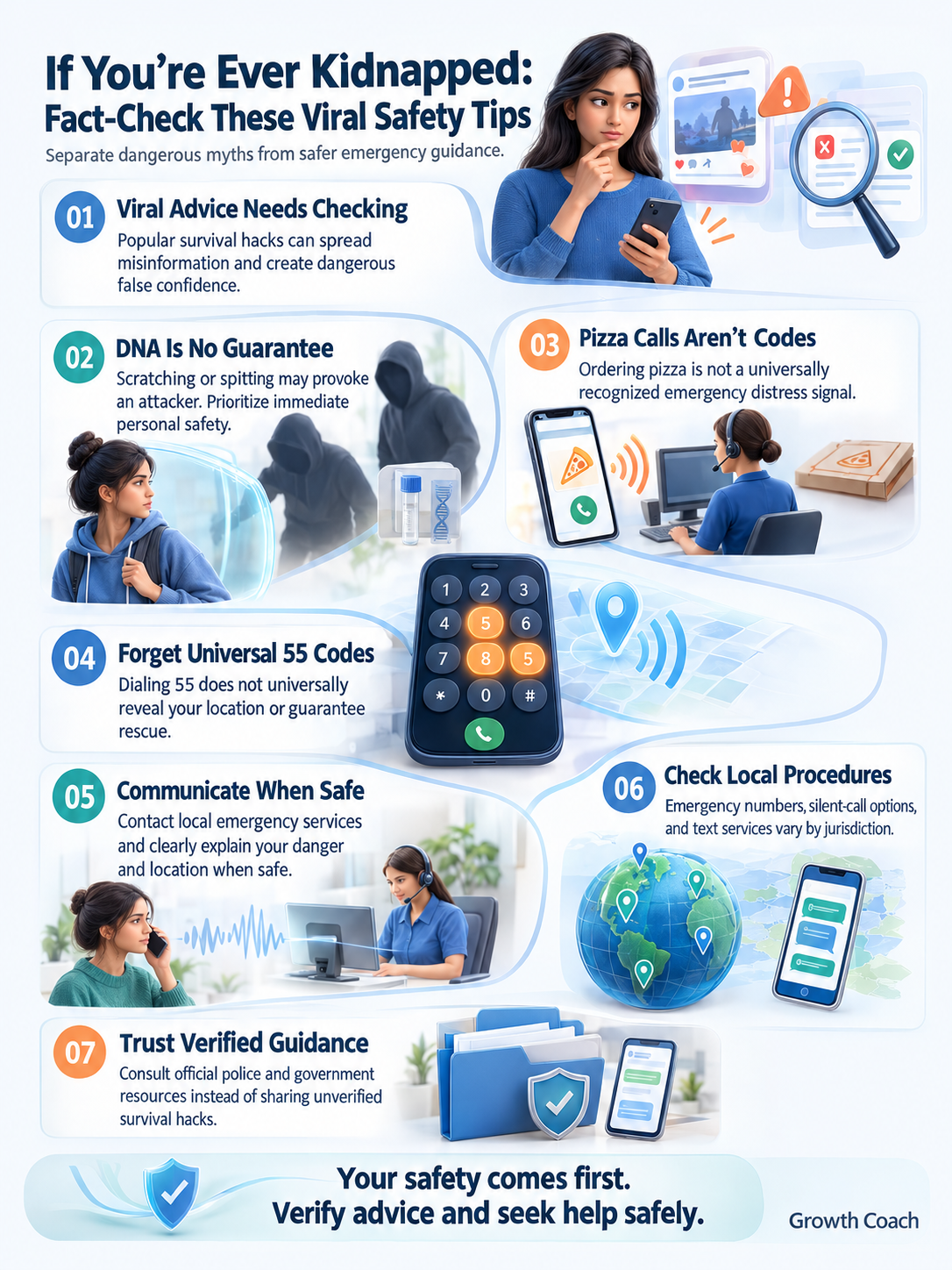
🔎 Let’s Debunk These Viral Kidnapping Safety Claims!
Myth 1: Scratching Your Kidnapper Leaves DNA Evidence That Will Save You.
This one sounds like something straight out of a spy movie, doesn’t it? The idea is that by scratching your abductor, you’ll leave your DNA on them, which will then help investigators identify them later. While DNA is indeed a powerful tool in forensic investigations, the advice to deliberately scratch an attacker is far from a universally safe or dependable strategy. In fact, attempting to do so could easily provoke further violence, making an already incredibly dangerous situation even worse. The same caution applies to other suggestions about spitting or intentionally leaving biological material behind. The reality is, evidence collection is highly situational. What might be possible in one scenario could be impossible or incredibly risky in another, especially when you’re in the midst of an assault or abduction. Your primary focus needs to be on survival and immediate safety, not on becoming an amateur forensic investigator.
The Safer Takeaway: Your physical safety is paramount. Do NOT risk escalating the danger by attempting a supposed forensic trick. If you manage to escape or are rescued, report everything you remember to the trained investigators. They are the experts who can assess what evidence might be useful.
Myth 2: You Should Deliberately Leave Clues for Rescuers.
This tip suggests leaving behind objects or marks to help authorities track your movements. While remembering details about your surroundings, the route you’re taken, the vehicle involved, or even descriptions of people can be incredibly helpful for law enforcement IF you can do so safely, deliberately creating clues isn’t a guaranteed method for being found. Your ability to observe, remember, or act might be severely limited in a high-stress, dangerous situation. Furthermore, attempting to leave evidence could draw unwanted attention from your abductor, potentially putting you in greater danger. There’s no one-size-fits-all technique that works in every single kidnapping scenario. The context matters immensely.
The Safer Takeaway: Always prioritize your immediate safety. If you can safely observe and remember details, do so. When you have an opportunity to communicate with emergency responders, share any details you’ve managed to safely retain. Don’t put yourself at risk trying to leave breadcrumbs.
Myth 3: Ordering a Pizza is a Secret Distress Signal.
This is one of the most commonly shared ‘secret codes’ online. The story often goes that you can call a pizza place, order a pizza, and if you use specific phrases or act strangely, the dispatcher will understand you’re in danger and call the police. Let’s be crystal clear: there is no universal pizza-ordering code that signals a kidnapping. A viral story about one dispatcher supposedly cracking the code should absolutely NOT be taken as proof that emergency operators everywhere recognize the same unofficial signal. Emergency call procedures vary significantly by jurisdiction. An operator might completely misunderstand an indirect or coded request, and relying on such an unofficial signal could tragically delay a crucial response. Your safety could depend on clear communication.
The Safer Takeaway: If you can safely contact emergency services (like 911, 999, 112, or your local equivalent), state clearly and directly that you are in danger. Provide your location or any identifying details you know. If speaking is unsafe or impossible, follow the specific instructions provided by your local emergency services for silent calls, texting, or other available options.
Myth 4: Dialing ’55’ Will Reveal Your Location to Rescuers.
Another popular claim suggests that simply dialing or pressing ’55’ on a phone will somehow alert authorities and reveal your location. Once again, there is no single ’55’ code that universally tracks a kidnapped person’s location. Emergency numbers and the procedures associated with them are highly dependent on the country and the specific emergency service provider. While some specific regions or services might have protocols involving additional digits or keypad responses in certain situations, this does not make the number ’55’ a global tracking method. Relying on this could be a dangerous gamble.
The Safer Takeaway: Familiarize yourself with the official emergency contact procedures for the country you are currently in. Do NOT rely on a number or code shared in a viral infographic unless it has been officially confirmed by an appropriate local authority. Knowing your local emergency number is key.
Myth 5: Sharing the Viral Post Boosts Your Chances of Rescue.
This one is a bit meta. The infographic might include a call to action asking you to share, like, or promote the post. The claim is that by doing so, you’re helping to spread awareness and potentially increasing your chances of being found or helping others. Let’s get this straight: promoting a social media post is NOT a kidnapping survival technique. Simply sharing, liking, or following a social media account does not, in itself, alert emergency services or validate the accuracy of the information presented. Engagement requests, especially when coupled with fear-inducing language or urgent calls to share, are often designed to make posts go viral quickly, regardless of their factual basis. It’s a tactic to increase reach, not a genuine safety measure.
The Safer Takeaway: Before you share any piece of information, especially something related to safety, take a moment to evaluate it critically. Look for a named official source, clear and practical instructions, and guidance that is relevant to your specific location and circumstances. Don’t let the urgency of a post override your critical thinking.
Myth 6: Staying Calm is a Universal Survival Rule.
The idea that staying calm is paramount during a dangerous situation is often presented. While maintaining as much composure as possible can indeed help you think more clearly and assess your options, it’s unrealistic and unfair to expect anyone to remain perfectly calm during a terrifying event like a kidnapping. Fear, confusion, disorientation, and difficulty concentrating are completely normal and understandable human responses to extreme danger. General reminders about staying aware and surviving are not substitutes for practical, situation-specific emergency guidance. What is safest for one person in one scenario might be different for another person in a different situation. The immediate threat and the available opportunities play a huge role.
The Safer Takeaway: Focus on what you can control in the immediate moment: your safety. Avoid taking unnecessary risks that could escalate the danger. Look for and seize opportunities to get help when it is safe and possible to do so. Self-compassion is also important; it’s okay to be scared.
📞 So, What SHOULD You Do in a Real Emergency?
If you ever find yourself in a situation where you believe you are being abducted, threatened, or unlawfully restrained, remember that there’s no single magical response that is safest for everyone in every circumstance. The immediate danger you’re facing, your physical surroundings, and whether you can communicate safely are all critical factors. Here’s a breakdown of what to focus on:
- Prioritize Immediate Safety Above All Else: Don’t feel pressured to perform a specific ‘trick’ you saw online. Your absolute top priority is to avoid actions that could unnecessarily increase the danger you’re in. If a safe opportunity to get away or reach other people presents itself, carefully assess the circumstances before acting.
- Contact the Appropriate Emergency Service When Possible: Use the official emergency number for the country where you are located. If you can communicate safely, state your emergency as clearly and calmly as possible. Provide your location, any nearby landmarks, or other useful details that can help responders find you quickly.
- If Speaking is Unsafe, Use Alternative Methods: If speaking aloud could put you at greater risk, don’t assume that every emergency service can automatically detect a silent call or correctly interpret background noise. It’s crucial to know and follow the locally published procedures for silent calls, emergency texting services, or any other alternative methods supported in your area.
- Know Your Local Emergency Procedures BEFORE You Need Them: This cannot be stressed enough. Emergency numbers (like 911 in the US/Canada, 999 in the UK, 112 in Europe), text-to-emergency services, and procedures for situations where you cannot speak vary significantly from one jurisdiction to another. Always confirm this vital information through official government or law-enforcement sources. Do not rely on potentially outdated or incorrect information from social media.
- Share Information with Responders When You Are Safe: Once you have reached a place of safety, provide emergency responders with a clear account of what happened. Share any details you can recall, no matter how small they may seem. Again, do not put yourself at additional risk to try and collect evidence or meticulously follow a checklist you saw somewhere.
IMPORTANT REMINDER: Emergency Procedures Are LOCATION-SPECIFIC!
This is a critical point that many viral tips fail to emphasize. Do not make assumptions that 911, 999, 112, emergency texting services, or any special keypad codes work the same way everywhere. Always take the time to confirm the official procedures for your specific location. When in doubt, always follow the instructions given by local emergency responders.
🌐 How to Spot Misleading Safety Advice Online
In the age of information overload, it’s vital to develop a critical eye, especially when it comes to personal safety. Before you put your trust in a viral infographic or a trending safety tip, take a moment to pause and examine *how* the claims are being presented. Information about serious threats like kidnapping deserves a much higher level of scrutiny than, say, a recipe for banana bread. The consequences of acting on false or misleading advice in an emergency can be severe, even life-threatening.
- WARNING SIGN: The Promise of a Universal Secret. Be extremely cautious when a post claims that a single number, phrase, or action will work universally across every country and in every single situation. Life, and emergencies, are rarely that simple.
- BETTER APPROACH: Verify the Original Guidance. Always try to trace the advice back to its source. Does the information come from an identifiable emergency service, a government authority, or a reputable law-enforcement organization? If the source is anonymous or vague, be skeptical.
Another red flag is missing context. A technique that might be theoretically possible in one very specific circumstance could be incredibly dangerous or completely impossible in another. Pay attention to emotional language, urgent demands to share the post immediately, and claims that lack any verifiable source or supporting evidence. These are all reasons to dig deeper and question the information’s validity.
Most importantly, never confuse a confident or polished presentation with proven reliability. A well-designed graphic with slick visuals can make even incorrect instructions look authoritative. Always prioritize accuracy and official guidance over slick design.
Key Takeaways to Remember:
- DNA Evidence: While DNA can be vital for investigations, deliberately provoking an attacker to leave evidence is NOT a reliable safety strategy and can increase danger.
- Pizza Orders: A pizza order is NOT a universally recognized distress code for kidnapping. Direct communication is best when safe.
- Dialing ’55’: There is NO universal ’55’ code that guarantees location tracking. Emergency procedures vary greatly by region.
- Social Media Sharing: Promoting a social media post is NOT an emergency response procedure. Focus on real-world safety actions.
- Emergency Numbers & Procedures: Official emergency contacts and silent/text procedures are location-specific. Always verify locally.
- Prioritize Safety & Verify: Always prioritize your immediate safety and seek verified guidance from reliable local authorities, not just viral posts.
Frequently Asked Questions (FAQs) About Kidnapping Safety Myths
Is the viral kidnapping infographic reliable?
Generally, no, not as a complete set of emergency instructions. While some points might contain a kernel of truth, several key claims within these types of infographics are misleading, presented as universal rules without proper context, or lack credible support. It’s crucial to verify any safety guidance with official, local authorities rather than relying solely on viral content.
Can ordering pizza secretly alert emergency services?
There is no universally recognized emergency code based on ordering pizza. While a specific dispatcher *might* understand a strange request in a particular instance, it’s not a reliable method. If it is safe to call emergency services directly, clearly state your situation. If speaking is unsafe, utilize a locally supported alternative communication method (like emergency texting) if available.
Does dialing ’55’ allow rescuers to track a kidnapped person?
No, there is no universal ’55’ code that guarantees location tracking by rescuers. Emergency procedures and codes are specific to different countries and service providers. Always confirm the correct emergency procedures with the relevant service in your country.
Should someone scratch an attacker to leave DNA evidence?
As a general rule, no. Deliberately attempting to collect DNA evidence by scratching an attacker could significantly increase your immediate danger and provoke a violent response. Your personal safety should always take precedence over a suggested forensic technique.
Can I text emergency services instead of calling?
This capability depends entirely on your location and the specific services available. In many areas, emergency texting is supported, but not all. You should check the official local guidance for your area to determine if emergency texting is an option and learn how to use it correctly.
What if I cannot speak during an emergency call?
If you are in a situation where you cannot speak, you should follow the specific silent-call or alternative communication instructions published by the local emergency service. Do not assume that a silent call or the presence of background noise will automatically convey the nature of your emergency to the dispatcher.
Should I share a viral safety post with friends and family?
It’s best to verify the claims made in the post first. Sharing inaccurate or misleading emergency advice, even with good intentions, can spread misinformation and potentially put others at risk. Critical evaluation before sharing is key.
FINAL PERSPECTIVE: Reliable Information IS Part of Personal Safety
Fear-based infographics and viral content can spread incredibly quickly because they often promise simple, easy answers to complex and frightening situations. However, a catchy trick or a memorable tip is not necessarily an effective or safe emergency procedure. Always approach such content with a healthy dose of skepticism.
Make it a habit to question unsupported claims, avoid taking actions that could unnecessarily increase your immediate danger, and take the time to learn the official emergency procedures for your specific location. When your personal safety is on the line, having verified, accurate guidance from trusted sources is infinitely more valuable than following a potentially dangerous viral checklist. Stay informed, stay safe!


