Have you ever felt like you are constantly battling yourself? You set ambitious goals, start with a burst of motivation, and then—almost like clockwork—you fall back into the same old, unproductive habits. It’s not a lack of willpower; it’s a matter of programming. Your subconscious mind acts as the operating system for your life, running scripts that were written years ago. If you want to change your results, you have to upgrade the software. Reprogramming your subconscious is the secret weapon used by high performers, elite athletes, and successful entrepreneurs to bypass self-sabotage and unlock their true potential. In this comprehensive guide, we will dive deep into how you can rewire your brain for success, boost your productivity, and foster a mindset that attracts achievement effortlessly.
The Hidden Engine Behind Success
Most of us live our lives on autopilot. We wake up, follow a routine, respond to stress, and make decisions based on past experiences. This happens because the subconscious mind is a storage facility for every memory, belief, and habit you have ever formed. When you try to change your life through conscious effort alone, you are often fighting against a massive, deeply ingrained force that wants to keep you in your comfort zone.
Reprogramming your mind isn’t about magic; it is about deliberate, structured psychological conditioning. By using techniques rooted in neuroscience and behavioral psychology, you can overwrite these old, limiting narratives. This isn’t just a “positive thinking” exercise; it is about building new neural pathways that make your success feel natural, automatic, and inevitable.
Understanding the Subconscious Mind and Its Influence
Think of your conscious mind as the captain of a ship and your subconscious as the engine room. The captain gives orders, but if the engine room is programmed to go in the opposite direction, the ship won’t move forward. The subconscious controls your physiological reactions, your emotional triggers, and your habitual responses to challenges. If you grew up believing that success is difficult or that you aren’t “enough,” your subconscious will find ways to prove that belief correct, even if your conscious mind wants the opposite.
These patterns are built from:
- Repeated experiences that cemented a specific worldview.
- High-intensity emotional events that acted as “imprints.”
- Social conditioning from family, peers, and media.
- The consistent, daily self-talk that you’ve repeated for years.
To break free, you must first recognize that these are just programs—they are not who you are. Once you realize they are malleable, you can start the process of updating them.
The Science of Mental Reprogramming
The beauty of the human brain lies in its neuroplasticity. We now know that the brain is not a static organ; it is constantly changing and rewiring itself based on input. You can use this to your advantage by focusing on three main principles:
1. Repetition Strengthens Neural Pathways
Every time you repeat a thought or an action, you are firing a specific neural pathway. The more you fire it, the stronger it gets. This is why habits are so hard to break—they are well-worn highways in your brain. To create a new habit, you have to consciously build a new road by repeating the new behavior until it becomes the path of least resistance.
2. Emotion Accelerates Learning
The brain prioritizes information that is tied to strong emotions. When you combine a new belief with a feeling of excitement, gratitude, or determination, you are essentially tagging that memory as “high priority.” This makes it much easier for your subconscious to adopt the new belief as a core truth.
3. Focus Directs Brain Wiring
Your brain is constantly filtering the world based on what you focus on (the Reticular Activating System). If you focus on problems, you will see obstacles everywhere. If you focus on solutions, your brain will start to notice opportunities that were previously invisible. By controlling your focus, you are physically directing where your brain should build new connections.
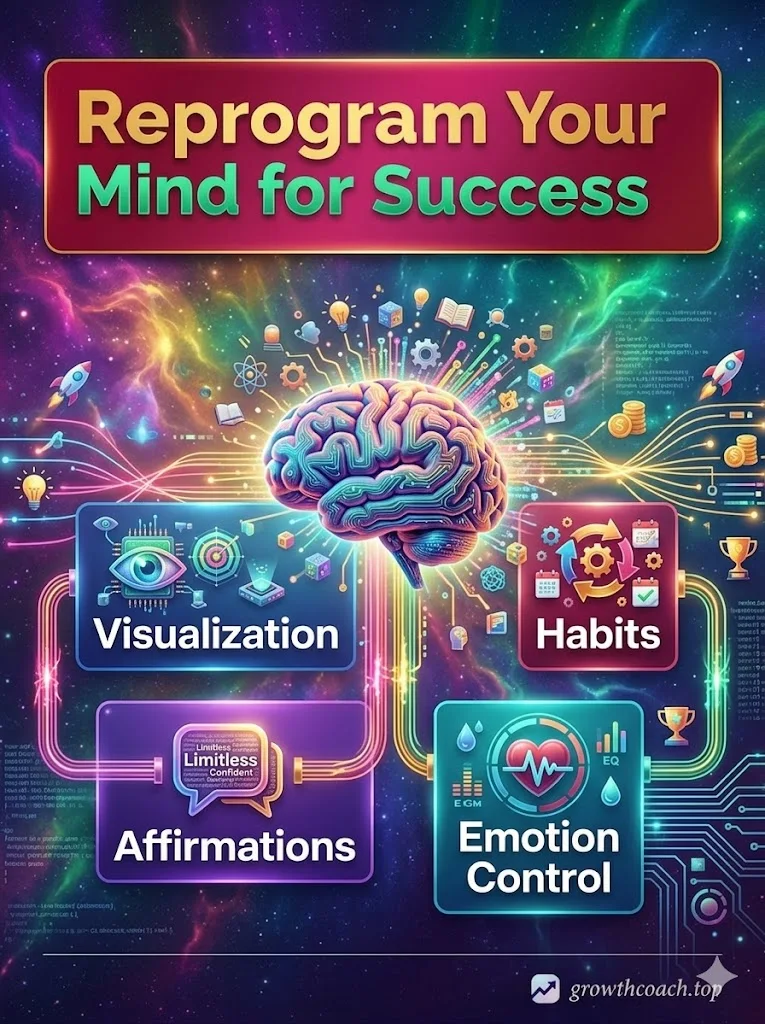
Visualization: Training the Mind Through Mental Imagery
Visualization is often dismissed as “daydreaming,” but high-level athletes have been using it for decades to improve performance. When you visualize, you are not just imagining a picture; you are simulating an experience. Research shows that the same areas of the brain light up when you vividly imagine an action as when you actually perform it.
To make visualization effective, follow these steps:
- Engage all five senses: Don’t just see the goal; feel the texture of the objects, hear the sounds of success, and notice the smells in your environment.
- Emotional involvement: Feel the pride, joy, and relief of achieving your goal. This emotional anchor is what tells your subconscious that this is a real event.
- Consistency: Do this for 5-10 minutes every single morning. Your brain needs the repetition to accept these images as your new reality.
Affirmations and Thought Reconditioning
Affirmations are the code language of your subconscious. If your internal dialogue is filled with phrases like “I’m not good at this” or “This is too hard,” you are actively programming yourself for failure. You need to flip the script.
Effective affirmations must be:
- In the present tense: Use “I am” statements, not “I will be.” Your subconscious doesn’t understand the future; it only understands what you tell it is true *now*.
- Positive and specific: Focus on what you want, not what you want to avoid. Instead of “I am not lazy,” use “I am consistently productive and focused.”
- Emotionally charged: Say your affirmations with conviction. If you say them like a robot, they won’t stick.
Emotional Anchoring for Rapid Behavioral Change
Have you ever heard a song that instantly took you back to a specific memory? That is an anchor. You can create your own anchors to access peak performance states on command. For example, if you want to feel confident before a big meeting, think of a time when you felt incredibly powerful. As that feeling hits its peak, perform a physical action, like pressing your thumb and forefinger together.
Repeat this process while focusing on that peak feeling. Over time, your brain will link that specific physical sensation to the state of confidence. Whenever you need a boost, just trigger the anchor, and you’ll find it much easier to step into that state of mind.
Habit Formation and Behavioral Conditioning
If you want to change your life, look at your habits. Your habits are the physical manifestation of your subconscious programs. To change them, you must understand the habit loop: Cue, Routine, Reward.
If you want to quit a bad habit, don’t just try to stop it; replace it. Identify the cue (e.g., stress), identify the reward (e.g., a feeling of relief), and swap the routine (e.g., instead of smoking, do 60 seconds of deep breathing). By keeping the cue and the reward the same but changing the action, you can rewrite your subconscious habits much faster than if you try to use sheer willpower alone.
Meditation and Mental Clarity Training
Meditation is the ultimate tool for clearing the clutter. It allows you to step back and act as an observer of your thoughts. Most people identify with their thoughts, but you are not your thoughts—you are the observer of them. By practicing mindfulness, you develop the ability to catch a negative thought before it takes root and replace it with something more constructive.
Environment Design and External Conditioning
Your environment is a reflection of your subconscious. If your desk is a mess, your mind will feel messy. If you are constantly surrounded by people who complain, your subconscious will adopt those patterns. Take control of your space. Organize your home and office to support your goals. Curate your social media feeds to follow people who inspire and teach you. When you change your environment, you change the cues that trigger your subconscious, making it easier to maintain your new, improved habits.
Neuroplasticity: The Brain’s Adaptability Advantage
The most encouraging takeaway from modern neuroscience is that you are not stuck. You aren’t “just the way you are.” You are a work in progress. Every day, you have the opportunity to prune away old, unproductive neural pathways and cultivate new ones. This is the power of neuroplasticity. By choosing your thoughts, your habits, and your environment, you are essentially the architect of your own brain. This is a lifelong process, but the results—greater confidence, better focus, and sustained success—are worth the effort.
Long-Term Strategy for Subconscious Mastery
Don’t try to do everything at once. Pick one area of your life you want to improve and start there. Spend two weeks focusing on your morning routine, then add in visualization. Keep a journal to track your progress and celebrate the small wins. Remember, your subconscious responds best to consistency, not intensity. A little bit of work done every single day will always beat a massive, one-time effort.
Building a Success-Oriented Mindset
Reprogramming your subconscious mind is the ultimate investment in yourself. When you align your internal programming with your external goals, you stop fighting against yourself and start flowing toward success. You will notice that decisions become easier, obstacles feel like challenges rather than threats, and your overall performance reaches new heights. Start today. Choose one limiting belief, identify the new, empowering belief you want to replace it with, and begin the process of repetition. You have the power to reshape your reality from the inside out.