
Summer across the globe is no longer just a season of sun-drenched vacations, outdoor recreation, and predictable seasonal transitions. In recent decades, it has rapidly transformed into a period of acute atmospheric anxiety. From the historic, stone-paved plazas of southern Europe to the densely populated metropolitan areas of North America and Asia, summers are consistently shattering historical temperature thresholds. These are not merely warm days or typical seasonal spikes; they are prolonged, brutal, and record-breaking thermal events that strain electrical grids to the point of failure, spark cataclysmic wildfires that erase entire ecosystems, and push the absolute structural limits of human physiological tolerance.
At the epicenter of this intensifying global crisis often lies a powerful and complex meteorological phenomenon known as a heat dome. As global warming continues to shift climatic baselines, these high-pressure atmospheric systems are becoming more frequent, more geographically expansive, and significantly more lethal. The purpose of this comprehensive, multi-part guide is to break down the underlying physics behind heat domes, review recent historical benchmarks across Europe and neighboring regions, analyze the multi-layered risks to human health and infrastructure, and offer a concrete, actionable roadmap of daily habits and environmental management tools designed to keep your family, your children, your pets, and your community safe in an increasingly volatile world.
Understanding the Atmospheric Blanket: What is a Heat Dome?
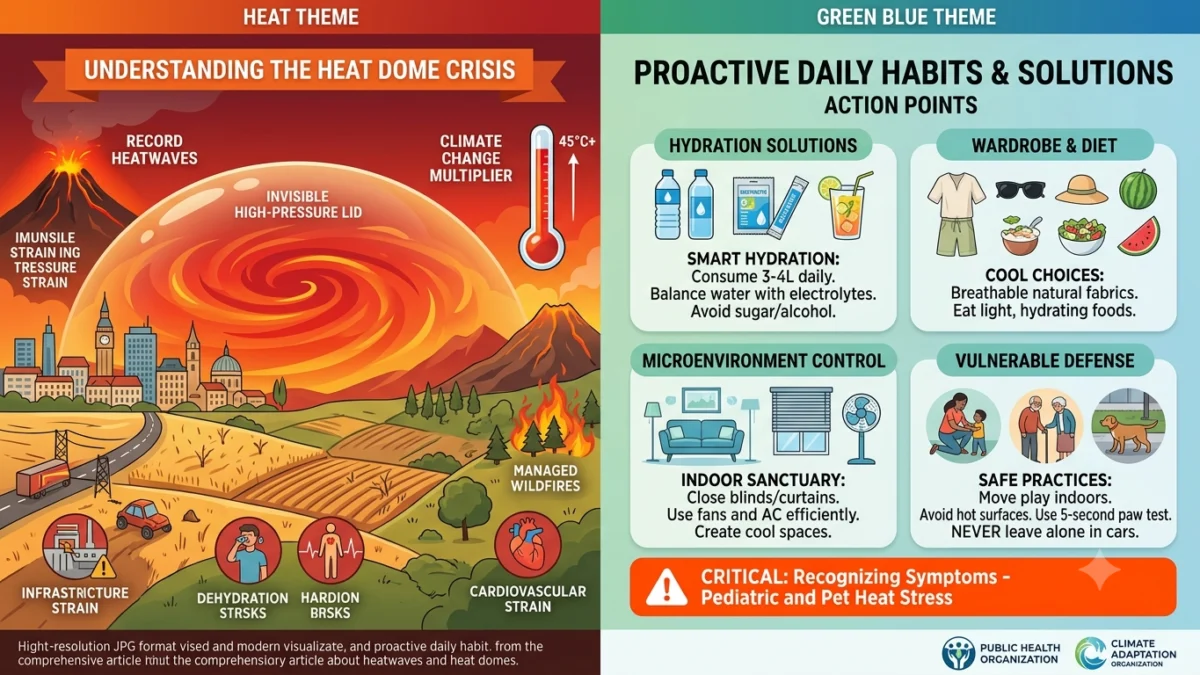
To effectively mitigate the dangers of extreme ambient heat, one must first understand the structural mechanisms fueling it. In meteorological terms, a heat dome forms when a strong, static region of high atmospheric pressure traps hot air over a vast geographical area, effectively acting like a gigantic, invisible oven lid.
Under normal, dynamic weather conditions, convective currents allow hot air near the surface to rise freely into the upper atmosphere, where it cools, condenses, and eventually disperses or returns as precipitation. However, when a massive high-pressure ridge establishes itself in the upper troposphere, it intercepts this natural cycle. This ridge acts as a heavy physical block, actively pushing the rising warm air back downward toward the surface of the Earth.
As this air sinks, it undergoes compressed heating according to fundamental thermodynamic laws, warming significantly as it is squeezed into a smaller volume. Furthermore, the high-pressure system acts as a shield against cloud formation, storm fronts, and cooling wind currents, creating cloudless, stagnant conditions. The sun beats down directly on the ground continuously, baking the soil and stripping it of moisture. This dry ground then heats up even faster, reinforcing a vicious cycle of accelerating temperatures. The longer the system stalls, the more intense the heat becomes.
The Climate Change Multiplier: While high-pressure ridges are natural components of Earth’s atmospheric circulation, global warming acts as an acoustic amplifier. Rising baseline global temperatures mean that when a heat dome forms today, it starts from a significantly higher thermal baseline than it did fifty years ago. Additionally, peer-reviewed climate studies suggest that the weakening and meandering behavior of the polar jet stream—driven by rapid Arctic warming—makes these high-pressure blocks far more likely to become completely stationary, locking extreme heat over a single region for weeks at a time.
Case Studies: Europe and Beyond Under Severe Thermal Stress
The practical, devastating reality of these atmospheric systems has manifested across multiple continents, with Europe serving as a critical indicator of this accelerating trend.
The European Theater
- Spain and Portugal: The Iberian Peninsula frequently bears the initial brunt of North African thermal plumes combined with stationary high pressure. Temperatures in regions like Andalusia regularly surpass 45°C (113°F), with cities like Seville and Córdoba entering multi-week periods of emergency status. Dried landscapes have catalyzed severe, fast-moving wildfires that ravage fragile ecosystems.
- France: Memories of the devastating 2003 heatwave have driven extensive municipal planning, yet recent heatwaves have tested these systems to their limits. National records have collapsed, with southern French towns breaching the 45°C threshold, forcing schools to close and public events to be suspended.
- Italy: Dubbed with ominous nicknames like “Cerberus” and “Charon” by local meteorologists, heat domes over Italy have pushed the island of Sicily to an astonishing, record-breaking 48.8°C (119.8°F). The prolonged duration of these systems has triggered unprecedented droughts in the Po River valley, threatening agricultural supply chains.
- The United Kingdom: In a stark illustration of how far north these thermal anomalies can extend, the UK officially crossed the 40°C (104°F) threshold for the first time in recorded history. Because British infrastructure is structurally designed to retain heat rather than deflect it, this anomaly caused widespread rail distortion, runway buckling, and severe domestic distress.
- Greece: Prolonged heat domes have historically plagued Greece, but recent iterations have combined extreme temperatures with single-digit relative humidity. This volatile mix fueled catastrophic wildfires in Rhodes, Attica, and Evia, forcing mass tourist evacuations and causing irreversible environmental damage to ancient forests.
The practical, devastating reality of these atmospheric systems has manifested across multiple continents, with Europe serving as a critical indicator of this accelerating trend.
| Region / Country | Peak Recorded Temp | Primary Environmental / Infrastructure Impact |
| Sicily, Italy | 48.8°C (119.8°F) | Po Valley agricultural collapse, intense grid strain |
| Lytton, Canada | 49.6°C (121.3°F) | Total community wildfire destruction, ecological loss |
| Andalusia, Spain | 47.6°C (117.7°F) | Extreme desertification, groundwater depletion |
| London, United Kingdom | 40.3°C (104.5°F) | Transportation network warping, domestic heat stress |
The Invisible Toll: Detailed Impacts of Extreme Heat
Public Health and Human Physiology
The human body functions within a narrow thermal range. When exposed to extreme ambient heat, the body relies primarily on two mechanisms to shed thermal energy: blood redistribution to the skin surface and sweat evaporation. Under a heat dome, if ambient temperatures exceed skin temperature (typically around 35°C) or if humidity prevents evaporation, these mechanisms fail.
- Heat Exhaustion vs. Heatstroke: Heat exhaustion manifests as heavy sweating, rapid pulse, dizziness, nausea, headache, and profound fatigue. If unaddressed, it rapidly escalates to heatstroke—a medical emergency where the body’s internal core temperature exceeds 40°C (104°F). At this stage, sweating stops, mental confusion sets in, and cellular proteins begin to denature, potentially leading to irreversible organ failure, brain damage, or death.
Proactive Daily Habits for Ultimate Personal Protection
💧 Advanced Hydration Strategies
Do not wait until you feel thirsty to drink water. Thirst is a late-stage indicator of mild cellular dehydration. During a heat dome event, active adults should consume between 3 to 4 liters of fluids daily. However, clean water intake must be balanced with electrolyte replacement. Sweating expels substantial amounts of sodium, potassium, and magnesium. Drinking excessive amounts of pure water without replenishing these essential minerals can induce hyponatremia—a dangerous medical condition characterized by low blood sodium levels that causes confusion, seizures, headaches, and acute fatigue.
🥗 Nutritional Adjustments
The metabolic process of digesting large, heavy, protein-dense meals generates significant internal thermal energy via a process known as the thermic effect of food. During extreme heatwaves, alter your diet to focus on small, frequent, nutrient-dense meals. Prioritize foods with high inherent water content, such as cucumbers, tomatoes, watermelons, celery, strawberries, and leafy green vegetables.
Vulnerable Horizons: Specialized Care for Children and Pets
The Absolute Rule of Car Safety: Never, under any circumstances, leave a child, an elderly person, or a pet inside a parked vehicle, even for a single minute, and even if the windows are cracked open. A car acts as a literal greenhouse; solar radiation passes through the glass windows, heating the dark interior plastics, steering wheels, and upholstery rapidly. On a 35°C day, the internal cabin temperature of a vehicle can spike to an astonishing 47°C (116°F) within just ten minutes, and breach 55°C (131°F) within half an hour. This rapid heat accumulation can cause fatal heatstroke in a small child or pet in a matter of minutes.
Veterinary Care and Animal Protection
Pets suffer immensely under heat domes. Dogs and cats do not sweat through their skin like humans; they rely almost exclusively on panting and heat release through their paw pads to cool down. Brachycephalic breeds (dogs with flat faces, such as Pugs, Bulldogs, and Boxers) are at an even greater disadvantage due to their restricted airways, making them incredibly prone to rapid respiratory distress and heatstroke.
- The 5-Second Paw Test: Before walking your dog, place the back of your bare hand firmly against the pavement or sidewalk for 5 seconds. If it is too hot for your hand, it is too hot for your dog’s paws and will cause painful blistering and burns.
Conclusion: Empowerment Through Preparedness
The rise of stationary heat domes and record-shattering heatwaves across Europe, North America, and Asia is a stark reminder of our changing global climate. These extreme weather phenomena pose genuine challenges to our health, infrastructure, and natural environment. However, by understanding the scientific factors that drive these systems and taking a proactive, organized approach to daily hydration, clothing, schedule adjustments, and indoor temperature management, you can successfully protect your family and community from extreme heat.
UNDER THE HEAT DOME
High pressure locks in scorching air, creating a dangerous environmental oven. When temperatures shatter records, passive defense fails.
⚠️ Wet-bulb limits & grid strain active. Take immediate defensive measures.
🔴 Vital Survival Action Matrix
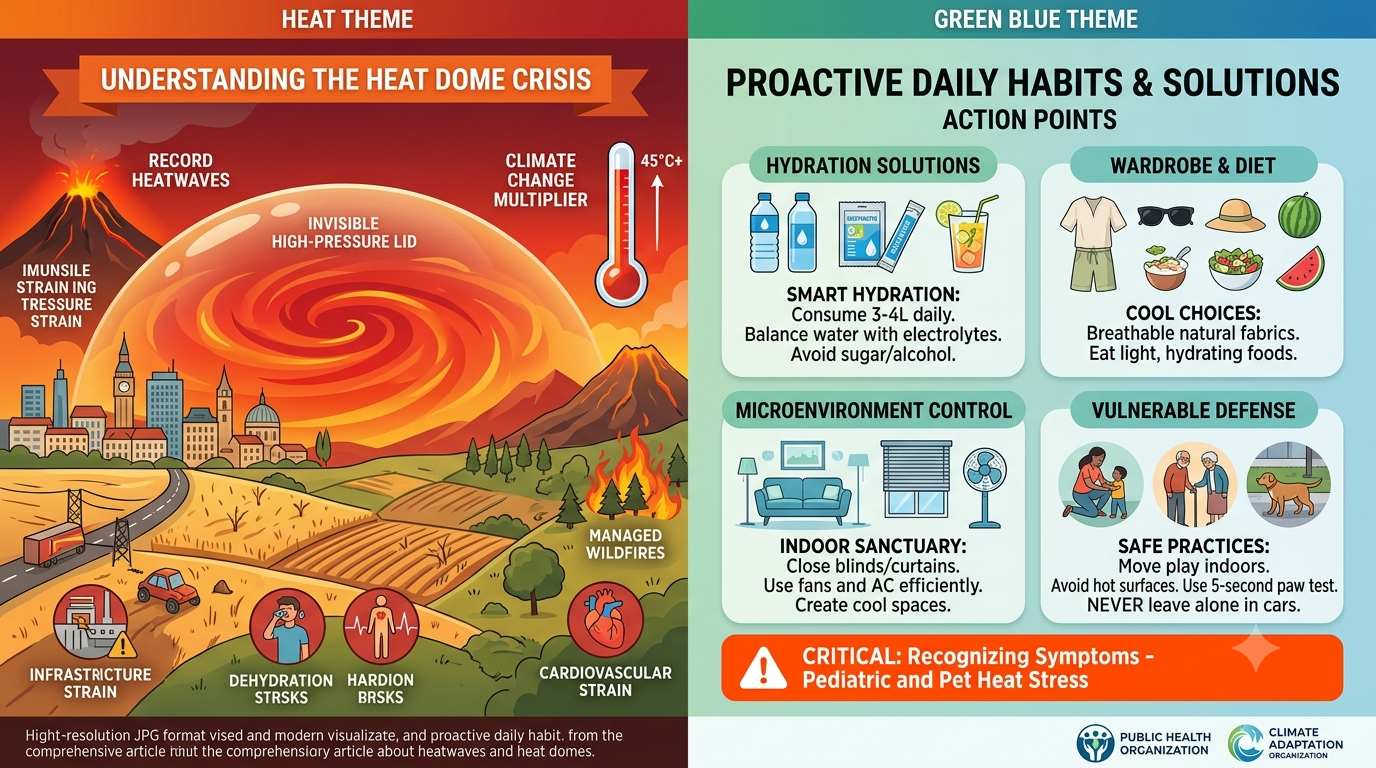
💧 Smart Hydration
Drink 3-4L daily. Balance pure water with electrolytes to prevent hyponatremia.
🥗 Cooling Diets
Eat light, high-water foods (cucumbers, melon). Avoid heavy, metabolic-heating proteins.
🏡 Microclimate Control
Seal blinds by day. Cross-ventilate at night. Stop fans if indoor temps bypass 35°C.
🐾 Vulnerable Defense
Keep kids off blistering playground structures. Apply the 5-sec rule to dog paws.
🚨 ZERO MINUTE CAR CAR RULES ARE ABSOLUTE FOR CHILDREN & PETS
