Hey there! Ever feel like your smartphone is doing too much of your thinking for you? You’re not alone. In this amazing digital age, we’ve got instant access to information, seamless communication, and automation that makes life a breeze. 📱 But, as convenient as it all is, this constant digital immersion is quietly chipping away at some of our most fundamental human capabilities. Think about it: from finding your way without GPS to actually talking through a problem with someone face-to-face, essential skills are starting to fade into the background. When we hand over all our decision-making and problem-solving to algorithms, we’re not just becoming less independent; we’re weakening those crucial mental muscles that make us capable, adaptable humans. 📉
What’s Really Disappearing in Our Tech-Obsessed World?
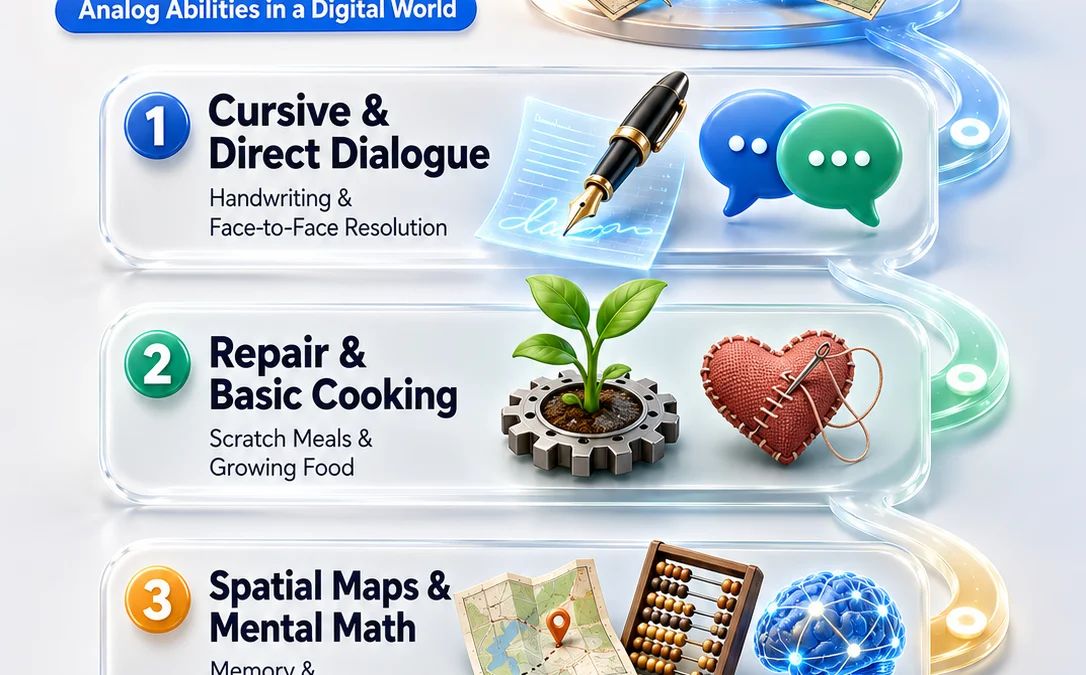
So, what exactly are these core human skills that are slowly slipping away? We’re talking about things like handwriting, resolving conflicts in person, fixing things ourselves, gardening, preserving food, cooking from scratch, doing mental math, remembering important information, navigating with a paper map, and even having basic first-aid knowledge. It might seem like a long list, but each of these abilities, when offloaded to our devices, gradually degrades our cognitive agility and our personal self-reliance. It’s a bit of a wake-up call, isn’t it? 🛠️🧠

Now, before you start hoarding typewriters and compasses, let’s be clear: this isn’t about ditching technology altogether. 🌐 It’s about finding a healthy balance. It’s about consciously making an effort to keep our minds sharp and our practical skills honed, ensuring we remain independent and capable individuals, even in a world brimming with digital convenience. Let’s dive into the skills we need to protect.
🗣️ 1. The Erosion of Communication and Literacy Skills ✍️
Our communication landscape has been utterly transformed by digital messaging. Think about how often you send a quick text or use an emoji instead of crafting a thoughtful email or, heaven forbid, having a real conversation. 💬 While efficient for some things, this shift means we’re losing the nuance and depth that come with more traditional forms of communication.
✍️ Handwriting and Cursive: Remember learning to write in cursive? It’s a skill that requires fine motor control and helps cement thoughts. Now, keyboards are the norm, and the art of forming letters by hand is fading. This isn’t just about pretty penmanship; it impacts how our brains process and retain information.
🤝 Direct Conflict Resolution: Let’s be honest, confronting someone directly about an issue can be uncomfortable. It’s often easier to send a passive-aggressive text or email. However, avoiding these face-to-face conversations means we’re missing out on developing crucial skills in empathy, negotiation, and understanding non-verbal cues.
The act of writing by hand is incredibly powerful for our brains. When you physically form letters, you engage different neural pathways compared to typing. This process leads to deeper information processing, better long-term memory, and enhanced conceptual learning. 🧠📝 It’s like giving your brain a mini-workout that typing just can’t replicate.
💡 Quick Tip
Try this: For just five minutes each morning, grab a notebook and pen and jot down your thoughts. It’s a fantastic way to sharpen your fine motor skills, clarify your mind, and get your day started on a more focused note before you even glance at your phone.
Similarly, tackling disagreements in person is a cornerstone of emotional intelligence. Being able to read body language, understand vocal tone, and respond in real-time helps prevent misunderstandings from escalating. It fosters empathy and strengthens relationships in a way that digital communication often can’t. 💬🧘
🛠️ 2. The Neglect of Practical, Self-Sufficiency Skills 🥗
We’ve become a society of consumers, relying on instant gratification and quick fixes. If something breaks, our first thought is often to replace it, not repair it. If we’re hungry, we order takeout or grab a pre-packaged meal. This ‘throwaway culture’ and the ease of online shopping and food delivery have made us less self-sufficient. 📦📲
🔧 Repair Culture: Mending clothes, fixing a leaky faucet, or even just tightening a loose screw on furniture are skills that are becoming rare. Instead of repairing, we often just buy new. This leads to unnecessary waste and a loss of practical problem-solving abilities.
🌱 Gardening and Growing Food: Understanding the basics of how plants grow, the importance of soil, and the rhythm of seasons is knowledge that’s diminishing. We’re increasingly disconnected from the source of our food.
🫙 Food Preservation: Methods like canning, pickling, fermenting, and drying food were essential for survival and nutrition for centuries. Now, these traditional techniques are rarely practiced in modern homes.
🍳 Scratch Cooking: The convenience of ultra-processed foods means fewer people are cooking meals from raw, whole ingredients. This impacts our health and our connection to the culinary traditions that have nourished families for generations.
Learning basic repair skills isn’t just about saving money; it’s a powerful way to reduce waste and contribute to a more sustainable planet. 🌍 There’s a profound sense of accomplishment and self-reliance that comes from fixing something with your own hands. 🔨
🧠 Expert Insight
Cooking from scratch puts you in the driver’s seat of your own health, giving you complete control over ingredients and nutrition. Plus, it’s a fantastic way to keep alive and pass on the delicious culinary heritage that’s been feeding families for ages.
And what about gardening? Even a small herb garden on a windowsill or a few tomato plants on a balcony can be incredibly rewarding. It reconnects us with nature’s cycles, deepens our appreciation for where food comes from, and often leads to healthier eating habits. 🌱🥗
🧩 3. The Fading of Cognitive and Navigational Abilities 🗺️
Our reliance on GPS and digital tools is fundamentally altering how our brains handle spatial information and problem-solving. When we delegate navigation and calculation to our devices, our internal ‘cognitive maps’ and mental processing power can shrink. 🧮📉
🔢 Mental Math: Can you quickly calculate a tip, a total bill, or a simple measurement without reaching for your phone? For many, these basic mental calculations are becoming surprisingly difficult.
💾 Memory Retention: Why memorize phone numbers, birthdays, or even directions when your phone stores them all? This constant offloading means our natural memory capacity isn’t being exercised.
🧭 Spatial Navigation: Following turn-by-turn GPS instructions means we often don’t engage with our surroundings. We lose our innate sense of direction and the ability to recognize landmarks.
Mental arithmetic is like a daily workout for your brain’s working memory and logical reasoning centers. 🧮 When we rely solely on calculators for even the simplest sums, we miss out on valuable, quick mental stimulation that keeps our cognitive functions sharp. ⚡
⚠️ Common Mistake
Constantly using GPS for routes you know well, like your commute, prevents your brain’s hippocampus—the part responsible for spatial memory—from building and strengthening those mental maps of your environment.
Navigating with a physical map requires you to actively engage with your surroundings. You notice street names, building types, terrain features, and cardinal directions. This active observation builds a robust understanding of the environment, unlike passively following a voice prompt. 🛣️🗺️
🩹 4. Declining Emergency Preparedness and First-Aid Knowledge 🚨
In a minor emergency, the first instinct might be to Google symptoms or solutions. While the internet is vast, it can sometimes lead to more panic than calm action, especially if you lack fundamental hands-on knowledge. 🚑 Without basic first-aid training, we’re often unprepared for unexpected medical situations.
🩹 Wound Care: Do you know the correct way to clean, sanitize, and dress a minor cut or burn effectively, without freezing up?
🩺 Basic CPR Awareness: Understanding the fundamental steps of Cardiopulmonary Resuscitation (CPR) could be life-saving while waiting for professional medical help to arrive.
Possessing basic medical knowledge provides a crucial sense of confidence. It empowers you to act calmly and decisively when accidents happen, potentially preventing minor incidents from becoming serious crises. 🛡️🏥
Let’s look at a quick comparison:
| Traditional Skill | Digital Alternative | Cognitive Benefit Lost |
|---|---|---|
| Paper Map Reading | GPS Voice Navigation | Spatial awareness & orientation 🧭 |
| Mental Arithmetic | Smartphone Calculator | Working memory processing 🧮 |
| Handwritten Notes | Voice-to-Text Typing | Deep conceptual learning 📝 |
| Basic Repair Work | Instant Replacement Order | Manual dexterity & resourcefulness 🛠️ |
🏆 Best Practice
It’s a smart move to keep a well-stocked first-aid kit in your home and car. Even better? Consider taking a weekend emergency response or first-aid course. Hands-on practice is invaluable for building real confidence.
🔄 Simple Daily Habits to Reclaim Your Mental Agility 💡
Okay, so we’ve covered some ground on what we might be losing. But the good news is, you don’t have to go off the grid to reclaim these vital skills. ⚡ It’s all about making small, intentional choices to incorporate analog habits back into your daily life. These practices keep your mind agile and your practical abilities sharp. 🌟
📵 Set Digital Boundaries: Designate specific times each day—maybe an hour before bed or during meals—to completely disconnect from screens. Use this time for hands-on activities or quiet reflection.
📖 Read Physical Books: Dive into a good old-fashioned book. Reading print material helps improve your attention span and fosters deeper focus, free from the constant ping of notifications.
🎨 Practice Manual Hobbies: Get your hands dirty! Whether it’s woodworking, gardening, sketching, painting, knitting, or cooking a complex meal from scratch, engaging in manual hobbies is incredibly beneficial.
📌 Key Takeaway
Think of technology as a powerful assistant, not a complete replacement for your own brainpower, creativity, and problem-solving skills. Use it wisely!
Building real-world independence isn’t just about self-reliance; it makes you more resilient. Imagine a power outage or a system failure – having practical skills means you’re less likely to be completely stuck. 🔌 Finding that balance between digital tools and traditional capabilities cultivates a grounded, confident, and capable mindset. 🌾
📌 Summary: Your Action Plan to Reclaim Essential Skills 📋
Ready to get started? Here’s a quick recap of skills to focus on:
✍️ Get Writing: Practice cursive or simply journal by hand. It’s great for memory and clarity.
🤝 Talk it Out: When conflicts arise, try to address them face-to-face rather than resorting to texts or emails.
🔧 Fix It Up: Before tossing something broken, see if you can repair it. It saves resources and builds skills.
🧮 Calculate Away: Challenge your brain daily with mental math. Start small and build up.
🧭 Navigate Naturally: Try navigating familiar routes without relying solely on GPS. Pay attention to landmarks.
🌟 Protecting Your Human Potential in a Tech-Driven World ✨
The digital world offers undeniable advantages, but safeguarding our core human abilities requires conscious effort. 🛠️ By weaving analog habits back into your daily routine, you’re not just preserving old skills; you’re actively enhancing your cognitive agility, boosting your self-reliance, and enriching your overall life experience. 🧠
Don’t feel overwhelmed! Start small. Pick just one skill to focus on this week. Maybe it’s cooking a meal entirely from scratch, calculating a restaurant bill in your head, or writing a thank-you note by hand. 📝 Small, consistent steps compound over time, building confidence, competence, and a deeper sense of connection to the real world. 🌿 Let’s embrace a more balanced, capable, and fulfilling way of living.