Is Your Chair Secretly Hurting You?
Let’s be honest: we live in a world designed for sitting. From the moment we wake up and check our phones to the long hours spent at our desks, in our cars, or curled up on the couch for a Netflix binge, our bodies are in a constant state of rest. But here is the hard truth: our bodies were never built to be stationary for 10 to 12 hours a day. The phrase “sitting is the new smoking” might sound like a dramatic alarmist headline, but when you peel back the layers of medical research, it becomes clear that physical inactivity is one of the most overlooked health crises of the 21st century.

In this guide, we are going to break down exactly why your chair is your health’s worst enemy and, more importantly, how you can reclaim your vitality without needing to run a marathon every day. If you are a remote worker, an office professional, or just someone who feels stiff and drained by 5:00 PM, this is for you.
The Silent Danger: Why Sitting Is So Risky
When you sit for extended periods, your body undergoes a series of physiological changes. Your metabolism slows down, your muscles stop pumping blood as efficiently as they should, and your insulin sensitivity drops. Think of your body like a high-performance machine—if you leave it parked in the garage for too long, the battery dies and the parts start to rust. That is exactly what happens to your cardiovascular and metabolic systems when you remain sedentary.
The Heart Health Connection
Cardiovascular disease is the leading cause of death globally, and sedentary behavior is a major contributor. When you sit, you aren’t just “resting”; you are actually putting your heart at a disadvantage. Prolonged sitting is linked to higher blood pressure and unhealthy cholesterol levels. Even if you hit the gym for 45 minutes after work, that doesn’t necessarily cancel out the damage caused by sitting for the other 15 hours of the day. This is what experts call the “active couch potato” phenomenon.
Blood Sugar and Diabetes
Your muscles are the primary site for glucose uptake. When they are idle, they stop clearing sugar from your bloodstream effectively. This leads to insulin resistance, which is the precursor to Type 2 diabetes. By simply standing or moving every hour, you keep your muscle fibers engaged, which helps regulate your blood sugar levels far more effectively than one intense workout session could.
The Mental Toll: Why You Feel So Tired
Have you ever noticed that the longer you sit at your computer, the more exhausted you feel? It’s not just mental strain; it’s physical stagnation. Lack of movement reduces the amount of oxygen-rich blood reaching your brain. This leads to “brain fog,” decreased motivation, and increased feelings of stress and anxiety. Movement is literally the fuel for your cognitive engine.
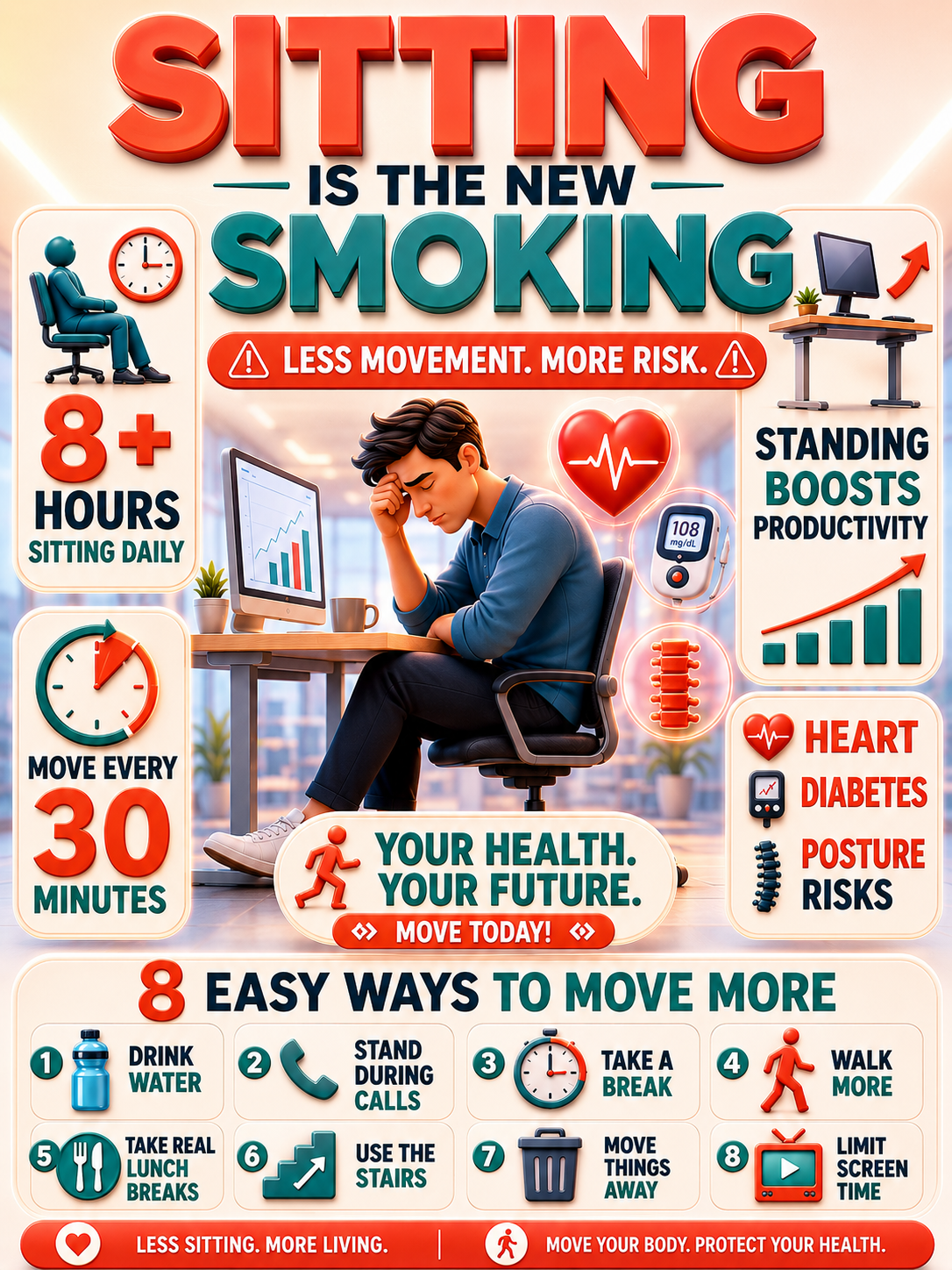
How to Break the Cycle: 8 Practical Hacks
You don’t need to quit your job to be healthy. You just need to change how you work. Here are eight actionable strategies to inject movement into your day:
- 1. The Hydration Trick: Drink more water. It’s the easiest way to force yourself to stand up. A full bladder is a natural movement reminder.
- 2. The Phone Call Rule: If you are on a call that doesn’t require screen sharing, get up. Pace around the room. You’ll be surprised at how much more focused you sound when you’re standing.
- 3. The 30-Minute Timer: Set a recurring alarm on your phone or computer. When it goes off, stand up, stretch your hip flexors, and do a few calf raises.
- 4. Walk and Talk: If you are in the office, stop sending emails to the person sitting ten feet away. Walk over to them. It’s better for your body and better for your team culture.
- 5. Reclaim Your Lunch: Never eat at your desk. The psychological break is just as important as the physical one. Go for a 10-minute walk after your meal to aid digestion.
- 6. Take the Stairs: It’s a classic piece of advice for a reason. It’s an easy, low-intensity way to boost your heart rate.
- 7. The “Inconvenience” Method: Move your printer, trash can, or water bottle to the other side of the room. Create reasons to stand up.
- 8. Limit Screen Time: After work, try to avoid jumping straight onto a different screen. Engage in hobbies that require you to stand or move.
The Standing Desk Debate: Is It a Magic Bullet?
Standing desks are fantastic tools, but they aren’t a panacea. The goal is not to stand all day—it’s to move all day. Static standing can lead to its own set of issues, like varicose veins or foot pain. The best workstation setup is one that allows for movement. If you use a standing desk, alternate between sitting and standing, and keep your body dynamic.
Conclusion: Small Movements, Big Impact
The key to longevity isn’t just about intense training sessions; it’s about the micro-movements you make every single day. By being more conscious of your posture and finding ways to break up long stretches of inactivity, you are protecting your heart, sharpening your brain, and boosting your productivity. Start small today—set that timer, drink that extra glass of water, and stand up for your health. Your future self will thank you.