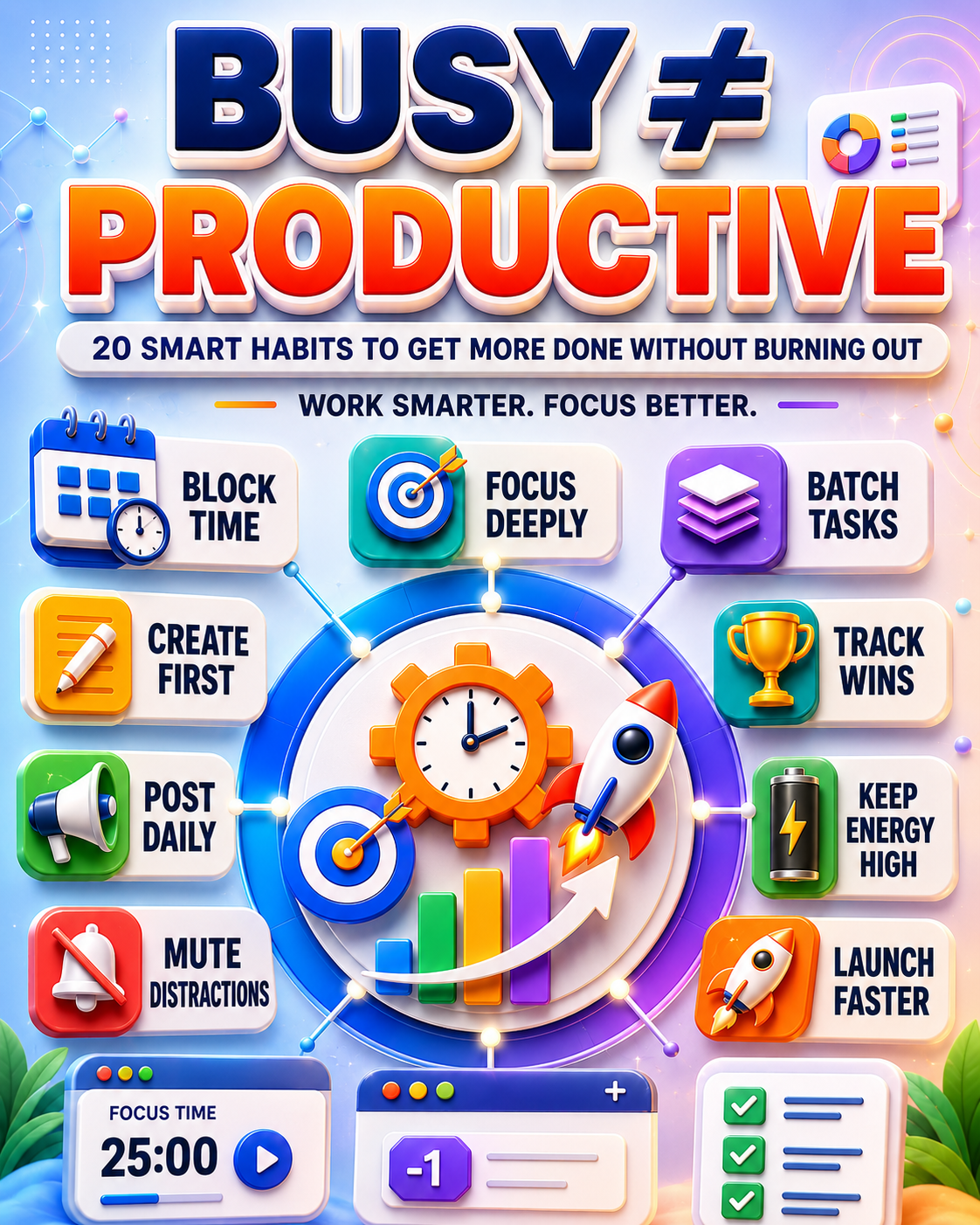
Ever feel like you’re spinning your wheels all day, juggling a million things, but not actually moving the needle? You’re not alone! In today’s hyper-connected world, it’s super easy to get caught up in the ‘busy’ trap. Professionals, entrepreneurs, students, creators – we all fall into this sometimes. We multitask like crazy, constantly react to notifications, and hop from one task to another, only to end the day feeling exhausted and wondering, “What did I *actually* accomplish?” The truth is, being busy isn’t the same as being productive. Real productivity is about achieving meaningful results, not just filling your calendar. That’s where smart habits come in. This guide is packed with 20 powerful, practical productivity habits designed to boost your focus, slash distractions, manage your energy like a pro, and help you perform at a high level sustainably – without hitting that dreaded burnout wall. ⚡
We’re going to dive deep into how you can genuinely get more done. Think prioritizing what truly matters, structuring your work for maximum impact (hello, deep work!), efficiently handling those repetitive tasks, building systems that work for you, tracking your progress, and keeping that momentum going strong. From smarter ways to plan your day to creating distraction-free workflows, these strategies are all about boosting your efficiency while safeguarding your mental clarity and that all-important work-life balance. 📈
Whether you’re hustling to build a business, climbing the career ladder, growing a brand from the ground up, or just aiming to up your personal performance game, these proven productivity principles are your secret weapon. They’ll help you generate more output with significantly less stress. Get ready to discover how small, consistent daily changes can pave the way for long-term success, build rock-solid discipline, and foster a much healthier, more sustainable approach to modern productivity. 🧠

🚀 Master Your Productivity: It’s About Impact, Not Just Activity
Let’s be real: our modern work culture often seems to celebrate being ‘busy’ above all else. Endless meetings, a constant barrage of notifications, the endless dance of multitasking, and those marathon working hours are frequently seen as badges of honor, sure signs of success. But here’s the kicker: productivity isn’t actually measured by how jam-packed your schedule looks. True productivity shines through when you’re completing meaningful work efficiently, all while keeping your mind sharp and your energy reserves healthy for the long haul.
Think about it. How many times have you found yourself reacting to emails all day, scrolling endlessly through different browser tabs, or switching between tasks so rapidly that by the time you look up, you realize you haven’t made any *real* progress? The crucial difference between simply being busy and actually being productive boils down to a few key elements: laser-sharp focus, smart systems, clear priorities, and taking intentional, impactful action.
This comprehensive guide is your roadmap to unlocking serious efficiency. We’re diving into 20 highly effective productivity habits that will help you skyrocket your output, sharpen your concentration, steer clear of burnout, and build a foundation for sustainable success. Get ready to transform how you work!
🚀 Why True Productivity Trumps Mere Busyness
Busyness can be a master of illusion. It makes us *feel* like we’re accomplishing a lot, but often, it’s just a flurry of activity with little substance. Productivity, on the other hand, is all about the results, the tangible outcomes, and the meaningful progress you’re making towards your goals. It’s the difference between running on a treadmill and actually reaching your destination.
So, what do highly productive individuals typically do differently? They:
- Prioritize ruthlessly: They know what’s important and focus their energy there.
- Guard their focus time: They intentionally carve out blocks for deep, uninterrupted work.
- Minimize distractions: They actively work to eliminate or reduce interruptions.
- Leverage systems over willpower: They build reliable processes instead of relying solely on motivation.
- Manage their energy: They understand that physical and mental well-being are crucial for sustained performance.
- Focus on consistency: They value steady progress over sporadic, intense bursts of overwork.
Ultimately, the goal isn’t to cram more hours into your day. It’s about achieving better results with smarter, more strategic effort. Let’s explore how you can make that shift.
🎯 1. Pick One Main Goal: The Power of Singular Focus
One of the most common productivity pitfalls? Trying to chase too many objectives all at once. When your focus is scattered across a dozen different priorities, your energy inevitably gets fragmented too. It’s like trying to aim a spotlight in ten different directions simultaneously – you end up illuminating very little effectively.
By focusing on a single, primary objective, you create incredible clarity and direction. This clear target helps you eliminate unnecessary tasks, make better decisions faster, and direct your full mental bandwidth towards what truly matters. It’s about identifying the one outcome that will create the biggest ripple effect of positive change in your work or life.
Benefits of Zeroing In on a Single Goal
- Enhanced Concentration: Your mind isn’t constantly pulled in different directions.
- Accelerated Execution: You move faster when you know exactly where you’re going.
- Reduced Overwhelm: A single focus simplifies your mental landscape.
- Sharper Priorities: It becomes much easier to say ‘no’ to distractions.
- Higher Completion Rates: You’re far more likely to finish what you start.
Instead of juggling an overwhelming list of to-dos, identify that one key result that will make the most significant impact. Make that your North Star.
💰 2. Start With Revenue-Generating Tasks: Prioritize High-Impact Activities
Not all tasks are created equal, right? Productive people understand this and make it a habit to tackle the highest-impact work first. What does that mean? It means focusing on activities that directly contribute to revenue generation or significant growth, especially during the times of day when your mental energy is at its peak – usually, that’s first thing in the morning.
Think about these examples of high-impact activities:
- Creating valuable products or services: The core of your business.
- Publishing impactful content: Attracts and engages your audience.
- Engaging in sales outreach: Directly drives new business.
- Developing strategic plans: Sets the direction for future success.
- Acquiring new clients: Essential for growth and sustainability.
- Investing in skill-building: Enhances your capabilities for future tasks.
By front-loading your day with these critical tasks, you ensure that the most important work gets done. Less critical, reactive tasks like sifting through emails or responding to every notification can wait until you’ve already secured significant progress on your primary goals.
⏰ 3. Block Dedicated Work Time: The Magic of Deep Work Sessions
Deep work, as defined by author Cal Newport, is the ability to focus without distraction on a cognitively demanding task. It’s where your most valuable and creative output happens. And the key to achieving it? Uninterrupted focus. That’s precisely why time blocking is such a powerhouse productivity technique.
Time blocking is essentially scheduling specific blocks of time on your calendar for focused work on particular tasks or projects. It’s your proactive defense against the constant onslaught of distractions and the costly mental overhead of context switching (jumping between different types of tasks). By dedicating specific times for specific work, you protect your attention and ensure that your most demanding tasks get the uninterrupted focus they deserve.
How to Maximize Your Time Blocking Sessions
- Schedule them like important meetings: Treat these blocks as non-negotiable appointments.
- Silence all notifications: Turn off email alerts, social media pings, and anything else that can break your flow.
- Define ONE clear objective per session: Know exactly what you aim to accomplish.
- Resist the urge to multitask: Focus solely on the task at hand.
- Incorporate short breaks: Step away briefly between sessions to refresh your mind.
Even just 60 to 90 minutes of truly uninterrupted deep work can often yield far more meaningful results than an entire day spent juggling distractions and context switching.
🎨 4. Create Before Consuming: Lead with Your Output
How does your typical morning start? For many, it’s a dive straight into emails, social media feeds, news headlines, or Slack messages. This habit immediately plunges your brain into a reactive state. You’re responding to the world’s agenda before you’ve even had a chance to set your own.
A much more productive approach? Flip the script. Prioritize creation *before* consumption. Start your day by engaging in activities that produce something tangible or move your most important projects forward, rather than passively consuming information or reacting to others’ demands.
Productive Morning Actions to Kickstart Your Day
- Writing: Draft that article, email, or report.
- Planning: Outline your strategy or your day’s tasks.
- Designing: Work on visual elements or user interfaces.
- Coding: Build or debug software.
- Building: Assemble or create physical or digital products.
- Strategizing: Map out your next steps for a key project.
By focusing on creation first, you build positive momentum right out of the gate. This proactive approach not only gets important work done but also primes your mind for clarity and focus throughout the rest of the day.
📅 5. Show Up Daily: The Compounding Power of Consistency
In the pursuit of productivity, consistency is king. It consistently outperforms intensity over the long run. Think of it like compound interest for your efforts: small, daily actions accumulate over time, leading to significant, sustainable growth and results that might seem impossible through sporadic bursts of effort.
Whether it’s consistently publishing content, dedicating time to learning new skills, or incrementally improving your workflows, this daily commitment builds momentum and creates long-term advantages that are hard to beat. It’s not about massive, earth-shattering breakthroughs every day; it’s about the steady, reliable progress that builds over weeks, months, and years.
What Daily Consistency Builds
- Unshakeable Discipline: It trains your brain to follow through.
- Powerful Momentum: Each day’s effort builds on the last.
- Earned Trust: With yourself and with others (clients, audience, team).
- Audience Growth: Consistent value attracts and retains followers.
- Skill Mastery: Regular practice leads to expertise.
Remember, true productivity is rarely about those rare, heroic efforts. More often than not, it’s the quiet, consistent rhythm of repeated small actions that truly drives success.
🔕 6. Eliminate Distractions: Guard Your Most Precious Resource – Attention
We live in a world designed to steal our attention. Constant notifications from our phones, endless browser tabs open on our computers, background apps buzzing, and the siren call of social media – they all conspire to fragment our focus and decimate our productivity. Every interruption, no matter how small, comes with a cognitive cost, forcing your brain to switch gears, which takes time and mental energy.
Mastering the art of distraction reduction is one of the most critical skills for modern productivity. It’s about being intentional about protecting your focus so you can do your best work.
Strategies for Ruthless Distraction Reduction
- Silence Notifications: Turn off non-essential alerts on your phone and computer.
- Utilize Focus Modes: Most operating systems have built-in features to minimize interruptions.
- Keep Only One Tab Open: Seriously, resist the urge to have dozens of browser windows cluttering your screen.
- Create a Clean Workspace: A tidy physical and digital environment reduces visual distractions.
- Set Communication Boundaries: Let colleagues know when you’re in deep work mode and can’t be interrupted.
- Schedule Social Media Usage: Designate specific times to check platforms rather than doing it randomly.
Think of protecting your attention as a core productivity skill. The more you can guard it, the more effective you’ll be.
📦 7. Batch Similar Tasks: Streamline Your Workflow
Constantly switching between different types of tasks is a massive drain on your mental energy. Each time you switch, your brain needs to reorient itself, recall context, and ramp up for the new activity. This ‘task switching’ tax can significantly slow you down and increase the likelihood of errors.
A highly effective strategy to combat this is ‘task batching.’ This involves grouping similar activities together and doing them all in one dedicated block of time. By doing this, you minimize context switching, allowing you to get into a rhythm and operate more efficiently.
Smart Examples of Task Batching
- Email Management: Designate specific times (e.g., twice a day) to check and respond to emails, rather than constantly monitoring your inbox.
- Content Creation: Write multiple blog posts, social media updates, or video scripts in one session.
- Meeting Scheduling: Handle all your meeting requests and scheduling at once.
- Administrative Tasks: Process invoices, file documents, or return voicemails in a dedicated block.
This approach reduces the ‘transition costs’ between different types of work and significantly speeds up your overall workflow. You become more focused and efficient by staying in the same ‘mode’ for longer periods.
☕ 8. Take Short Strategic Breaks: Recharge for Peak Performance
It might seem counterintuitive, but working non-stop without breaks can actually *decrease* your productivity, focus, and creativity over time. Our brains aren’t designed for sustained, high-intensity focus for hours on end. Continuous work without periods of recovery leads to mental fatigue, reduced cognitive performance, and ultimately, burnout.
Incorporating short, strategic breaks throughout your workday is essential for maintaining mental endurance and improving the quality of your output. These aren’t breaks to scroll through social media (which can often be more draining than refreshing); they’re moments to truly step away and recharge.
Healthy and Effective Break Activities
- Go for a short walk: Even 5-10 minutes of movement can make a difference.
- Stretch: Release physical tension built up from sitting.
- Hydrate: Grab a glass of water – dehydration impacts cognitive function.
- Practice deep breathing: Calm your nervous system and reset your focus.
- Look away from screens: Give your eyes a much-needed rest.
Sustainable productivity isn’t just about the intense periods of work; it’s equally about the periods of rest and recovery that allow you to come back refreshed and ready to tackle your next task with renewed energy and focus.
📚 9. Learn Something Weekly: Invest in Continuous Growth
The world is constantly evolving, and the skills that were cutting-edge yesterday might be outdated tomorrow. To stay relevant, competitive, and effective, continuous learning is non-negotiable. High performers understand this and make it a priority to dedicate time each week to expanding their knowledge, refining their systems, and enhancing their capabilities.
This isn’t just about formal courses; it can include reading industry articles, listening to relevant podcasts, experimenting with new tools, or even discussing new ideas with peers. The key is consistent, intentional learning.
Valuable Areas for Weekly Learning
- Communication Skills: Effective writing, public speaking, active listening.
- Leadership Principles: Motivating teams, strategic decision-making.
- Emerging Technologies: Staying updated on AI, software, and digital tools.
- Productivity Systems: Discovering new methods and tools to optimize your workflow.
- Marketing & Sales: Understanding how to reach and convert customers.
- Financial Literacy: Managing personal and business finances effectively.
Making weekly learning a habit significantly boosts your adaptability, problem-solving abilities, and overall long-term career growth. It’s an investment that pays dividends.
📝 10. Write Down Processes: Systematize for Scalability
Ever found yourself explaining the same thing over and over, or struggling to remember the exact steps for a recurring task? Documented systems and processes are the antidote to confusion and the catalyst for faster, more accurate execution. Instead of constantly reinventing the wheel or relying on tribal knowledge, productive individuals create clear, step-by-step systems for common workflows.
These documented processes act as a reliable guide, ensuring consistency and reducing the mental load required to perform tasks. They are the backbone of efficient operations, whether you’re working solo or managing a team.
Key Benefits of Documenting Your Processes
- Faster Delegation: Easily hand off tasks to others with clear instructions.
- Improved Organization: Everything is laid out logically and accessibly.
- Reduced Mistakes: Standardized steps minimize errors and inconsistencies.
- Easier Scaling: Processes are essential for growing a business or team.
- Enhanced Consistency: Tasks are performed the same way every time.
Well-defined systems transform chaotic, ad-hoc work into predictable, repeatable productivity, freeing up your mental energy for more strategic thinking.
🤝 11. Ask for Help Early: Leverage and Collaboration
A common productivity killer is the mistaken belief that you have to do everything yourself. Trying to be a lone wolf, especially when faced with complex challenges or overwhelming workloads, often leads to delays, frustration, and subpar results. Recognizing when and how to seek support early on is a hallmark of smart productivity.
This isn’t about weakness; it’s about efficiency and effectiveness. It’s about understanding the power of leverage and collaboration.
Effective Ways to Seek and Utilize Help
- Delegate Repetitive Tasks: Offload tasks that don’t require your unique expertise.
- Collaborate with Experts: Bring in people with specialized skills when needed.
- Use Automation Tools: Let technology handle tasks that can be automated.
- Outsource Low-Value Activities: Hire freelancers or agencies for non-core functions.
Smart productivity isn’t about brute force self-reliance; it’s about strategically using the resources, skills, and time of others (and technology) to achieve your goals more effectively.
⚙️ 12. Use Simple Tools: Clarity Over Complexity
In the world of productivity, more complex systems and a vast array of tools don’t necessarily equate to better results. In fact, overly complicated systems often create more friction, require more maintenance, and ultimately hinder productivity rather than helping it.
The most effective productivity tools and systems are typically the ones that are simple, intuitive, and easy to integrate into your daily routine. They should support your workflow, not complicate it. The goal is to reduce mental clutter and make it easier to get things done.
Essential Categories of Simple Productivity Tools
- Task Managers: Apps like Todoist, Asana, or simple to-do lists.
- Calendar Systems: Google Calendar, Outlook Calendar for scheduling and time blocking.
- Automation Platforms: Tools like Zapier or IFTTT to connect apps and automate workflows.
- Note-Taking Apps: Evernote, Notion, or simple text files for capturing ideas.
- Time Trackers: Toggl, Clockify for understanding where your time goes.
Focus on using a few reliable tools that work well for you, rather than constantly chasing the next ‘shiny object’ productivity app. Simple, consistent workflows lead to better habits and less mental overhead.
🔋 13. Protect Your Energy: The Foundation of All Productivity
It’s impossible to be productive if you’re running on empty. Productivity is inextricably linked to your physical and mental well-being. When your energy levels are depleted, your ability to focus, think creatively, and execute tasks effectively plummets. Therefore, managing and protecting your energy is often *more* critical than managing your time.
Think of energy as your most valuable resource. Investing in habits that optimize your energy levels will pay huge dividends in your overall productivity and well-being.
Key Habits for Energy Optimization
- Prioritize Quality Sleep: Aim for 7-9 hours of consistent, restful sleep.
- Incorporate Regular Movement: Exercise boosts energy levels and reduces stress.
- Stay Properly Hydrated: Dehydration leads to fatigue and brain fog.
- Eat Nutritious Meals: Fuel your body and brain with whole foods.
- Practice Stress Management: Techniques like mindfulness or meditation can conserve mental energy.
- Maintain Consistent Routines: Predictable routines reduce decision fatigue and conserve mental resources.
By actively managing your energy, you create the sustainable foundation needed for high performance day after day.
📄 14. Plan on One Page: Clarity Through Simplicity
Overly complex planning systems can quickly become a distraction in themselves. Spending hours creating intricate plans that are hard to follow can be counterproductive. The beauty of simple planning lies in its clarity and ease of execution.
A highly effective approach is to create a concise, one-page daily plan. This forces you to distill your priorities down to what’s most essential. It makes your goals tangible and actionable, reducing mental overload and improving your ability to execute.
What a Simple One-Page Daily Plan Should Include
- Top 1-3 Priorities: The absolute most important things to accomplish.
- Scheduled Focus Blocks: Time dedicated to your key priorities.
- Key Deadlines: Any critical deadlines for the day.
- Important Reminders: Anything crucial not to forget.
This focused approach brings immediate clarity to your day, making it much easier to know what to work on and when, thereby boosting your execution.
🧪 15. Test Small Improvements: Embrace Incremental Optimization
Instead of attempting massive, overwhelming overhauls of your entire system, focus on making small, incremental improvements. Think of yourself as a scientist running small experiments. Test minor adjustments to your routines, workflows, or tools, and then measure the results.
This iterative approach to optimization is far more sustainable and less likely to lead to burnout or resistance. Small wins build confidence and momentum, making larger changes feel more achievable over time. It’s about continuous learning and adaptation.
Examples of Productivity Experiments to Test
- Varying Work Schedules: Try working earlier or later for a week.
- Experimenting with Focus Music: See if ambient sounds or classical music helps concentration.
- Adjusting Morning Routines: Swap out activities to see what energizes you most.
- Refining Meeting Structures: Test shorter agendas or different facilitation styles.
- Optimizing Content Workflows: Try batching certain steps or using new templates.
This mindset of continuous, small-scale testing and refinement often leads to surprisingly powerful long-term results and a more robust, personalized productivity system.
📋 16. Create Decision Rules: Automate Routine Choices
Every decision you make, no matter how small, consumes mental energy. When your day is filled with constant micro-decisions – “Should I check email now?”, “What should I wear?”, “Which task should I do next?” – you deplete your cognitive resources, leaving less energy for the truly important, complex decisions.
Productive individuals create ‘decision rules’ or standard operating procedures for recurring situations. These rules act as pre-made choices that eliminate the need for constant deliberation, saving mental energy and speeding up execution.
Practical Examples of Decision Rules
- Email Checking Schedule: Decide to check and respond to emails only twice a day at set times.
- Content Publishing Cadence: Commit to posting on social media or your blog at specific, consistent times.
- Template Usage: Utilize pre-designed templates for common tasks like emails, reports, or project proposals.
- Following Standard Procedures: Adhere to established workflows for onboarding, customer service, etc.
By reducing the number of unnecessary decisions you need to make each day, you preserve your mental bandwidth for strategic thinking and high-priority tasks.
🌐 17. Keep One Tab Open: Conquer Digital Clutter
Digital clutter is just as detrimental to focus as physical clutter. Having an overwhelming number of browser tabs open is a common symptom of this, and it significantly fragments your concentration. Each open tab is a potential distraction, a silent demand on your attention, and a contributor to mental fatigue.
Simplifying your digital workspace by drastically reducing the number of open tabs can have a profound impact on your focus, efficiency, and overall clarity.
Benefits of a Minimal Digital Environment
- Sharper Focus: Fewer distractions mean better concentration.
- Increased Speed: Less digital clutter can make your computer run faster and reduce search time.
- Enhanced Clarity: A cleaner interface reduces cognitive load.
- Improved Task Completion: You’re less likely to get sidetracked.
Embracing a minimalist approach to your digital environment is a powerful strategy for enabling deep work and maintaining a clear, focused mind.
📆 18. Review Progress Weekly: Learn and Adapt
Consistent progress requires consistent reflection. Taking time each week to review what you’ve accomplished, what worked well, and what could be improved is crucial for ongoing growth and optimization. Weekly reviews provide valuable insights that inform your planning and execution for the upcoming week.
This process helps you identify successful habits that are worth continuing, pinpoint inefficient systems or processes that need tweaking, recognize missed priorities, and discover new areas for improvement. It’s a powerful feedback loop for your productivity.
Making Your Weekly Review Effective
- Schedule It: Block out time, perhaps at the end of the week (e.g., Friday afternoon).
- Reflect on Accomplishments: What did you complete? What went well?
- Analyze Challenges: What obstacles did you face? What didn’t go as planned?
- Identify Lessons Learned: What insights did you gain?
- Plan for Next Week: Based on your review, what adjustments will you make?
Even a simple, focused review session once a week can dramatically enhance your future productivity and ensure you’re constantly moving in the right direction.
🏆 19. Track Small Wins: Fuel Your Motivation
Motivation isn’t a constant. It often ebbs and flows. One of the most effective ways to keep motivation high and build momentum is by actively tracking and celebrating your small wins. Seeing visible progress, no matter how minor, creates a powerful positive feedback loop that reinforces good habits and encourages you to keep going.
Don’t wait for the big project completion to feel a sense of accomplishment. Break down your goals and acknowledge the smaller milestones along the way. This builds confidence and makes the overall journey feel more manageable and rewarding.
Examples of Small Wins to Track
- Completing a significant task or project phase.
- Publishing a piece of content (blog post, social update, video).
- Finishing a planned workout session.
- Maintaining consistency with a new habit for a week.
- Learning a new skill or completing a module of a course.
- Successfully overcoming a challenging situation.
These small victories, when acknowledged and tracked, accumulate into significant confidence and a stronger sense of self-discipline over time.
🚀 20. Launch Before Perfect: Bias Towards Action
Perfectionism can be a major roadblock to productivity and progress. The relentless pursuit of an unattainable ideal often leads to procrastination, endless tweaking, and ultimately, delayed or never-launched projects. Highly productive individuals, while valuing quality, understand the importance of prioritizing execution and iterative improvement over flawless upfront perfection.
Taking action, even if the initial output isn’t perfect, creates invaluable opportunities for learning, feedback, and momentum. It’s far better to get something out into the world and improve it based on real-world input than to keep it locked away in a state of perpetual ‘almost ready’.
The Power of Taking Action
- Generates Feedback: Real-world input is essential for improvement.
- Builds Experience: You learn by doing, not just by planning.
- Creates Momentum: Action begets more action.
- Unlocks Learning Opportunities: Mistakes and successes teach valuable lessons.
In almost every scenario, consistent progress and learning gained from taking action will ultimately outperform the paralysis of waiting for perfection.
🧠 The Real Secret to Sustainable Productivity: It’s a System
Let’s cut to the chase: sustainable productivity isn’t about working yourself into the ground. It’s not about being the busiest person in the room. True, high-level performance that lasts comes from a balanced, intentional approach that integrates several key elements:
- Clear Priorities: Knowing exactly what matters most.
- Focused Execution: Directing your energy effectively.
- Robust Systems: Building reliable processes.
- Healthy Routines: Nurturing your physical and mental well-being.
- Energy Management: Optimizing your most vital resource.
- Consistent Action: Showing up day after day.
The most productive people aren’t necessarily the ones who are always frantic and overwhelmed. They are the ones who have mastered the art of protecting their attention, focusing their efforts on meaningful outcomes, and building systems that support their goals without leading to burnout.
📈 Final Thoughts: Work Smarter, Live Better
In the grand scheme of modern productivity, the focus is shifting. It’s less about simply doing *more* and much more about doing what matters *most*. By strategically integrating these 20 powerful habits into your daily life, you can profoundly transform your focus, significantly reduce the risk of burnout, and dramatically improve your long-term success.
Whether you’re on a mission to build a thriving business, advance your career, grow a powerful brand, or simply enhance your personal effectiveness, sustainable productivity always starts with intentional systems and consistent, focused execution. Remember, lasting success isn’t forged in the fires of constant busyness; it’s meticulously built through focused action, repeated consistently over time.