Life throws curveballs, doesn’t it? We all face moments of intense pressure, stress, and uncertainty. These are the times that can either make us or break us. But have you ever noticed how some people just seem to navigate these choppy waters with a remarkable sense of calm and control? These individuals often possess a high degree of emotional intelligence (EI), and a key part of their superpower lies in the language they use, both internally and externally. They don’t magically eliminate stress, but they possess a toolkit of phrases that help them manage their emotions, think clearly, and respond constructively. This article dives deep into 12 powerful sentences that emotionally intelligent people deploy when the heat is on. We’ll explore how these simple yet profound statements help foster resilience, enhance self-awareness, improve communication, and ultimately lead to smarter, more effective responses in any high-pressure situation. Get ready to unlock a more confident and capable you!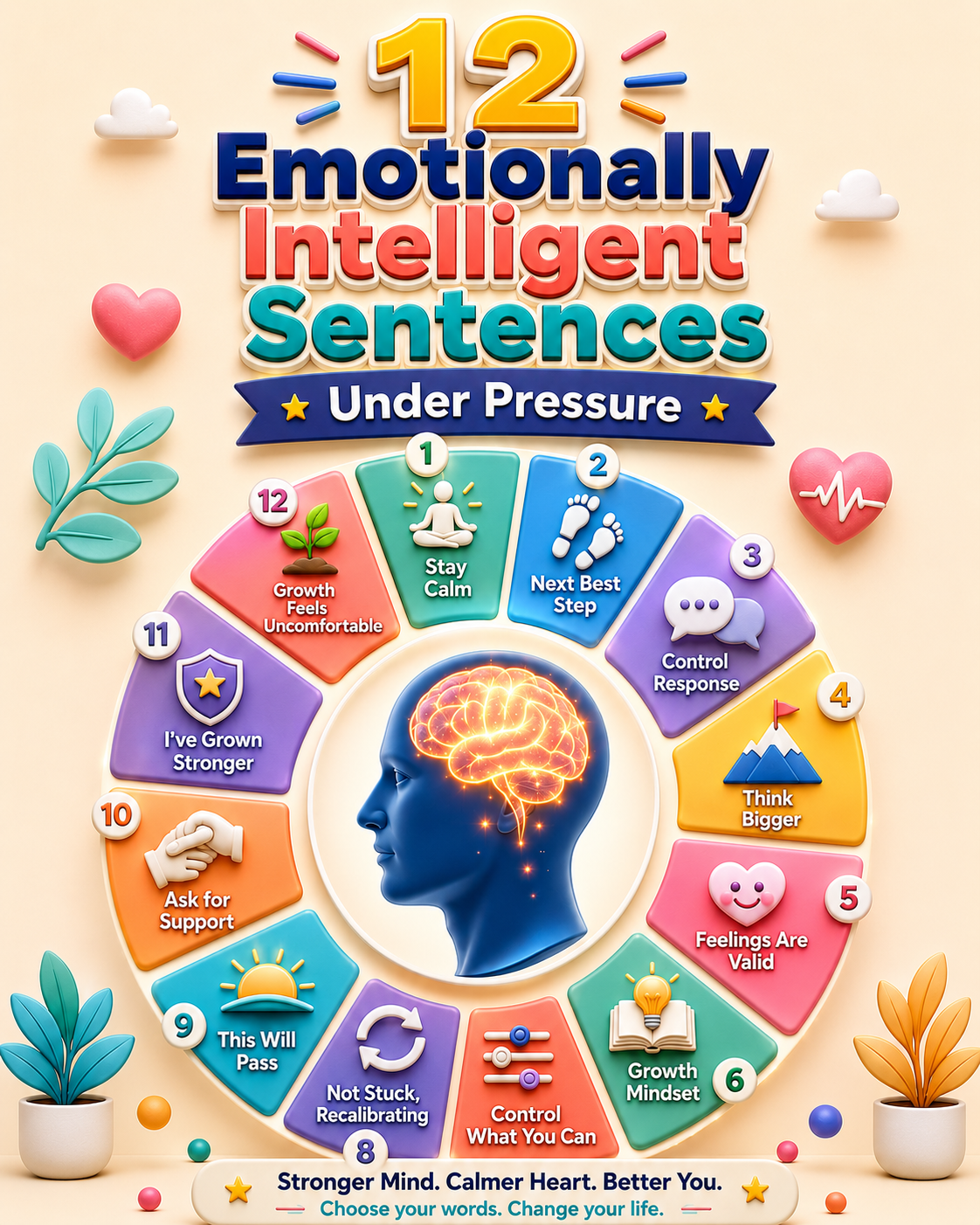
In the heat of the moment, when stress levels are soaring and challenges seem insurmountable, the words we choose can be our greatest allies or our worst enemies. Think about it: when you’re feeling overwhelmed, do you tend to spiral into negative self-talk, or do you find yourself reaching for phrases that anchor you? Emotionally intelligent individuals have a knack for this. They understand that while they might not be able to control every external event, they absolutely have agency over their internal response. This proactive approach to managing emotions and thoughts is a hallmark of high EI. It’s not about suppressing feelings or pretending everything is fine when it’s not; it’s about acknowledging the reality of the situation while consciously choosing a response that serves your well-being and your goals.
Why is emotional intelligence so crucial in today’s fast-paced world? It’s the bedrock of effective leadership, builds stronger relationships, enhances communication, boosts confidence, and significantly impacts our overall mental wellness and productivity. Countless studies highlight that people with higher EI tend to manage stress more effectively, make better decisions under pressure, and foster healthier interactions in both their personal and professional lives. It’s a skill that pays dividends across the board. The following 12 powerful sentences are more than just optimistic affirmations; they are practical, mindset-shifting tools that help reduce emotional overwhelm, cultivate self-awareness, and foster healthier, more constructive reactions when facing life’s inevitable difficulties.
Understanding the Core of Emotional Intelligence
Before we dive into the specific phrases, let’s quickly clarify what we mean by emotional intelligence. At its heart, EI is the capacity to recognize, understand, manage, and effectively use emotions. It’s a multifaceted skill set that encompasses several key areas:
- Self-awareness: Knowing your own emotions, strengths, weaknesses, values, and how they impact others.
- Emotional regulation: The ability to manage and control disruptive emotions and impulses.
- Empathy: Understanding and sharing the feelings of others.
- Social skills: Managing relationships, building networks, and finding common ground.
- Motivation: Having the drive to achieve goals, often fueled by intrinsic factors.
- Stress management: Effectively coping with demanding situations and bouncing back.
- Positive communication: Expressing oneself clearly and constructively, and listening actively.
People who excel in these areas understand that emotions are powerful drivers of behavior, decision-making, and interpersonal dynamics. Instead of being swept away by immediate feelings, they cultivate the ability to pause, reflect, and choose responses that align with their long-term values and desired outcomes. It’s about intentionality, not impulsivity.
The 12 Powerful Sentences for Navigating Pressure
💪 1. “This is tough, but I can handle it.”
When stress hits, our natural inclination can be to focus on the difficulty, which often fuels self-doubt and fear. Emotionally intelligent individuals, however, acknowledge the challenge head-on without letting it paralyze them. This phrase is a powerful affirmation of personal resilience and capability. It doesn’t deny the hardship but frames it within the context of one’s own strength. Instead of succumbing to a ‘victim’ mindset, this statement fosters a belief in one’s ability to cope and overcome. It’s about maintaining a balanced perspective, recognizing the reality of the situation while bolstering inner confidence.
🔍 Why It Matters for Emotional Resilience
- Builds emotional resilience: It directly affirms your capacity to bounce back from adversity.
- Reduces panic responses: By stating capability, it counteracts the urge to panic.
- Encourages problem-solving: It shifts the focus from the problem’s difficulty to your ability to find a solution.
- Improves confidence during uncertainty: It acts as an internal anchor when external circumstances are unstable.
🚶 2. “What’s the next best step I can take?”
Feeling overwhelmed often stems from looking at the entire mountain of a problem rather than the path immediately ahead. This can lead to analysis paralysis, where the sheer magnitude of the task prevents any action from being taken. Emotionally intelligent people bypass this by focusing on actionable progress. This sentence is a brilliant redirect, shifting attention from the paralyzing fear of the unknown or the enormity of the situation to concrete, manageable actions. It breaks down daunting challenges into smaller, more achievable steps, thereby reducing anxiety and sharpening mental focus. It’s about moving forward, one deliberate step at a time, rather than getting stuck in the ‘what ifs’.
🌟 Key Benefits for Action and Clarity
- Improves decision-making: Focuses the mind on immediate, actionable choices.
- Encourages forward momentum: Prevents stagnation by prompting action.
- Prevents emotional paralysis: Cuts through overwhelm by identifying the very next task.
- Enhances focus under pressure: Directs cognitive resources towards solutions, not problems.
💬 3. “How I respond matters more than what’s happening.”
In many stressful situations, we have limited control over the external events themselves. However, emotional intelligence highlights that we always have control over our reaction. This profound realization is a cornerstone of personal responsibility and maturity. By internalizing this idea, individuals shift from a reactive mode to a proactive one. They understand that their choice of response—whether it’s anger, calm, defensiveness, or understanding—has a far greater impact on the outcome and their own well-being than the triggering event itself. This phrase is key to maintaining composure, professionalism, and preventing conflicts from escalating unnecessarily.
🧠 Emotional Insight into Response Control
Choosing a thoughtful, measured response over an impulsive reaction is a critical skill. It preserves dignity, strengthens communication, fosters understanding, and protects one’s own mental and emotional peace. It’s the difference between being a victim of circumstances and being the master of your own experience.
🌍 4. “Let’s look at the bigger picture.”
Stress has a way of narrowing our focus, making immediate problems feel all-consuming and insurmountable. Emotionally intelligent individuals actively combat this tunnel vision by consciously broadening their perspective. This sentence is an invitation to step back, zoom out, and consider the situation within a larger context. It helps to contextualize the current challenge, recognizing that it is likely a temporary phase or a single element within a much larger, ongoing narrative. This strategic perspective reduces the emotional intensity of the moment, encourages more rational and long-term thinking, and helps maintain a sense of optimism by reminding us that most immediate crises are not permanent.
🚀 Why Perspective is a Powerful Tool
- Reduces emotional intensity: Seeing the situation in context diminishes its immediate power.
- Improves strategic thinking: Encourages consideration of long-term consequences and goals.
- Encourages rational decisions: Helps to detach from immediate emotional reactions for clearer judgment.
- Helps maintain optimism: Reminds us that the current difficulty is not the entire story.
❤️ 5. “This feeling is valid, but it doesn’t define me.”
A common misconception about emotional intelligence is that it means suppressing or ignoring difficult emotions. In reality, EI is about acknowledging and understanding emotions without letting them dictate your identity or actions. This phrase is a perfect example of healthy emotional validation and separation. It allows for the experience of feelings like fear, frustration, or sadness without equating those feelings with one’s core self. Stressful emotions are temporary states, not permanent characteristics. Recognizing this distinction is crucial for maintaining self-esteem and preventing negative emotional experiences from undermining one’s sense of worth or capability.
🌈 The Practice of Healthy Emotional Regulation
Emotionally intelligent people don’t pretend they don’t feel things. Instead, they acknowledge their feelings, understand their source, process them constructively, and then choose how to move forward without being enslaved by them. This is the essence of emotional mastery.
🎓 6. “What is this experience teaching me?”
Challenges and setbacks, while often painful, are also potent opportunities for learning and growth. Emotionally intelligent individuals have a growth mindset; they actively seek the lessons embedded within difficult experiences rather than dwelling solely on the negative aspects. This question reframes adversity from a purely negative event into a valuable learning opportunity. It fosters adaptability, encourages self-reflection, and builds resilience by demonstrating that even failures or struggles can contribute to personal development and future success. It transforms the narrative from ‘I failed’ to ‘I learned’.
📚 Growth Mindset Benefits in Action
- Encourages resilience: Learning from mistakes builds the capacity to overcome future challenges.
- Builds adaptability: Understanding lessons learned makes one more flexible in new situations.
- Improves self-awareness: Reflecting on experiences reveals patterns and areas for growth.
- Supports long-term success: Viewing challenges as learning opportunities fuels continuous improvement.
🎯 7. “I can’t control everything, but I can control how I respond.”
The desire for control is a significant source of stress for many. When we feel powerless against external forces, anxiety often spikes. Emotionally intelligent people recognize the futility of trying to control the uncontrollable. Instead, they strategically focus their energy on the one area where they truly have agency: their own reactions and behaviors. This phrase is a powerful anchor for mental stability and emotional discipline. By clearly distinguishing between what is within their influence and what is not, individuals can reduce unnecessary worry, accept circumstances more readily, and channel their efforts more effectively towards productive actions.
⚡ Practical Impact on Stress and Calm
- Strengthens emotional discipline: Reinforces the power of choice in response.
- Reduces stress overload: Eliminates anxiety stemming from trying to control the uncontrollable.
- Improves calm thinking: Fosters a sense of groundedness by focusing on personal agency.
- Encourages acceptance: Promotes peace by letting go of the need to control external factors.
🔄 8. “I’m not stuck; I’m recalibrating.”
Moments of stagnation, setbacks, or unexpected detours can easily lead to feelings of being trapped or like a failure. Emotionally intelligent individuals reframe these experiences not as endpoints but as necessary periods of adjustment and reflection. This phrase brilliantly shifts the narrative from a negative state of being ‘stuck’ to a positive, proactive process of ‘recalibrating.’ It acknowledges that progress isn’t always a straight line; sometimes, it requires pausing, reassessing, and making adjustments. This perspective fosters flexibility, patience, and optimism, reminding us that even periods of apparent inactivity are often crucial steps in a larger journey of growth and development.
🌱 Why Reframing is Key to Resilience
- Encourages optimism: Positions pauses as part of progress, not failure.
- Reduces negative self-talk: Counters thoughts of being stuck with a sense of purposeful adjustment.
- Supports mental resilience: Builds the capacity to navigate non-linear paths without despair.
- Maintains motivation: Keeps forward momentum alive by viewing adjustments as essential steps.
⏳ 9. “This moment will pass.”
During intense pressure, it’s easy for difficult emotions and challenging circumstances to feel like they will last forever. This sense of permanence can amplify distress and lead to catastrophic thinking. Emotionally intelligent people use this simple, grounding reminder to contextualize their current experience. By acknowledging the transient nature of emotions and situations, they can reduce the immediate intensity of distress and prevent themselves from getting lost in overwhelming negativity. This phrase fosters patience, reduces panic, supports emotional balance, and encourages a calmer, more rational outlook by reminding them that even the toughest times eventually subside.
🌤️ Benefits for Emotional Stability
- Encourages patience: Helps endure difficult times by knowing they are temporary.
- Reduces panic: Counteracts the feeling of an unending crisis.
- Supports emotional balance: Provides perspective to avoid emotional extremes.
- Promotes calm thinking: Creates mental space to think clearly amidst turmoil.
🤝 10. “Who can I reach out to for support?”
One of the most significant indicators of emotional intelligence is the understanding that seeking help is a sign of strength, not weakness. Emotionally intelligent individuals recognize the profound value of connection and leverage their support systems when facing challenges. This proactive approach to seeking assistance is a sophisticated form of self-care and problem-solving. It acknowledges that no one has all the answers and that collaboration can lead to better outcomes. Building and maintaining strong relationships is a key component of EI, and knowing when and how to ask for help significantly enhances stress management and overall emotional well-being.
💡 Why Support Systems are Essential
- Reduces isolation: Connects individuals during difficult times, fostering a sense of belonging.
- Improves emotional health: Sharing burdens can alleviate stress and provide emotional relief.
- Encourages problem-solving: External perspectives can offer new insights and solutions.
- Strengthens relationships: Asking for and offering support deepens bonds and trust.
🔥 11. “I’ve faced challenges before, and I grew stronger.”
Our past experiences are rich with evidence of our resilience and capacity to overcome adversity. Emotionally intelligent people tap into this personal history as a powerful source of confidence and reassurance during tough times. This phrase serves as a potent reminder of past triumphs and the growth that resulted from them. It reinforces self-trust and combats the fear or doubt that often accompanies new challenges. By recalling previous instances where they navigated difficulties and emerged stronger, individuals can bolster their belief in their ability to handle the current situation, thereby improving their emotional confidence and reducing fear.
🧠 Psychological Benefits of Recalling Past Successes
- Builds self-trust: Reinforces belief in one’s own capabilities based on past evidence.
- Encourages resilience: Reminds the individual of their inherent ability to bounce back.
- Reduces fear: Mitigates anxiety by demonstrating that challenges are surmountable.
- Improves emotional confidence: Boosts self-assurance in handling current and future pressures.
🌱 12. “It’s okay to feel uncomfortable; it means I’m growing.”
Genuine personal growth and transformation rarely happen within our comfort zones. Discomfort, uncertainty, and challenge are often the precursors to significant development. Emotionally intelligent individuals embrace this reality. Instead of avoiding situations that feel uncomfortable, they approach them with curiosity and a willingness to learn. This mindset reframes discomfort not as a sign of failure or a reason to retreat, but as an indicator that they are pushing boundaries and expanding their capabilities. This perspective is crucial for fostering resilience, encouraging personal development, and embracing the transformative power of challenging experiences.
🚀 Personal Development Insight
The edge of our comfort zone is where learning and evolution occur. Recognizing that discomfort is a signal of growth, rather than a threat, empowers individuals to engage with challenges more boldly and effectively, leading to greater confidence and meaningful progress.
The Profound Impact of Emotionally Intelligent Language
Our internal dialogue and external communication significantly shape our reality. The words we choose to use, both when thinking to ourselves and when speaking with others, have a direct impact on our emotions, behaviors, and how we cope with stress. Adopting the language of emotional intelligence helps to cultivate healthier thought patterns, which in turn supports greater emotional well-being, stronger relationships, and more effective problem-solving.
These 12 powerful sentences are effective because they:
- Promote self-awareness: They encourage introspection and understanding of one’s internal state.
- Reduce emotional reactivity: They offer tools to pause and choose a response rather than simply reacting.
- Encourage resilience: They build a belief in one’s capacity to handle difficulties.
- Support healthy communication: They facilitate constructive dialogue and understanding.
- Improve stress management: They provide practical strategies for navigating high-pressure moments.
- Strengthen emotional control: They empower individuals to manage their feelings and reactions.
By consciously practicing these phrases, whether internally or in conversation, you can gradually reshape how you perceive and respond to challenges. This isn’t about overnight transformation, but about consistent, intentional effort leading to lasting change.
Cultivating Emotional Intelligence Every Day
The good news is that emotional intelligence isn’t a fixed trait; it’s a skill that can be developed and strengthened with practice. By integrating mindful habits into your daily life, you can enhance your EI over time.
📌 Practical Ways to Boost Your EI
🌿 Practice Self-Awareness
Make it a habit to check in with yourself throughout the day. Notice your emotional triggers, the thoughts that arise, and your typical reactions. Journaling can be a powerful tool here.
💬 Improve Communication
Consciously choose your words, especially during tense conversations. Practice active listening and strive for clarity and empathy in your exchanges.
🧠 Pause Before Reacting
When you feel a strong emotional surge, take a deliberate pause. A few deep breaths can create the space needed to choose a more constructive response rather than reacting impulsively.
📖 Reflect on Challenges
After facing a difficult situation, take time to reflect. What lessons can be drawn from the experience? What could you do differently next time?
🤝 Build Supportive Relationships
Invest time in nurturing relationships with people who offer genuine support. Healthy connections are vital for emotional resilience and effective communication.
🌈 Reframe Negative Thinking
Challenge negative or catastrophic thoughts. Actively work to replace them with more balanced, realistic, and solution-focused perspectives.
💡 The Takeaway: Your Words, Your Power
Ultimately, pressure situations serve as a mirror, reflecting our ingrained emotional habits. Emotionally intelligent people aren’t exempt from stress, fear, or uncertainty. Their distinct advantage lies in their sophisticated and effective responses. The 12 powerful sentences we’ve explored are practical manifestations of emotional resilience, deep self-awareness, and adept communication under duress. They are potent tools for shifting focus from panic to clarity, from feeling overwhelmed to taking thoughtful, decisive action.
In a world that constantly presents us with demands and challenges, cultivating emotional intelligence is not just beneficial—it’s essential. It’s one of the most valuable assets you can possess, both personally and professionally. Remember, small, consistent changes in the language you use can lead to profound transformations in your mindset, your relationships, your confidence, and your overall sense of well-being.
The next time you find yourself under pressure, pay attention to the words you’re using. Internally and externally, the language you choose has the power to shape the outcome far more than the situation itself. Harness that power, and navigate your challenges with greater grace, strength, and wisdom.