The Secret Sauce to Unlimited Potential: Mastering Your Mindset
Have you ever wondered why some people seem to breeze through life’s biggest challenges while others get stuck at the first sign of trouble? It’s not necessarily about raw talent or luck. The real differentiator is something psychologists call a growth mindset. If you are looking to level up your career, improve your personal life, and build bulletproof resilience, you have come to the right place. In this deep dive, we’re going to explore eight actionable, highly effective strategies to rewire your brain for success.

Why Your Mindset is Your Greatest Asset
At its core, a growth mindset is the unwavering belief that your intelligence, skills, and talents are not fixed traits. They are muscles. Just like you can hit the gym to build physical strength, you can engage in deliberate practice to build mental capacity. People with a fixed mindset often avoid challenges because they fear looking incompetent. In contrast, those with a growth mindset see every obstacle as a golden opportunity to expand their knowledge base.
In our modern, high-speed economy, the ability to adapt is the ultimate competitive advantage. Whether you are climbing the corporate ladder, launching a startup, or simply trying to master a new hobby, your mindset dictates your ceiling. Let’s break down how you can shift your perspective today.
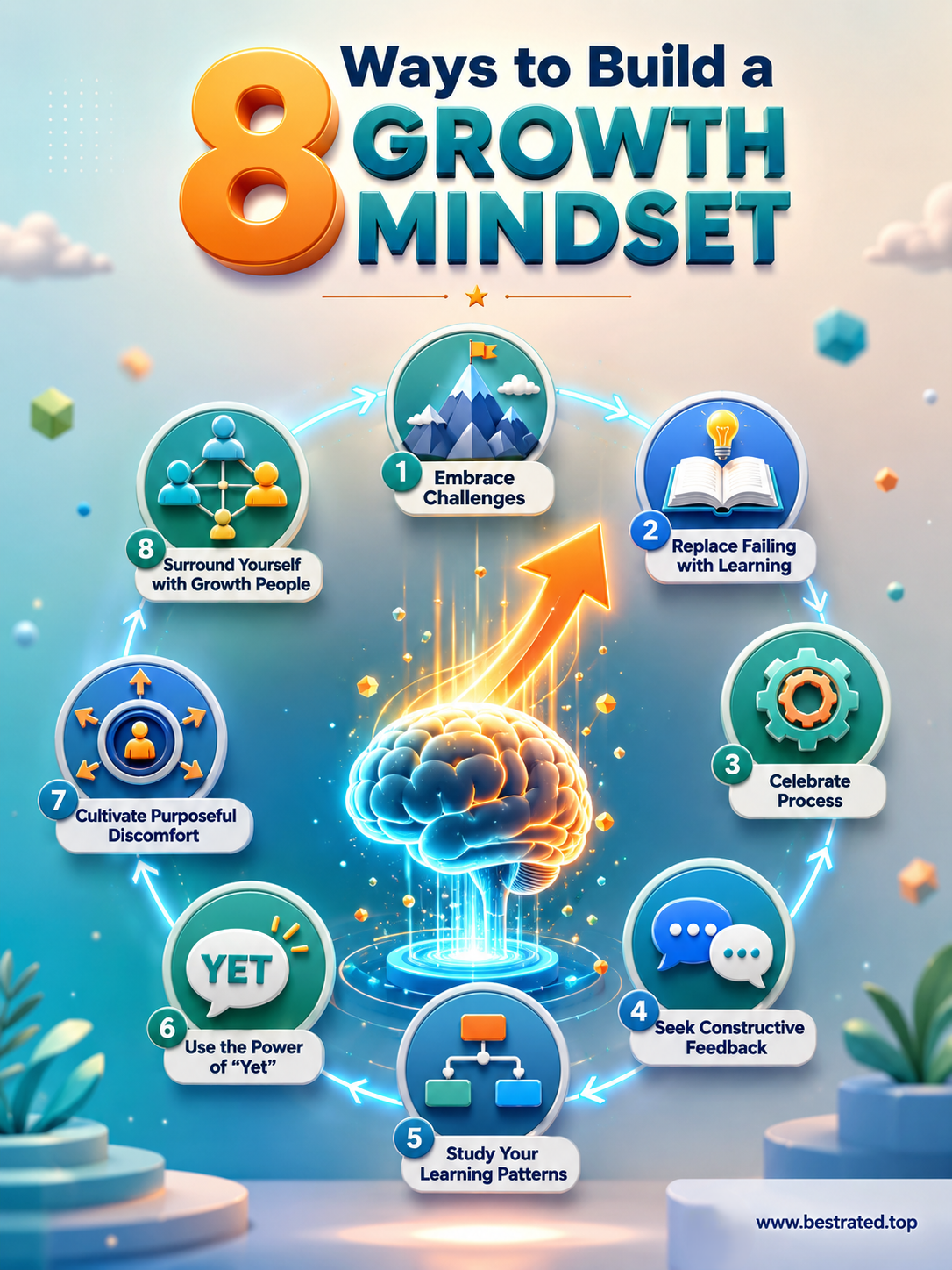
1. Lean Into Challenges as Training Grounds
Most of us naturally shy away from things that make us feel uncomfortable. But here is the truth: comfort is the enemy of progress. When you intentionally choose the difficult path, you aren’t just doing more work; you are physically building new neural pathways in your brain. This process, known as neuroplasticity, makes you sharper, faster, and more capable of handling future pressures.
How to make it happen: Start a ‘Challenge Journal.’ Every time you face a difficult project or a tough conversation, write it down. Document what you learned and, more importantly, what new skill you gained. When you gamify the struggle, you stop fearing it and start craving it.
2. Redefine Failure as Data
We’ve been conditioned to view failure as a negative outcome. But in the world of growth-oriented high achievers, failure is just data. It’s an indicator that you are pushing the boundaries of your current capabilities. If you aren’t failing occasionally, you aren’t aiming high enough.
Actionable Tip: After a setback, conduct a ‘Post-Mortem Analysis.’ Ask yourself three questions: What went wrong? What did I learn that I didn’t know before? What is one small, actionable step I can take next time to improve the outcome? This prevents you from dwelling on the negative and forces you to focus on the solution.
3. Obsess Over the Process, Not the Outcome
It is easy to get distracted by the finish line—the promotion, the trophy, or the profit margin. However, outcomes are often influenced by variables outside your control. The process, however, is 100% yours. By focusing on your daily habits and systems, you create a sustainable engine for long-term success.
Pro Tip: Create a ‘Process Scorecard.’ Track your consistency rather than your results. Did you put in the work today? Did you follow your routine? If you focus on the input, the output will eventually take care of itself.
4. Actively Seek Out Constructive Feedback
Your blind spots are your biggest liabilities. We all have them—areas where we think we are doing great, but in reality, we could be doing much better. The only way to reveal these areas is through honest, constructive feedback. It might sting for a second, but it is the fastest shortcut to mastery.
How to apply it: Don’t just wait for annual reviews. Ask your peers, mentors, or even your family members: “What is one thing I could do to be more effective in this area?” Then, listen. Don’t defend yourself. Just absorb the information and apply it immediately.
5. Master Your Unique Learning Style
We are all wired differently. Some people are visual learners who need to see a diagram to understand a concept. Others are kinesthetic learners who need to get their hands dirty. If you are struggling to learn a new skill, it might not be the topic that is hard—it might be the method you are using.
Actionable Tip: Experiment with different learning modalities. Try audiobooks if reading feels sluggish. Try teaching a concept to a friend (the Feynman Technique) to see if you truly understand it. Once you identify how you learn best, you can supercharge your skill acquisition.
6. Harness the Power of “Yet”
Language is more than just communication; it is a blueprint for your reality. If you say, “I’m not good at public speaking,” you are setting a permanent limit on yourself. If you add the word “yet,” you open a door to infinite possibilities. “I’m not good at public speaking yet.” It sounds simple, but it changes your brain from a state of resignation to a state of anticipation.
Daily Exercise: Catch yourself whenever you use absolute language. Whenever you hear a negative thought, immediately tack “yet” onto the end of it. It’s a small tweak that yields massive psychological dividends.
7. Cultivate Purposeful Discomfort
You’ve heard the phrase “get out of your comfort zone,” but what does that really mean? It means intentionally putting yourself in situations where you feel slightly out of your depth. Whether it’s signing up for a workshop, taking on a project you aren’t sure you can handle, or public speaking, this is where the magic happens.
How to apply it: Aim for the ‘Goldilocks Zone’—a task that is just slightly too hard for your current level. If it’s too easy, you’re bored. If it’s too hard, you’re anxious. Find that sweet spot where you are challenged but still capable of making progress.
8. Curate Your Inner Circle
You are the average of the five people you spend the most time with. If your circle is full of people who complain, avoid risks, and settle for the status quo, their mindset will inevitably bleed into yours. On the flip side, if you surround yourself with growth-oriented, ambitious, and supportive individuals, you will find yourself rising to meet their standards.
Actionable Tip: Take an honest look at your social circle. Are they pushing you to be better? Do they celebrate your wins? If not, look for communities, networking groups, or online forums where growth-minded individuals congregate. Your environment is the ultimate growth hack.
Conclusion: The Long Game of Personal Evolution
Developing a growth mindset is not a destination; it is a lifelong journey. It requires daily practice, self-awareness, and the humility to keep learning. By reframing failure, embracing discomfort, and surrounding yourself with the right people, you aren’t just changing your habits—you are changing your destiny. Start small, stay consistent, and remember: you have the power to grow into whoever you want to be. The only thing standing in your way is your mindset. So, why not make it a growth mindset?