Understanding the Brain’s Resistance to New Habits
Have you ever stood in front of your closet at 6:00 AM, staring at your running shoes, knowing you promised yourself you’d work out, only to crawl back into bed? You aren’t lazy. You aren’t failing. You are experiencing a perfectly normal, biological phenomenon. Your brain is wired to resist change, and understanding why is the first step to finally mastering your habits. At GrowthCoach, we help you bridge the gap between your intentions and your actions by uncovering the neurological secrets behind behavior change.

The Boardroom in Your Head: The Battle for Control
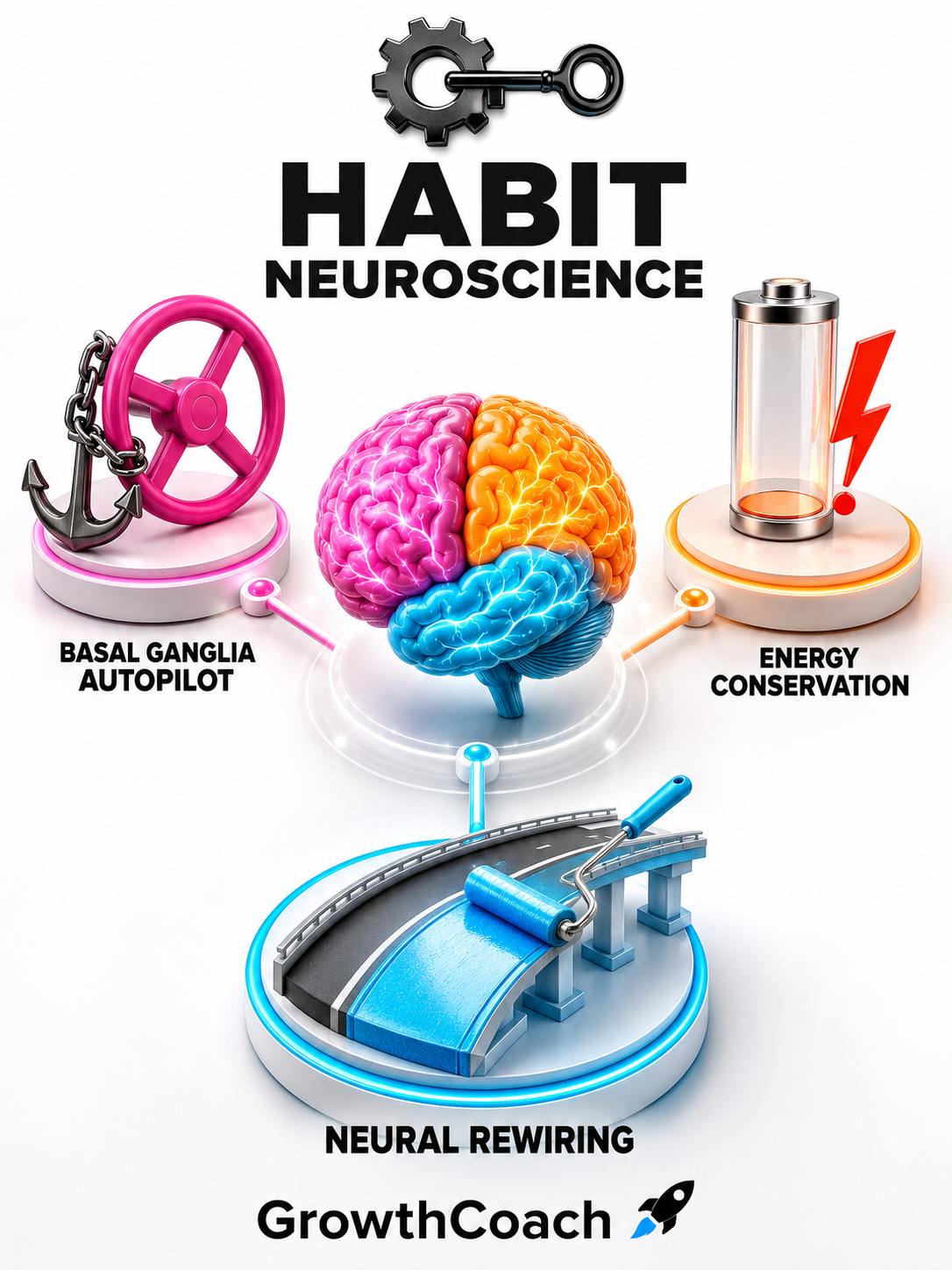
Think of your brain as a corporate office with two primary departments that rarely get along. On one side, you have the Prefrontal Cortex—the visionary CEO. It’s the part of you that sets goals, dreams of a better future, and plans your new life. It’s logical, ambitious, and forward-thinking. On the other side, you have the Basal Ganglia, the department of operations and logistics. This part of your brain is strictly focused on efficiency, safety, and energy conservation. It loves routines, it loves habits, and it hates change.
When you decide to start a new habit, your Prefrontal Cortex is excited. But the Basal Ganglia sees your new habit as a threat to its carefully managed routine. It views the extra energy required to perform a new action as a waste of precious metabolic resources. This is why the ‘willpower’ you feel at the start of a new goal often evaporates within a few weeks. It’s not a lack of character; it’s a biological tug-of-war.
Why Your Brain Loves Being Lazy: The Energy Conservation Principle
Your brain is an energy-hungry machine. Despite being only 2% of your body weight, it consumes roughly 20% of your daily caloric intake. Because of this massive demand, your brain has evolved to become the ultimate penny-pincher. It constantly looks for ways to automate your life so it can save energy. This is the core of the Habit Loop.
When you repeat a behavior, your brain ‘hardcodes’ that behavior into your neural architecture. Once it’s hardcoded, performing the action requires almost zero conscious effort. This is great when you’re driving home on autopilot, but it’s a nightmare when you’re trying to integrate a new, difficult habit like meditation or exercise. Your brain essentially says, “Why should we spend the energy to do this new, difficult thing when we have an old, easy habit that gets the job done?”
Rewiring Your Brain: The Reality of Neuroplasticity
To truly change, you have to understand that habits are physical structures. They are actual pathways in your brain. Think of your habits as forest trails. The more you walk a path, the wider, smoother, and more defined it becomes. This is due to a process called myelination, where your brain coats your neural pathways in a fatty substance called myelin to speed up electrical signals. Your old, destructive habits are like eight-lane highways—they are fast, efficient, and easy to travel.
A new habit, however, is like a tiny, overgrown footpath. At first, it’s difficult to navigate. You feel resistance, you get tired, and you’re tempted to turn back to the highway. This is why consistency is the only way to build new habits. You aren’t just ‘trying’ to do something new; you are physically building a new road in your brain. You have to keep walking that path until your brain recognizes it as the new ‘default’ highway.
Strategic Tips to Hack Your Biological Resistance
So, how do we outsmart our own biology? We have to stop relying on brute-force willpower and start using behavioral engineering. Here are three ways to make change easier:
- Start Small, Go Micro: Don’t try to run a marathon on day one. Your brain will immediately flag the energy expense as a threat. Instead, start with a habit so small it’s impossible to fail—like doing one push-up or reading one page of a book. This bypasses the basal ganglia’s alarm system.
- Habit Stacking: Anchor your new habit to an existing, automated routine. If you already drink coffee every morning, make that your trigger to do your new, smaller habit. Your brain is already ‘awake’ and in a routine; you are simply piggybacking your new goal onto an established neural pathway.
- Environmental Design: Reduce the friction. If you want to run in the morning, lay your clothes out the night before. If you want to eat healthier, remove the junk food from your pantry. By making the desired behavior the path of least resistance, you take the burden off your prefrontal cortex.
The Long-Term View: Why Patience Wins
Real, lasting change takes time. Many people give up because they expect immediate results. But remember, you are performing a construction project in your brain. You are building new roads and letting old ones fall into disrepair. This process doesn’t happen overnight. It takes weeks or even months of consistent, patient application. When you feel that resistance rising, don’t get frustrated. Recognize it as your brain doing exactly what it was designed to do. Acknowledge the resistance, stay the course, and keep building your neural architecture.
At GrowthCoach, we believe that self-mastery is a journey, not a destination. It’s about creating an ecosystem of success where your daily actions align with your long-term vision. By understanding the neuroscience behind your resistance, you can stop fighting yourself and start working with your biology to create the life you want. Whether you’re looking to improve your productivity, health, or mindset, the keys are already inside your head. You just need the right tools to unlock them.
Take the Next Step in Your Growth Journey
Feeling overwhelmed by the prospect of changing your life? You don’t have to navigate these complex neural pathways alone. At GrowthCoach, we specialize in helping individuals break through the invisible walls of self-sabotage and build high-performance habits that actually stick. We turn the science of success into practical, daily blueprints that fit your unique lifestyle. If you’re ready to stop the internal tug-of-war and start building the life you deserve, reach out to our team today. Let’s map out your growth, optimize your mindset, and turn your goals into your new reality. The best version of you is waiting—let’s go get it!