Hey there! Ever feel like you’re running on a hamster wheel, going a million miles a minute but not actually getting anywhere? You’re swamped with tasks, your inbox is a disaster, and your to-do list seems to multiply overnight. Sound familiar? In today’s super-fast world, it’s SO easy to mistake being ‘busy’ for being ‘productive’. We’re bombarded with notifications, stuck in endless meetings, and trying to juggle a dozen things at once. It creates this *illusion* of progress, right? But then, at the end of the day, you’re left feeling utterly exhausted, with a pile of unfinished tasks and the nagging feeling that you didn’t accomplish anything truly meaningful. It’s frustrating, to say the least!
True productivity isn’t about cramming more into your day or working longer hours. It’s about working smarter, focusing your energy on the *right* things, and doing them efficiently. The truth is, many of us unknowingly fall into habits that silently sabotage our focus, drain our energy, and tank our performance. These productivity killers create a whirlwind of activity, making it feel like you’re making strides, when in reality, you’re just spinning your wheels. We’re talking about things like endless multitasking, constant distractions, that pesky perfectionism, poor planning, and even heading straight for burnout. These aren’t just minor annoyances; they are major roadblocks to achieving your goals.
But here’s the good news: it doesn’t have to be this way! Understanding these common productivity pitfalls is the absolute first step to reclaiming your time, your energy, and your focus. This guide is your roadmap to transforming that feeling of being perpetually busy into genuine, impactful productivity. We’ll dive deep into the eight biggest culprits draining your efficiency and, more importantly, equip you with practical, actionable strategies to overcome them. You’ll learn how to prioritize like a pro, manage your time with surgical precision, build an impenetrable fortress against distractions, master the art of saying ‘no’, and maintain a sustainable pace without hitting a wall of exhaustion. Get ready to discover how structured planning, laser-like focus techniques, and intentional work habits can turn your daily grind into a journey of meaningful accomplishment. Whether you’re a student burning the midnight oil, an entrepreneur building an empire, a professional climbing the corporate ladder, or a creative soul bringing your visions to life, these methods are designed to boost your concentration, skyrocket your efficiency, and pave the way for long-term personal growth. Let’s ditch the busywork and start building smarter habits today!

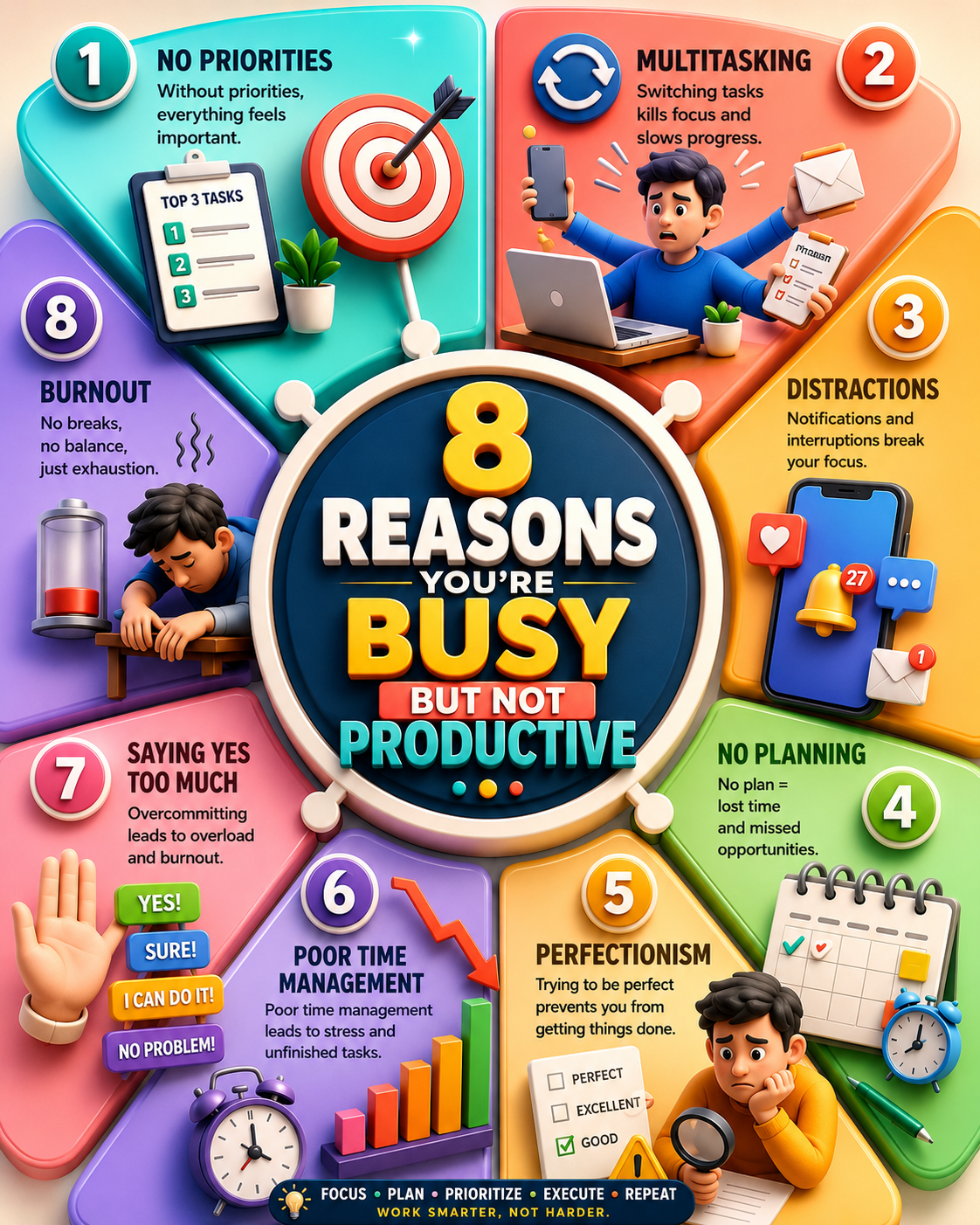
🚀 Why You’re Swamped But Not Seeing Results: The Top 8 Productivity Killers
In our hyper-connected, always-on world, the badge of ‘busyness’ is worn like a badge of honor. We see overflowing calendars, a constant stream of notifications pinging our devices, the relentless juggle of multitasking, and schedules packed tighter than a rush-hour train. All of this creates a convincing illusion that we’re incredibly productive. But let’s be real: how many times have you collapsed into bed at night, utterly drained, only to realize that the truly important stuff is still sitting there, untouched? This isn’t productive; it’s just exhausting.
The secret sauce to genuine productivity isn’t found in working harder or longer. It’s about channeling your precious energy into high-impact actions that move the needle on your most important goals. The problem is, common habits and environmental factors often work against us, silently eroding our efficiency, clouding our mental clarity, and making even the simplest tasks feel like climbing Mount Everest. These aren’t just minor inconveniences; they are the silent assassins of your productivity.
So, if you’re tired of feeling like you’re always busy but never truly accomplishing what matters, you’re in the right place. Identifying the root causes of this unproductive busyness is the crucial first step toward unlocking your true potential. Let’s break down the eight biggest productivity killers lurking in your daily routine and, more importantly, arm you with proven strategies to conquer them and finally achieve meaningful results.
1. The Chaos Creator: No Clear Priorities 🎯
Imagine trying to navigate a city without a map or a destination. That’s what your workday looks like without clear priorities. This is arguably the biggest reason people find themselves constantly busy but never truly productive. When every single task screams for your attention, your brain gets overwhelmed. It struggles to distinguish between what’s urgent, what’s important, and what can wait. This lack of clarity leads to a chaotic workflow where your precious time and energy are scattered like confetti.
Without a clear sense of what truly matters, you’ll often find yourself:
- Constantly Juggling: Tasks become a frantic game of whack-a-mole, with each one demanding immediate attention, none getting focused effort.
- Drowning in Decision Fatigue: You waste mental energy deciding what to tackle next, leaving you too depleted to actually *do* the work.
- Procrastinating on the Important Stuff: The truly impactful, but perhaps more challenging, tasks get pushed back day after day in favor of easier, less critical activities.
- Wasting Golden Hours: Your most productive time is often consumed by low-value activities that don’t move you closer to your goals.
This reactive mode means you’re constantly putting out fires instead of intentionally building towards something significant. You’re busy, yes, but you’re not steering the ship.
Why Prioritization is Your Productivity Superpower
Think of priorities as your compass and your map. They guide your focus toward the tasks that deliver the highest impact and the greatest return on your time and effort. High-achievers and truly productive individuals don’t try to do everything; they strategically identify a small handful of essential outcomes and pour their energy into making those happen. It’s about the 80/20 rule in action – identifying those 20% of tasks that yield 80% of the results.
Your Action Plan: Master the ‘Top Three’ Method
Ready to bring order to the chaos? Try this simple yet incredibly effective strategy:
- Identify Your ‘Big Three’: At the start of each day (or even the night before), identify the three most important tasks you absolutely need to accomplish. These should be tasks that significantly contribute to your main goals.
- Tackle Them First: Make these high-priority items your non-negotiables. Block out time in your schedule to work on them before diving into anything else.
- Defer the Rest: If other tasks or requests come up, consciously decide if they are truly urgent or important. If not, schedule them for later or delegate them. Protect your time for your ‘Big Three’.
This focused approach dramatically sharpens your concentration, slashes feelings of overwhelm, and ensures you’re making tangible progress on what truly matters, every single day. It’s about intentionality, not just activity.
2. The Focus Killer: Constant Multitasking 🔄
Ah, multitasking. It’s the siren song of the modern workplace, promising efficiency and the ability to conquer mountains of work. We brag about how many things we can do at once. But here’s the hard truth: research consistently shows that multitasking isn’t just *not* more efficient; it’s actually a massive productivity drain. It significantly reduces your output, increases the likelihood of errors, and fries your brainpower.
Every single time you switch your attention – from an email to a Slack message, from a phone call to a document you were working on – your brain has to re-engage, re-orient, and re-focus. This mental gear-shifting isn’t seamless; it takes time, it consumes precious cognitive resources, and it weakens your ability to concentrate deeply on any single task.
Are You a Secret Multitasker? Spot the Signs
How often do these sound like you?
- Notification Overload: You habitually check emails, social media, or news alerts while you’re supposed to be focused on a project.
- Meeting Multitasking: You’re responding to messages or browsing the web during a meeting, pretending to pay attention.
- Tab Hopping: Your browser has dozens of tabs open, and you constantly switch between them, trying to keep everything in play.
- Background Noise: You listen to podcasts or watch videos while studying or working on complex tasks.
The Hidden Costs of Task Switching
The constant ping-ponging between tasks might feel productive in the moment, but over time, it leads to:
- Shattered Concentration: Your ability to focus deeply for extended periods deteriorates.
- Lowered Work Quality: Mistakes creep in, and the overall quality of your output suffers.
- Skyrocketed Stress: The feeling of being pulled in a million directions is incredibly stressful and anxiety-inducing.
- Dramatically Increased Timelines: What could have taken an hour of focused work ends up taking three hours (or more!) due to constant interruptions and refocusing.
The concept of ‘deep work’ – that state of uninterrupted concentration that allows for high-level cognitive tasks – becomes virtually impossible when you’re constantly multitasking. You’re sacrificing depth for a superficial breadth of activity.
Your Solution: Embrace Single-Tasking Power
It’s time to break free from the multitasking myth and embrace the power of focused, single-tasking sessions:
- Dedicated Focus Blocks: Commit to working on *one* task for a defined period, typically ranging from 25 to 90 minutes.
- Silence the Sirens: Turn off ALL non-essential notifications on your phone and computer during these blocks. Seriously. All of them.
- Minimize Tab Temptation: Close unnecessary browser tabs. If a thought pops up for something else, jot it down quickly and return to your current task.
- Finish One, Start Another: Train yourself to see a task through to completion (or a defined stopping point) before moving on to the next.
When you allow your brain to fully immerse itself in a single task, the quality of your work skyrockles, and you’ll often find you complete tasks faster and with less mental fatigue. Focused attention is your superpower; don’t dilute it.
3. The Momentum Killer: Distractions Everywhere 📱
In the digital age, distractions are not just an occasional nuisance; they are a constant, pervasive force actively working against your productivity. Think about it: your phone buzzes with a notification, a colleague stops by your desk with a quick question, social media beckons with endless scrolling, and your email inbox is a black hole of incoming messages. Each of these interruptions, no matter how small, acts like a tiny pinprick, slowly deflating your focus and shattering your mental momentum.
When your concentration is broken, it’s like trying to restart a car engine that keeps stalling. It takes significant effort and time to get back into the flow state where you were truly productive. This constant fragmentation of attention trains your brain to operate in a shallow, reactive mode, making deep, focused work feel increasingly difficult.
Why Those Little Interruptions Are So Dangerous
When your focus gets hijacked, several things happen:
- Mental Momentum Vanishes: That feeling of being ‘in the zone’ disappears, and it takes considerable time and effort to regain it.
- Re-engagement Takes Time: Studies show it can take upwards of 20 minutes to fully regain focus after a significant interruption. Imagine that happening multiple times an hour!
- Stress Levels Spike: Constantly being pulled in different directions creates a low-grade, persistent stress that drains your mental and emotional reserves.
- Creativity Takes a Hit: Deep thinking and creative problem-solving require sustained, uninterrupted focus. Distractions actively stifle these processes.
Over time, a work environment saturated with distractions doesn’t just slow you down; it fundamentally rewires your brain to crave novelty and avoid sustained concentration. You become addicted to the quick dopamine hits of notifications and new information.
Your Sanctuary: Creating a Focus Zone
The good news is you can actively fight back and create an environment that champions concentration. It requires intention and discipline, but the payoff is immense:
- Tame Your Notifications: Go into your phone and computer settings right now. Turn off notifications for *everything* that isn’t absolutely critical. Schedule specific times to check email and messages rather than letting them dictate your attention.
- Use Tech to Your Advantage: Employ website blockers (like Freedom, Cold Turkey, or StayFocusd) during your work sessions to prevent yourself from mindlessly browsing social media or news sites.
- Declutter Your Workspace: A tidy physical (and digital) workspace reduces visual distractions and promotes a sense of calm and order, making it easier to focus.
- Communicate Your Needs: Let colleagues know when you need uninterrupted focus time. Use status indicators on messaging apps, wear headphones, or even put up a physical sign.
By proactively managing your environment and minimizing external stimuli, you cultivate a mental space that supports deep work, boosts clarity, and dramatically speeds up task completion. You’re taking back control of your attention.
4. The Time Sink: No Planning Leads to Wasted Hours 🗓️
Ever start your day with a vague sense of what you *should* do, only to find yourself flitting from one task to another without making real progress? This is the hallmark of working without a plan. When you don’t have a clear roadmap for your day, you inevitably fall into reactive mode. You spend precious minutes (or even hours!) deciding what to tackle next, assessing incoming requests, and generally figuring things out on the fly. This constant ‘figuring out’ is a massive drain on your productivity.
Without a structured plan, your day becomes a series of disconnected actions rather than a strategic march toward your goals. This often results in:
- Missed Deadlines: Tasks get overlooked or underestimated, leading to last-minute rushes and missed due dates.
- Pervasive Confusion: You feel unsure about what’s most important, leading to anxiety and a lack of direction.
- Rock-Bottom Efficiency: Without a clear sequence or time allocation, you’re not working as efficiently as you could be.
- Increased Procrastination: When a task feels overwhelming or its purpose is unclear, it’s much easier to put it off.
Planning isn’t just about creating a to-do list; it’s about providing essential direction, reducing uncertainty, and ensuring your actions are aligned with your objectives. It’s the difference between wandering aimlessly and navigating with purpose.
Crafting Your Blueprint for a Productive Day
Ready to ditch the chaos and embrace intentionality? Here’s how to build a daily plan that actually works:
The Power of Morning (or Evening) Ritual Planning
Dedicate just 10-15 minutes at the start of your day (or the end of the previous day) to:
- Review Your Goals: Briefly look at your weekly or monthly objectives to ensure your daily tasks align.
- List Key Priorities: Identify those crucial ‘Top Three’ tasks we discussed earlier.
- Estimate Time Blocks: Roughly allocate how much time each major task will require. Be realistic!
- Prepare Essential Materials: Gather any documents, links, or tools you’ll need for your priority tasks.
Mastering the Time Blocking Strategy
Once you have your priorities, allocate specific blocks of time in your calendar for different types of activities. This isn’t just about scheduling tasks; it’s about scheduling your focus:
- Deep Work Blocks: Schedule 1-3 hours of uninterrupted time for your most demanding, high-impact tasks.
- Meeting Blocks: Group meetings together to avoid breaking up your focus time.
- Communication Blocks: Designate specific times for checking and responding to emails and messages.
- Learning/Development Blocks: Allocate time for professional development or skill-building.
- Break Blocks: Yes, schedule your breaks! This ensures you get necessary rest.
By implementing structured planning and time blocking, you transform your day from a series of random events into a well-orchestrated sequence of productive actions. You gain clarity, reduce wasted time, and ensure you’re consistently moving forward.
5. The Progress Stopper: Perfectionism Slows Everything Down ⚠️
Perfectionism. It sounds noble, right? It’s often disguised as having high standards or a commitment to excellence. But for many, it’s a sneaky, powerful productivity obstacle. The relentless pursuit of flawlessness can lead you to spend an inordinate amount of time tweaking minor details, polishing aspects that don’t significantly impact the overall outcome, and endlessly refining something that is already good enough. This isn’t excellence; it’s procrastination in disguise, and it grinds progress to a halt.
The core issue with perfectionism is that it often stems from a fear of failure or criticism. This fear paralyzes action and creates immense internal pressure. When you’re striving for an impossible ideal, you can end up:
- Delaying Project Completion Indefinitely: Projects never feel ‘finished’ because there’s always *one more thing* to perfect.
- Developing a Fear of Making Mistakes: If every output must be flawless, the risk of making even a small error becomes terrifying, leading to avoidance.
- Falling into Deeper Procrastination: The sheer magnitude of making something ‘perfect’ can feel so daunting that you avoid starting altogether.
- Experiencing Mental Exhaustion: The constant self-criticism and pressure to achieve an unattainable standard are mentally and emotionally draining.
Here’s a crucial insight: many of the world’s most successful outcomes weren’t born from flawless execution on the first try, but from consistent, iterative progress and learning from mistakes. It’s the ‘done is better than perfect’ mantra that often unlocks real achievement.
Shift Your Mindset: Progress Over Perfection
The goal shouldn’t be an unattainable, mythical state of perfection. Instead, aim for completion, iterative improvement, and learning along the way. Focus on delivering value and then refining based on feedback or future needs, rather than getting stuck in an endless loop of self-editing.
Your Strategy: Embrace ‘Good Enough’ and Iterate
Ready to break free from the perfectionism trap?
- Set Realistic Quality Standards: Define what ‘done’ and ‘good enough’ look like *before* you start. What are the essential requirements? Focus on meeting those.
- Implement Strict Deadlines: Set firm deadlines for yourself and stick to them. When the deadline hits, the task is considered complete, even if it’s not ‘perfect’.
- Focus on Progress Metrics: Track how much you’re actually *accomplishing* rather than how polished each individual piece is. Celebrate forward movement.
- Plan for Iteration: If improvement is needed, build it into the next phase or a later version. Get the core functionality or message out first.
Remember, completed work builds momentum and delivers value. Endless refinement, on the other hand, leads to stagnation and frustration. Give yourself permission to be imperfectly productive.
6. The Efficiency Drain: Poor Time Management ⏰
Time management is more than just a buzzword; it’s a fundamental skill set that underpins all productivity. Without effective strategies to manage your time, hours can simply evaporate. You find yourself constantly rushing, missing deadlines, underestimating how long tasks will take, and spending disproportionate amounts of time on trivial matters while critical ones languish. It’s a recipe for stress and underachievement.
Are You Suffering from Poor Time Management?
Look out for these tell-tale signs:
- Constant State of Urgency: You feel like you’re always racing against the clock, never quite catching up.
- Habitual Deadline Misses: Deadlines are more like suggestions than firm commitments.
- Overestimating Your Capacity: You consistently believe you can fit far more into your day than is realistically possible.
- Time on Trivial Tasks: You spend too much energy on minor details or low-impact activities, neglecting the bigger picture.
Proven Techniques for Mastering Your Time
Fortunately, there are effective techniques you can implement to regain control:
Revisit Time Blocking: Your Daily Schedule’s Best Friend
As mentioned before, dividing your day into specific, dedicated time blocks for different types of activities is incredibly powerful. It provides structure and ensures that important work gets scheduled time.
The Pomodoro Technique: Short Bursts of Intense Focus
This popular method breaks work into focused intervals separated by short breaks:
- Work intensely on a single task for 25 minutes (one ‘Pomodoro’).
- Take a short 5-minute break to stretch, walk around, or grab water.
- After completing four Pomodoros, take a longer break (15-30 minutes).
This technique combats mental fatigue and encourages deep focus by creating a rhythm of work and rest.
Track Your Time: Illuminate the Hidden Leaks
For a week, meticulously track how you spend your time. Use an app, a spreadsheet, or a simple notebook. You’ll likely be shocked to discover where your hours are *really* going. Identifying these ‘productivity leaks’ is the first step to plugging them.
Even small, consistent improvements in how you manage your time can lead to significant increases in your output, a reduction in stress, and a greater sense of control over your workday.
7. The Overload Engine: Saying Yes to Everything 🚫
This is a classic productivity killer, especially for people-pleasers and those who are eager to prove themselves. Overcommitment – saying ‘yes’ to every request, every meeting, every extra project – is one of the fastest routes to burnout and a complete derailment of your productivity. While it might feel good in the moment to be seen as helpful or indispensable, constantly agreeing to take on more than you can handle inevitably leads to stretched resources, compromised quality, and immense stress.
Why is overcommitment so detrimental?
- Diluted Focus: When your plate is overflowing, your attention is scattered across too many commitments, preventing you from giving your best to any single one.
- Escalating Stress: The pressure of trying to meet too many demands creates chronic stress and anxiety.
- Decreased Work Quality: Rushing to complete multiple tasks often means cutting corners and producing subpar work.
- No Room for Recovery: You eliminate essential downtime needed for rest, reflection, and recharging, paving the way for burnout.
Protecting your time and energy isn’t selfish; it’s a fundamental requirement for sustainable high performance. You simply cannot be effective if you are constantly depleted.
Cultivate the Art of Strategic Boundaries
Truly productive individuals understand that saying ‘no’ to the non-essential is what allows them to say a powerful ‘yes’ to their most important priorities. They don’t operate on autopilot agreement; they make conscious, strategic choices about where to invest their limited resources.
How to Master the ‘Professional No’
Instead of defaulting to an immediate ‘yes,’ practice these steps:
- Pause and Evaluate: Before agreeing, take a moment. Does this request align with your current priorities and capacity?
- Consider the Long-Term Impact: What will saying ‘yes’ to this mean for your other commitments and your overall goals?
- Delay Non-Essential Requests: You can say, “Let me check my schedule/capacity and get back to you.” This buys you time to make an informed decision.
- Communicate Clearly and Respectfully: If you must decline, do so politely but firmly. You can offer alternatives if appropriate (e.g., “I can’t take that on right now, but perhaps I can help with X next week?”).
Learning to say ‘no’ gracefully to distractions and low-value requests frees up your mental bandwidth and physical energy, allowing you to dedicate yourself fully to the things that truly matter and drive meaningful results.
8. The Energy Drain: No Breaks Lead to Burnout 🔋
There’s a pervasive myth that working non-stop is the key to maximum productivity. The reality? It’s a fast track to burnout. Our brains and bodies are not designed for perpetual motion. Continuous work without periods of rest and recovery actually diminishes focus, stifles creativity, and leads to a significant decline in cognitive performance. Think of your brain like a muscle; it needs rest to repair and grow stronger.
When you consistently skip breaks, you’ll start to notice the signs:
- Persistent Fatigue: You feel physically and mentally drained, even after a full night’s sleep.
- Eroding Motivation: The drive to work and achieve starts to wane, replaced by apathy.
- Difficulty Concentrating: Your focus becomes scattered, and simple tasks feel overwhelmingly difficult.
- Increased Irritability: Small annoyances become major frustrations, impacting your mood and relationships.
- Creativity Plummets: Your ability to think outside the box and generate new ideas dries up.
Why Strategic Breaks Are Your Productivity Secret Weapon
Far from being a waste of time, strategic breaks are essential for maintaining peak performance. They help you:
- Restore Mental Energy: Breaks act like a mental reset, allowing your brain to recover from focused effort.
- Improve Decision-Making: A rested mind is better equipped to make sound judgments and solve complex problems.
- Boost Focus and Attention: Short breaks can significantly improve your ability to concentrate when you return to your task.
- Support Long-Term Performance: Regular recovery prevents burnout and ensures you can maintain a high level of productivity over time.
Recharge Your Batteries: Effective Recovery Strategies
Make breaks a non-negotiable part of your workday. Here are some effective ways to recharge:
- Move Your Body: Take a short walk, do some stretching, or engage in light physical activity.
- Stay Hydrated: Dehydration can significantly impair cognitive function. Keep water handy.
- Practice Mindfulness: Engage in deep breathing exercises or a few minutes of meditation.
- Disconnect from Screens: Step away from your computer and phone. Let your eyes and mind rest from digital input.
- Engage Your Senses: Listen to music, step outside for fresh air, or simply gaze out a window.
Remember, rest isn’t a sign of weakness or laziness. It’s an intelligent, strategic component of sustained productivity and overall well-being. Treat it with the importance it deserves.
Becoming Truly Productive: Beyond Just Being Busy 🌱
So, what’s the takeaway from all this? Real, sustainable productivity isn’t about frantic activity or simply filling every moment of your day. It’s about intentional action, unwavering focus, and cultivating work habits that support your well-being, not deplete it. The individuals who consistently achieve great things are typically those who have mastered a few key principles:
- They Prioritize Ruthlessly: They know what matters most and focus their energy there.
- They Practice Deep Focus: They protect their attention and minimize distractions.
- They Plan Strategically: They have a roadmap for their day and week.
- They Guard Their Time Fiercely: They understand the value of their time and set boundaries.
- They Manage Their Energy Wisely: They recognize that energy, not just time, is a critical resource, and they prioritize recovery.
- They Eliminate the Unnecessary: They actively avoid distractions and commitments that don’t serve their core goals.
The beauty is that you don’t need a massive overhaul. Small, consistent changes in your daily behaviors – how you plan, how you focus, how you manage your time, and how you rest – can compound over time to create profound improvements in your performance, your clarity, and your overall personal growth. It’s about working smarter, not just harder.
Final Thoughts: Ditch the Busywork, Embrace True Productivity 💡
Let’s be clear: simply being busy all day long is not a badge of honor, nor is it a reliable indicator of meaningful progress. True productivity is the art of achieving valuable outcomes while safeguarding your mental clarity and ensuring you have the energy to sustain your efforts long-term. It’s about working with intention and effectiveness.
By consciously identifying and dismantling those common productivity killers – the endless multitasking, the constant barrage of distractions, the pitfalls of poor planning, the paralyzing grip of perfectionism, and the inevitable crash of burnout – you create the space and the capacity to work smarter, not just harder. You move from a state of reactive chaos to proactive achievement.
The ultimate secret isn’t about cramming more tasks into your schedule. It’s about executing the *right* tasks with unwavering focus, consistent effort, and a clear sense of purpose. It’s about quality of action, not just quantity.
Embrace the power of incremental improvement. Small daily wins in honing your focus, refining your planning, and mastering your time management can, over weeks, months, and years, completely revolutionize your productivity, enhance your effectiveness, and propel your personal growth to new heights. Ready to make the shift?