Hey there! Ever feel like you’ve hit a wall, wondering how to push past your limits and achieve more? You’re not alone! The secret sauce to unlocking your full potential isn’t some magic bullet; it’s about cultivating a growth mindset. Think of it as a superpower that helps you see challenges not as roadblocks, but as stepping stones. Growth isn’t a sudden lightning strike; it’s the result of countless small, intentional choices, a commitment to learning, and a resilient spirit. This guide is packed with 11 practical, everyday ways to build that powerful growth mindset. We’re talking about embracing humility, taking smart risks, turning those inevitable stumbles into fuel, and keeping that spark of curiosity alive. Each tip is designed to help you move forward with crystal-clear purpose and unwavering confidence.
Ready to discover how feedback can become your best friend, why putting in the effort trumps focusing solely on the outcome, and how tiny improvements can lead to massive, lasting transformations? Whether you’re aiming to climb the career ladder, boost your performance, or simply build a more robust personal foundation, these mindset shifts are your practical roadmap to sustainable success. Let’s dive in and learn how to think smarter, learn faster, and navigate life with newfound confidence!
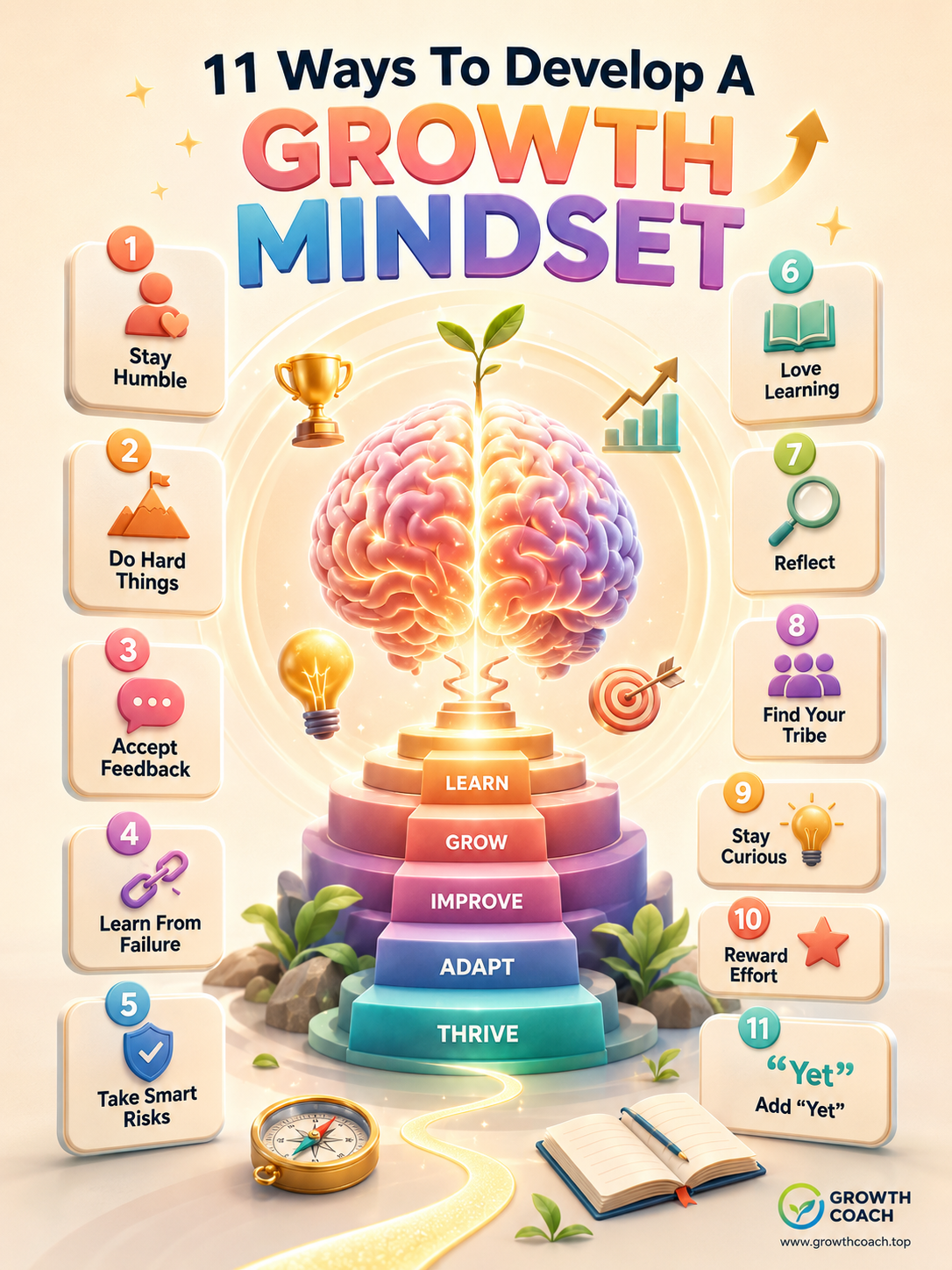
So, you’re asking, ‘How can I actually develop a growth mindset in my daily life?’ Great question! It’s so much more than just plastering on a smile and thinking positively. A true growth mindset is the deep-seated belief that your skills, your intelligence, and your capabilities aren’t fixed. Nope! They can evolve and expand through dedicated effort, continuous learning, and the willingness to adapt. People who consistently achieve growth and progress rarely just wait for motivation to strike. Instead, they actively build habits and patterns that fundamentally change how they react to challenges, bounce back from mistakes, and seize opportunities.
This guide is your toolkit, packed with eleven actionable mindset shifts designed to pave the way for your long-term personal and professional development. Let’s get started on building that unstoppable growth engine!
🚀 1. Embrace Intellectual Humility: The Foundation of Growth
First up on our growth journey is intellectual humility. What does that even mean? Simply put, it’s the profound understanding that your current knowledge, no matter how vast, is incomplete. It’s about acknowledging that there’s always more to learn, more to understand, and more perspectives to consider. This isn’t about feeling less intelligent; it’s about being wise enough to know your limits and open enough to expand them.
Here’s how you can weave intellectual humility into your daily life:
- Stay Open to New Perspectives: Actively seek out viewpoints that differ from your own. Engage in conversations with people who have different backgrounds and experiences. The goal isn’t necessarily to agree, but to understand.
- Welcome Correction Without Defensiveness: When someone offers constructive criticism, try not to immediately jump to your defense. See it as valuable input, a chance to see yourself more clearly. Easier said than done, right? Practice taking a deep breath and saying, “Thank you for that feedback.”
- Replace Certainty with Curiosity: Instead of being absolutely certain about things, cultivate a sense of wonder. Ask yourself, “What if?” or “How else could this work?” Curiosity is the engine of discovery.
- Ask Better Questions: Move beyond superficial questions. Dig deeper. Ask “why” more often. Ask clarifying questions to ensure you truly grasp a concept or situation.
Folks who are constantly evolving understand a fundamental truth: growth truly begins where our assumptions end. When we let go of the need to be ‘right’ all the time, we open ourselves up to incredible learning opportunities.
Why This Mindset Shift Matters
Practicing intellectual humility doesn’t just make you a more pleasant person to be around; it dramatically improves your decision-making. By acknowledging that you don’t have all the answers, you create the mental space needed for genuine learning and deeper understanding. It’s the bedrock upon which all other growth strategies are built.
🔥 2. Tackle the Tough Stuff Consistently: Embrace Discomfort
Let’s be real: comfort rarely sparks transformation. If you’re always staying within your cozy zone, you’re likely missing out on significant growth opportunities. Pushing yourself, even just a little, is where the magic happens. This isn’t about masochism; it’s about strategically stepping outside your comfort zone to expand your capabilities.
Here’s how to make discomfort your ally:
- Choose Challenges That Stretch Your Capability: Look for tasks that feel slightly out of reach but not impossible. Think of it as finding the edge of your current abilities and leaning into it.
- Build Tolerance for Discomfort: Just like building a muscle, you can build your tolerance for challenging situations. Start small. Endure a slightly longer workout, tackle a complex problem for an extra 15 minutes, or speak up in a meeting when you feel nervous.
- Focus on Progress, Not Ease: Shift your internal narrative from “Is this easy?” to “Am I making progress?” Celebrate the small steps forward, even when the overall journey is difficult.
The most profound growth often emerges after repeated exposure to experiences that stretch you. It’s in those moments of struggle that you discover strengths you never knew you had.
Practical Action Step
Commit to setting at least one challenge each week that feels just a little bit beyond your current comfort zone or skill level. It could be learning a new software feature, initiating a conversation with a new colleague, or trying a more complex recipe. The key is consistency.
🎯 3. Harness the Power of Feedback: Your Growth Compass
Think of feedback not as a personal critique, but as invaluable information. It’s data about your performance, your actions, and their impact. It’s absolutely not a judgment of your worth as a person. Learning to receive and act on feedback is one of the most potent accelerators of personal and professional development.
Make feedback work for you:
- Seek Observations from Trusted Sources: Don’t wait for feedback to come to you. Proactively ask mentors, colleagues, or friends whose opinions you respect for their honest observations. Be specific: “How could I have handled that client meeting more effectively?”
- Separate Your Identity from Your Performance: This is crucial. Your performance on a task or project is not a reflection of your inherent value. When you receive feedback, remind yourself: “This is about my actions, not about *who I am*.”
- Convert Insights into Action: The most valuable feedback is the kind that leads to tangible changes. Once you’ve processed the information, identify concrete steps you can take to improve.
People who improve rapidly don’t just receive feedback; they create systems for continuously reviewing and applying it. They see it as a vital part of their growth cycle.
Ask a Better Question
Instead of just asking “How did I do?”, try framing your questions to elicit actionable insights. A powerful question is:
“What is one specific thing I can improve upon based on this?”
This question guides the feedback giver to offer concrete suggestions and focuses your attention on actionable steps.
⚡ 4. Transform Failure into Fuel: The Raw Material of Progress
Here’s a mindset shift that can be a game-changer: Failure is not the opposite of growth; it’s often the raw material for it. Every successful person has experienced setbacks. The difference lies in how they interpret and utilize those experiences. Instead of seeing a failure as an endpoint, view it as a critical data point on your journey.
Reframe your relationship with failure:
- Analyze Outcomes Objectively: When things don’t go as planned, take a step back. What actually happened? Avoid emotional reactions and focus on the facts of the situation.
- Identify Controllable Factors: Within any outcome, there are elements you could control and elements you couldn’t. Focus your energy on understanding what *you* could have done differently.
- Extract Lessons Immediately: Don’t let the sting of failure prevent you from learning. As soon as possible, identify the key takeaways. What did this experience teach you?
Reframe Your Language
This is where language becomes powerful. Instead of telling yourself:
“I failed.”
Try adopting this perspective:
“I collected useful data.” or “This approach didn’t work, so now I know what to try next.”
This subtle linguistic shift can fundamentally alter your emotional response and your willingness to try again.
🎲 5. Take Calculated Risks: Stepping into the Unknown
Meaningful growth inherently involves stepping into the unknown, which means embracing uncertainty. This doesn’t mean being reckless. Calculated risk is about acting with a degree of preparation and foresight, not jumping in blindly. It’s about making informed decisions to move forward even when the outcome isn’t guaranteed.
How to take smarter risks:
- Evaluate Possible Outcomes: Before taking a leap, brainstorm the best-case, worst-case, and most likely scenarios. What are the potential rewards? What are the potential downsides?
- Prepare Recovery Plans: For the potential negative outcomes, think about how you would mitigate them or recover if they occurred. Having a backup plan can significantly reduce anxiety.
- Move Despite Incomplete Certainty: You will rarely, if ever, have 100% certainty. The key is to gather as much relevant information as possible, make the best decision you can with that information, and then act. Don’t let the pursuit of perfect knowledge paralyze you.
Growth rarely flourishes in environments that are perfectly predictable and safe. It thrives when we allow ourselves to venture just beyond the familiar.
📚 6. Cultivate a Deep Love for Learning: Make It Your Identity
For those who consistently grow, learning isn’t just an activity; it’s a core part of their identity. They don’t just learn when they have to; they actively seek out knowledge and new skills because they genuinely enjoy the process. This intrinsic motivation is a powerful driver for continuous improvement.
Nurture your love for learning:
- Read Consistently: Make reading a daily habit. Whether it’s books, articles, or industry reports, expose yourself to new ideas regularly.
- Experiment Frequently: Don’t just read about things; try them out! Apply new concepts, test different approaches, and see what works in practice.
- Build Before Mastering: Don’t get bogged down in trying to perfect every detail before you start. Get a working version or a basic understanding first, then refine. Iteration is key.
- Reflect Regularly: As we’ll discuss more, taking time to think about what you’ve learned and how you’re applying it solidifies the knowledge and sparks further insights.
People who maintain a high level of curiosity tend to adapt much faster to changing circumstances than those who rely solely on their existing expertise.
Build a Dedicated Learning Habit
You don’t need hours each day. Even committing just 20 focused minutes daily to exploring something new – a skill, a topic, a concept – can create significant momentum over time.
🔍 7. Reflect on Your Journey: Turn Experience into Insight
Reflection is the crucial bridge that transforms raw experience into actionable improvement. Without it, simply repeating actions can lead to stagnation rather than growth. It’s like going through the motions without understanding *why* you’re doing them or *how* they could be done better.
Make reflection a habit:
- Review Your Weekly Wins: At the end of each week, take a few minutes to acknowledge what went well. This builds confidence and reinforces positive behaviors.
- Notice Recurring Mistakes: Be honest with yourself. Are there patterns in the challenges you face or the errors you make? Identifying these is the first step to breaking them.
- Define One Improvement Action: Based on your wins and your mistakes, decide on one specific, concrete action you will take to improve in the coming week.
Key Reflection Questions
To guide your reflection, consider these questions:
- What worked well, and why?
- What didn’t work as expected, and what were the contributing factors?
- What specific changes will I make moving forward based on this experience?
This process turns passive experience into active learning.
🤝 8. Find Your Tribe: Surround Yourself with Growth-Minded People
Your environment profoundly shapes your thinking. The people you spend time with, the communities you engage with – they all influence your beliefs, your standards, and your aspirations. We naturally absorb the attitudes and expectations of those around us.
Curate your circle intentionally:
- Build Relationships with Ambitious People: Seek out individuals who are driven, passionate, and focused on their own growth. Their energy can be contagious.
- Join Communities of Builders and Learners: Whether online or in-person, find groups dedicated to learning, creating, and supporting each other’s development.
- Exchange Ideas Regularly: Make it a point to discuss your goals, challenges, and insights with your network. Hearing different perspectives can spark new solutions and provide encouragement.
The right environment doesn’t just provide support; it raises your expectations and expands your sense of what’s possible for yourself.
🌍 9. Stay Curious Like a Child: The Engine of Discovery
Remember when you were a kid, constantly asking “Why?” That childlike curiosity is a powerful engine for discovery. Children learn at an astonishing rate precisely because they approach the world with an open mind, experimenting without the crippling fear of judgment or failure.
Rekindle your curiosity:
- Ask More Questions: Don’t be afraid to admit what you don’t know. Frame questions not from a place of ignorance, but from a place of genuine interest in understanding.
- Explore Unfamiliar Subjects: Step outside your usual areas of interest. Read a book on a topic you know nothing about, watch a documentary on a foreign culture, or try a hobby completely unrelated to your work.
- Stay Interested Instead of Appearing Knowledgeable: The goal isn’t to impress others with what you already know, but to expand your understanding by being open to learning new things.
The Curiosity Rule
A simple guiding principle: Spend less time trying to prove you know things, and more time exploring the vast world of what you don’t know.
🏆 10. Reward Effort, Not Just Outcomes: Celebrate the Process
While results are important, they aren’t the whole story. Focusing solely on outcomes can be demotivating, especially during challenging periods. It can lead you to give up if the desired result isn’t immediate. Instead, shift your focus to celebrating and rewarding the effort you put in.
Shift your reward system:
- Celebrate Preparation: Acknowledge the time and energy spent planning, researching, and getting ready for a task.
- Recognize Persistence: When you encounter obstacles but keep pushing forward, that persistence deserves recognition.
- Measure Habits: Track the consistent actions you’re taking (e.g., “Did I practice for 30 minutes today?”) rather than just the final score.
Effort compounds over time. The consistent actions you take, even if small, build the foundation for stronger, more sustainable performance and eventual success.
A Clear Example
Instead of only celebrating:
Perfect execution.
Consider rewarding:
Completed practice sessions.
This encourages showing up and putting in the work, which is the precursor to perfection.
💬 11. Master the Power of “Yet”: Unlock Potential with Language
Our language profoundly influences our thoughts and actions. One of the simplest yet most powerful tools for cultivating a growth mindset is the addition of a single word: “yet”. This small word injects possibility and frames current limitations as temporary.
Transform your thinking with “yet”:
Instead of saying:
❌ “I can’t do this.”
Reframe it as:
✅ “I can’t do this yet.”
Or instead of:
❌ “This is too hard.”
Try:
✅ “This is too hard right now.”
This tiny linguistic shift creates an immediate sense of momentum. It implies that with time, effort, and learning, the situation can change. It transforms a statement of finality into an invitation for development.
🌟 Putting It All Together: Your Growth Mindset Blueprint
It’s crucial to understand that a growth mindset isn’t a fixed personality trait you’re born with or without. It’s a collection of conscious choices, repeated consistently over time. It’s a practice, a way of approaching life’s inevitable ups and downs.
Here’s a quick recap of the core principles:
- Develop Humility: Acknowledge what you don’t know.
- Seek Challenge: Step outside your comfort zone.
- Learn Continuously: Make learning a lifelong pursuit.
- Stay Curious: Ask questions and explore.
- Reward Effort: Value the process as much as the outcome.
- Embrace Feedback: See it as data, not judgment.
- Reframe Failure: Use setbacks as learning opportunities.
- Take Calculated Risks: Move forward with informed courage.
- Reflect Regularly: Turn experience into insight.
- Find Your Tribe: Surround yourself with supportive, growth-oriented people.
- Use “Yet”: Frame limitations as temporary.
These small shifts, practiced consistently, are the building blocks for extraordinary outcomes. Your future capabilities aren’t predetermined; they are actively built, day by day, choice by choice.
❓ Frequently Asked Questions About Growth Mindset
What exactly is a growth mindset?
A growth mindset is the fundamental belief that your abilities, intelligence, and talents can be developed through dedication, hard work, learning, and persistence. It’s the opposite of a fixed mindset, which assumes these qualities are innate and unchangeable.
Can literally anyone develop a growth mindset?
Absolutely! The beauty of a growth mindset is that it’s learned. While some people might naturally lean towards it, consistent habits, intentional learning strategies, and conscious effort can help anyone cultivate a stronger growth mindset over time.
How long does it typically take to change your mindset?
Mindset development is a gradual process, much like building any other skill or habit. It unfolds through repeated actions, consistent reflection, and the ongoing practice of these growth-oriented strategies. There’s no set timeline; it’s a continuous journey of improvement.
Why is seeking and receiving feedback so crucial for growth?
Feedback is like a mirror reflecting your blind spots and areas for improvement. It provides essential data that you might not be able to see on your own. By actively seeking and thoughtfully applying feedback, you can significantly accelerate your learning curve and make more targeted improvements.
If I could only adopt one habit to boost my growth the fastest, what would it be?
While all these strategies are powerful, a combination of daily learning (even just 20 minutes!) coupled with consistent, structured reflection is arguably the most potent duo for rapid growth. Learning provides new input, and reflection ensures you integrate and apply it effectively, creating a virtuous cycle of development.