The Art of Navigating High-Stakes Workplace Dialogue
We have all been there: the moment tension hits its peak in a meeting, a project deadline is missed, or a stakeholder pushes back on your vision. These moments, while uncomfortable, are the crucible of professional growth. The way you handle these difficult conversations defines your leadership trajectory. When emotions run high, most people default to a reactive state—defending their ego or attacking the other person. However, truly elite professionals use behavioral science to flip the script, turning potential conflict into a collaborative breakthrough.

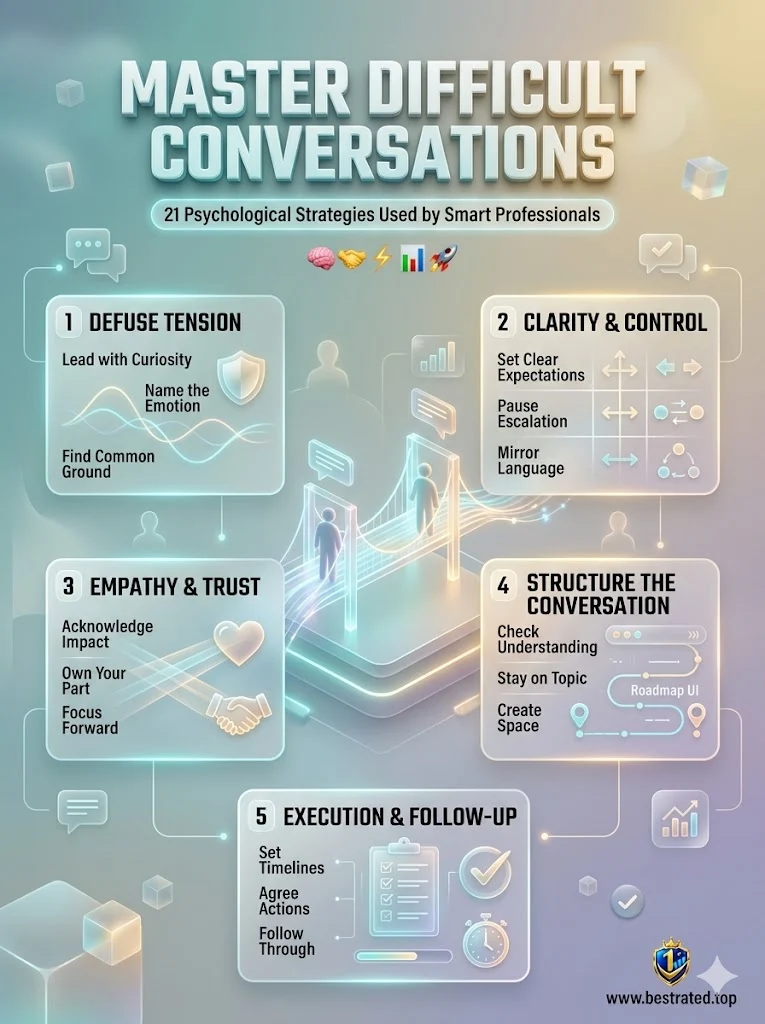
In this guide, we aren’t just talking about “staying calm.” We are diving into 21 specific, actionable, and psychological tactics that help you master the corporate landscape. Whether you are a manager dealing with a toxic team dynamic or an individual contributor navigating a performance review, these strategies will help you move from a reactive, defensive posture to a proactive, solution-oriented leader.
Phase 1: Neutralizing the Initial Tension
The first 60 seconds of a difficult conversation are critical. If you start with an accusation, you lose. If you start with curiosity, you gain control. Here is how to set the stage for success.
1. Lead with Curiosity
Instead of saying “You missed this deadline,” try “I noticed the timeline shifted; walk me through the challenges you’re facing.” By asking open-ended questions, you lower the other person’s defensive wall. You aren’t attacking; you are investigating.
2. Name the Energy
When you feel the tension in the room, don’t ignore it. That only makes it grow. Acknowledge it directly: “I can sense there is some frustration regarding this project; let’s put that on the table so we can resolve it.” This acts as a pressure release valve.
3. Establish Common Ground
Remind the other party that you are on the same team. “We both want this launch to be successful.” This simple alignment shifts the conversation from “Me vs. You” to “Us vs. The Problem.”
Phase 2: The Architecture of Clarity
Once the initial heat has dissipated, you need to build a structure that prevents the conversation from spiraling back into emotional chaos.
4. Set Clear Expectations
Ambiguity is the enemy of productivity. Clearly define what a successful outcome looks like for both sides. Use phrases like, “My goal here is to ensure we are aligned on the new project scope. What is your primary goal for this discussion?”
5. Use the Strategic Pause
If you feel yourself getting angry or the other person is becoming irrational, take a break. A quick “Let’s take a five-minute reset so we can approach this with fresh eyes” is not a sign of weakness; it’s a sign of emotional intelligence.
6. Mirror Their Language
People feel heard when they hear their own words reflected back. If they use the word “bottleneck,” use the word “bottleneck.” It creates an instant subconscious rapport that signals you are on the same page.
Phase 3: Empathy as a Tactical Tool
Empathy isn’t just about being ‘nice.’ It’s about understanding the other person’s reality so you can better navigate the negotiation.
7. Acknowledge the Impact
When you tell someone, “I understand how these changes have impacted your current workflow,” you disarm them. You aren’t necessarily agreeing with them, but you are acknowledging their experience.
8. Own Your Part
Nothing builds trust faster than taking responsibility. If you contributed to the friction, say so. “I realize my communication on this was unclear, and I take responsibility for that.” This forces the other person to lower their guard.
9. Focus on the Future
Don’t dwell on who messed up in the past. That leads to circular arguments. Instead, ask, “How do we ensure this doesn’t happen again in the next sprint?” This keeps the conversation moving forward.
Phase 4: Maintaining Control of the Conversation
Difficult conversations often suffer from “scope creep.” Here is how to keep the meeting on track.
10. Check for Understanding
Periodically say, “Let me pause and make sure I’m understanding you correctly. Are you saying that X is the issue?” This stops misunderstandings before they turn into full-blown conflicts.
11. Create Space
Sometimes, the best answer is “I need time to think about this.” Never feel pressured to reach a final decision in a heated moment.
12. Stay on Topic
If the other person tries to bring up an issue from six months ago, gently re-center them: “I understand that’s a frustration, but let’s focus on the issue at hand right now so we can get this resolved today.”
Phase 5: Transitioning to Collaborative Design
You don’t want to win the argument; you want to win the outcome. That requires the other person to be invested in the solution.
13. Express Confidence
Reinforce the relationship. “I know we have the talent to solve this, and I value your input on how we get there.”
14. Share the Context
People don’t resist change; they resist being left in the dark. Explain the ‘why’ behind your decisions. Transparency is the antidote to resentment.
15. Invite Solutions
Instead of telling them what to do, ask them for their ideas. “What do you think is the best way to handle this moving forward?” When they own the solution, they are much more likely to follow through.
Phase 6: Execution and Accountability
A conversation without a follow-up is just talk. Here is how to lock in the resolution.
16. Set Precise Timelines
“By when can we expect this to be completed?” Always set a specific date and time for the follow-up.
17. Validate Their Concerns
Even after a solution is reached, ask: “What do you see as a potential risk to this plan?” This helps you catch problems before they happen.
18. Stay Factual
When reviewing performance or progress, stick to the data. “The data shows we have a 10% gap in performance.” It’s hard to argue with facts; it’s very easy to argue with opinions.
19. Close with Clear Action Items
End the meeting by summarizing. “So, I will handle X, you will handle Y, and we will reconvene on Friday at 2 PM. Does that sound right?”
20. Follow Through
Your reputation is built on your follow-through. If you promised an email or a resource, send it immediately after the meeting. It proves you are reliable.
21. Document the Growth
Treat every conflict as a case study. What did we learn? How can we change our process to avoid this in the future? This turns a “difficult conversation” into a “system improvement.”
By mastering these 21 strategies, you move from being a manager who reacts to problems to a leader who designs solutions. Start small, pick one or two of these tactics to try in your next meeting, and watch how the dynamic of your team begins to shift. Professional communication isn’t about being perfect; it’s about being prepared and intentional.