Ever wondered which bones break most often? It’s a question that touches on everything from our daily activities and lifestyle choices to the way our bodies age and how strong our bones truly are. Broken bones, or fractures, are incredibly common worldwide, affecting people of all ages and backgrounds. By diving into the global patterns of bone fractures, especially using data from 2019, we can uncover fascinating insights into injury risks, sex-based differences, and the growing concern of hip fractures in older women. Plus, we’ll explore how an aging and growing global population means more fractures overall, even if the risk per person isn’t skyrocketing. From your lower leg and forearm to your skull, face, and hips, the way bones break tells a story. In this deep dive, we’ll not only look at the numbers but also equip you with practical, actionable strategies for better bone health, fall prevention, safer environments, and getting the timely healthcare you need to keep your skeletal system strong and resilient. Let’s get started on understanding and preventing these common injuries! 🧠

Unpacking Global Bone Fracture Patterns: What the Numbers Tell Us
First things first, what exactly is a fracture? Simply put, it’s when a bone cracks or breaks completely. This usually happens when the force applied to the bone is stronger than the bone itself can handle. Think about it: a sudden fall, a rough sports tackle, a car accident, a workplace mishap, or even just a direct blow can lead to a fracture. Sometimes, underlying conditions that weaken bones can make them more susceptible to breaking, even from minor impacts.
Globally, broken bones are a significant public health issue. Looking at the 2019 estimates, it’s clear that millions of fractures occur across various parts of the skeleton every single year. These aren’t isolated incidents affecting just one type of person; they span all age groups, genders, and activity levels. The data really highlights that fractures are a widespread concern, impacting communities worldwide.
What’s really interesting is how these global patterns emerge. It’s not just about how often people get injured. The total number of fractures we see in a population is a complex mix of factors. We need to consider the sheer size of the population, its age makeup (are there more young people or more older adults?), how active people are, their exposure to risks like traffic accidents or dangerous jobs, how strong their bones are naturally, and, crucially, how easy it is for them to access healthcare when something goes wrong. All these elements weave together to create the global fracture landscape we observe.
Why Should We Care About Fracture Patterns?
Understanding these patterns is super important for so many people. For healthcare professionals, it helps in anticipating common injuries and planning resources. For policymakers, it can guide public health initiatives and safety regulations. Athletes and coaches can use this knowledge to focus on injury prevention strategies. For older adults and their families, it sheds light on specific risks like falls and the importance of bone health. Essentially, knowing where and why bones break most often gives us valuable clues about how to prevent it from happening in the first place.
Moreover, fracture statistics offer a window into broader societal trends. For instance, if the total number of fractures goes up, it doesn’t automatically mean that *your* personal risk of breaking a bone has increased. Sometimes, an increase in total fractures can be driven by simple population growth – more people means more potential injuries. Similarly, an aging population means a larger segment of people are in age groups where certain types of fractures, especially those related to bone weakening, are more common. So, while age-standardized rates (which adjust for population age structure) might show a slight decrease or stay stable, the overall number of fractures requiring medical attention can still climb. This is a critical distinction for public health planning and resource allocation.
📈 Tracking the Most Commonly Fractured Bones Around the Globe
Let’s get down to the nitty-gritty. The 2019 global estimates paint a clear picture of where fractures are most prevalent. We’re talking about millions of cases at several key skeletal sites each year. It’s not just one or two bones that are commonly affected; the numbers span a range of locations, each with its own story.
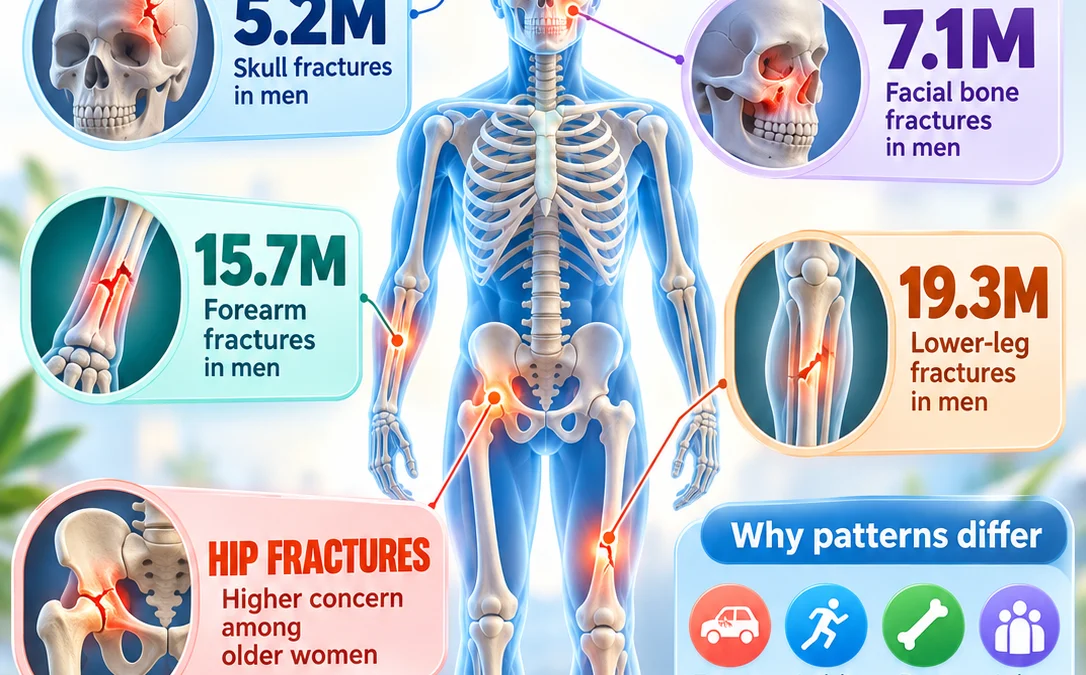
One of the most frequently cited areas for fractures is the lower leg. The data shows a significant number of these injuries, with estimates around 19.3 million fractures occurring in men compared to 13.4 million in women. This is a substantial figure and points to the high impact and stress this part of the body endures.
Moving up the body, forearm fractures are another major category. These injuries are quite common, affecting both sexes significantly. The estimates show approximately 15.7 million cases in men and a very close 15.0 million cases in women. This near-parity suggests that forearm fractures might be linked to a broader range of activities and potential accidents affecting both genders fairly equally.
When we look at the skull, a more pronounced sex difference emerges in the estimates, with approximately 5.2 million fractures in men versus 2.4 million in women. This could be related to differences in exposure to head trauma, perhaps from certain sports, occupational risks, or traffic accidents.
Similarly, facial bone fractures also show a notable gap between the sexes, with around 7.1 million cases reported in men compared to 3.5 million in women. Again, this suggests that factors related to trauma exposure, potentially including interpersonal violence or specific types of accidents, might play a role in these higher numbers among men.
It’s really important to remember that these figures represent large-scale population estimates. They help us understand general trends and identify high-risk areas or demographics. They are not a crystal ball predicting your personal risk. Different fractures have vastly different causes, ranging from minor falls to severe trauma. The severity, the treatment required, and the long-term impact can vary dramatically depending on which bone is broken and how it happened.
👨🦱 Why Do Men Seem to Experience More Fractures at Many Sites?
The data consistently points to men experiencing a higher number of fractures across a wide array of skeletal sites. What could be behind this pattern? Several interconnected factors likely contribute.
One significant reason is often related to exposure to higher-risk activities and trauma. Think about common scenarios: contact sports like football or rugby, physically demanding occupations (construction, mining, etc.), higher rates of motorcycle or bicycle use in certain regions, and potentially more engagement in riskier behaviors. These activities and environments inherently increase the opportunities for traumatic injuries that can lead to fractures.
Trauma exposure is a key concept here. A fracture isn’t just about how strong your bones are; it’s very much about the external forces acting upon them. The circumstances surrounding an accident – the speed of impact, the angle of the fall, whether protective measures were in place – all significantly influence whether a bone breaks and where the fracture occurs. Men, due to lifestyle and occupational factors, might encounter more situations where high-impact trauma is a possibility.
Of course, bone health itself is a critical component. While men might have higher rates of traumatic fractures, bone density and strength play a role in how easily a bone breaks. However, the observed sex differences in many fracture types seem to be more strongly linked to external factors rather than solely inherent bone weakness across the board. Stronger bones can indeed withstand more mechanical stress, but even the strongest bone can fracture under sufficient force.
It’s vital to add a caveat: these are population-level trends. This doesn’t mean every man is destined to break more bones than every woman. Individual risk is a complex equation. Age, specific job roles, personal activity levels (even within a sex), a history of previous injuries, underlying bone conditions like osteoporosis, medications, and even the specific environment someone lives and works in – all these play a massive role. So, while the statistics show a general trend, individual experiences can vary widely.
👩 Why Are Hip Fractures So Much More Common in Women?
Here’s where the pattern shifts dramatically. Hip fractures are a notable exception to the general trend of men experiencing more fractures. The data consistently highlights that hip fractures become particularly prevalent and concerning among women, especially as they get older. This isn’t a minor difference; it’s a significant public health concern with profound implications for quality of life.
A primary driver of this difference is the hormonal changes women experience, particularly the decline in estrogen levels following menopause. Estrogen plays a crucial role in maintaining bone health throughout a woman’s life. It helps regulate the balance of bone remodeling – the ongoing process where old bone is broken down and new bone is formed. When estrogen levels drop significantly, this balance can be disrupted, leading to accelerated bone loss in many women.
This accelerated bone loss can contribute to the development of osteoporosis. Osteoporosis is a condition characterized by weakened, brittle bones that are much more susceptible to fractures, even from relatively minor stresses like a simple fall. This makes women, particularly post-menopausal women, significantly more vulnerable to hip fractures.
The risk is compounded by the natural aging process. As people age, regardless of sex, muscle strength can decrease, balance may become less stable, vision can decline, and reaction times might slow down. All these factors increase the likelihood of experiencing a fall. For a woman with reduced bone density due to menopause-related hormonal changes, a fall that might result in a bruise for a younger person could easily lead to a serious hip fracture.
Hip fractures are particularly serious because they often require surgery, lengthy rehabilitation, and can lead to a significant loss of mobility, independence, and overall health in older adults. They carry a higher risk of complications and mortality compared to many other types of fractures. This is why focusing on hip fracture prevention in older women is such a critical aspect of geriatric care and public health strategy.
The Intimate Connection Between Menopause and Bone Health
Let’s delve a bit deeper into the menopause-bone health link. Our bones are living tissues, constantly undergoing a process called remodeling. Think of it like a continuous cycle of renewal. Specialized cells called osteoclasts break down old bone tissue, and other cells called osteoblasts build new bone to replace it. This process is essential for repairing micro-damage and maintaining bone strength and mineral content.
Hormones, especially estrogen, play a vital role in orchestrating this remodeling process. Estrogen helps to slow down the rate at which bone is broken down by osteoclasts. After menopause, when estrogen production significantly decreases, the activity of osteoclasts is no longer as effectively regulated. This leads to a faster rate of bone resorption (breakdown) compared to bone formation. The result is a net loss of bone mass and density.
It’s crucial to understand that not every woman will develop severe osteoporosis or suffer a hip fracture after menopause. Genetics, lifestyle, nutrition, and other health factors all play a part. However, the hormonal shift undeniably increases the *risk* for many women. This underscores the importance of proactive bone health management, including regular check-ups, lifestyle adjustments, and potentially medical interventions, for women as they approach and move through menopause. It’s about building resilience *before* fragility sets in.
👴 How an Aging and Growing Population is Reshaping the Fracture Landscape
One of the most profound takeaways from global fracture data is the distinction between age-standardized fracture rates and the absolute total number of fractures. This is a crucial concept for understanding future healthcare needs.
Interestingly, according to the trends suggested by the mindmap data, age-standardized fracture rates (which account for the age structure of the population) have seen a slight decline since around 1990 in many regions. This might suggest improvements in safety, awareness, or healthcare for specific age groups. However, this positive trend in *rates* can be overshadowed by an increase in the total number of fractures occurring globally.
So, why does the total number keep climbing if rates are stable or falling? It boils down to two major demographic shifts: population growth and population aging.
Firstly, there are simply more people on the planet than ever before. More people naturally means more potential for injuries, including fractures. Even if the likelihood of a fracture within any given age group remains the same or decreases slightly, a larger pool of individuals means a higher absolute number of fractures will occur.
Secondly, and perhaps more impactful for certain types of fractures, is the phenomenon of population aging. Globally, people are living longer, and a larger proportion of the population is now in older age groups. Older adults are at a significantly higher risk for certain fractures, particularly fragility fractures (those resulting from low-impact falls due to weakened bones). As the ‘baby boomer’ generations age, the number of individuals in the highest-risk age brackets for conditions like osteoporosis and hip fractures is growing substantially.
This demographic shift presents a significant challenge for healthcare systems worldwide. Even if medical interventions and prevention strategies become more effective (leading to lower rates within specific age cohorts), the sheer increase in the number of older adults means that healthcare providers may still face a rising tide of fracture cases. This necessitates a proactive approach to prevention, focusing on the factors that contribute to fractures in these vulnerable populations.
Therefore, the focus on prevention becomes paramount. Strategies aimed at reducing falls among seniors, maintaining bone strength through lifestyle and medical management, promoting safe physical activity, and ensuring timely access to care are not just good public health practices; they are essential for managing the future burden of fractures in an aging world. Investing in these preventative measures can help mitigate the increasing demands on healthcare resources and, more importantly, help individuals maintain their health, mobility, and independence as they age.
🛡️ Proactive Fracture Prevention: It Starts Long Before an Injury
Thinking about fracture prevention shouldn’t just be about what to do *after* an accident. True prevention is a holistic approach that focuses on building and maintaining your body’s resilience and creating a safer environment. It’s about strengthening your defenses against potential harm.
Regular physical activity is a cornerstone of bone and muscle health. Engaging in weight-bearing exercises (like walking, jogging, dancing) and resistance training (using weights or resistance bands) helps to strengthen bones and muscles. Stronger muscles improve balance and coordination, which are critical for preventing falls. It’s about finding activities you enjoy and can sustain safely.
Fall prevention is particularly crucial for older adults, but beneficial for everyone. This involves a multi-faceted approach: improving balance through specific exercises (like Tai Chi), strengthening leg muscles, getting regular eye check-ups to ensure good vision, and making sure any necessary corrective lenses are up-to-date. Promptly addressing any issues with dizziness or medication side effects that could affect balance is also key.
Creating safer surroundings is about minimizing environmental hazards that can lead to falls. This includes ensuring walkways are clear of clutter, improving lighting in all areas of the home (especially stairs and hallways), installing grab bars in bathrooms, using non-slip mats on wet surfaces, and wearing supportive, well-fitting footwear. Simple home modifications can make a huge difference in reducing accidental falls.
Bone health assessment might be a wise step for individuals with known risk factors for osteoporosis or fragility fractures. This could include a family history of osteoporosis, previous fractures, certain medical conditions, or long-term use of specific medications. A healthcare provider can assess your individual risk and recommend appropriate screening, such as a bone density scan (DEXA scan), if necessary.
Don’t underestimate the power of adequate nutrition. Your skeletal system needs the right building blocks to stay strong. Ensuring you get enough calcium (essential for bone structure) and Vitamin D (crucial for calcium absorption) is vital. Protein is also important for muscle and bone health. A balanced diet rich in fruits, vegetables, lean proteins, and dairy or fortified alternatives provides the nutrients your body needs for optimal skeletal maintenance.
Finally, adopting healthy lifestyle choices can significantly impact long-term bone health. Smoking is detrimental to bone density and healing. Excessive alcohol consumption can interfere with calcium absorption and bone formation. Maintaining a healthy weight and avoiding extreme dieting also supports overall skeletal well-being. These are all interconnected factors that contribute to a stronger, more resilient body.
🧠 What Do These Global Fracture Differences *Really* Tell Us?
When we look at the global picture of fractures, it’s clear that a single statistic or reason can’t explain everything. These patterns are shaped by a complex interplay of factors that vary significantly between populations and individuals. Let’s break down what these differences are really telling us:
Physical Activity Levels and Types: Different cultures and communities engage in vastly different types and intensities of physical activity. Some involve high-impact sports, others focus on manual labor, and some are more sedentary. This directly influences the types of stresses our bodies are exposed to and the likelihood of both traumatic injuries and stress-related issues.
Exposure to Trauma: This is a huge one. Road traffic accidents are a major source of fractures globally, and their incidence varies wildly depending on infrastructure, traffic laws, vehicle safety standards, and driver behavior. Workplace safety regulations and the prevalence of hazardous industries also play a role. Exposure to environmental hazards or even higher rates of interpersonal violence in certain areas can also contribute to fracture statistics.
Underlying Bone Health: While external trauma is a major cause, the intrinsic strength of bones is critical. Factors like genetics, nutrition (calcium, vitamin D intake), hormonal status (like menopause in women), and the prevalence of conditions like osteoporosis or osteomalacia significantly affect whether a given impact will result in a fracture. Populations with higher rates of bone-weakening conditions will naturally see more fractures, especially fragility fractures.
Access to and Quality of Healthcare: The ability to accurately diagnose, record, and treat fractures can differ dramatically. In regions with limited access to medical facilities or diagnostic tools like X-rays, fractures might go undiagnosed or unreported, skewing statistics. The quality of care also impacts outcomes and recovery, influencing long-term health and subsequent fracture risk.
Demographic Structure (Age and Sex): As we’ve discussed, the age distribution and sex composition of a population are key determinants. A country with a large elderly population will inevitably have a different fracture profile (more fragility fractures) than a very young population (more traumatic fractures from accidents and sports). Sex differences in lifestyle, occupation, and hormonal health also create distinct patterns.
These interconnected factors highlight why a one-size-fits-all approach to understanding fracture risk is impossible. Global estimates are invaluable for identifying broad trends, understanding public health challenges, and directing resources. However, when it comes to assessing an individual’s risk or developing targeted prevention strategies, a much more personalized approach is needed, taking into account their specific circumstances, health history, and lifestyle.
🚨 When a Suspected Fracture Needs Immediate Medical Attention
While prevention is key, knowing when to seek professional help is critical. If you suspect a fracture, it’s always best to get it checked out by a medical professional. Certain signs and symptoms warrant immediate medical evaluation, especially if they are severe.
You should seek medical attention if you experience:
- Severe pain that doesn’t subside
- Significant swelling or bruising around the injured area
- Obvious deformity of the limb or bone
- Inability to move the affected limb or bear weight on it
- Numbness or tingling in the injured area
- A bone that appears to be sticking out through the skin (an open or compound fracture)
Emergency medical care (calling 911 or your local emergency number) is particularly important if the injury involves:
- Uncontrolled bleeding
- Signs of poor circulation (e.g., pale or bluish skin, coldness in the extremity)
- A suspected head, neck, or back injury
- A possible fracture in a child
What to do while waiting for help:
- Immobilize the injured area: Try to keep the injured limb as still as possible. Avoid moving it unnecessarily.
- Do NOT try to straighten or manipulate a suspected fracture. Forcing a broken bone back into place can cause further damage to nerves, blood vessels, and surrounding tissues.
- Control bleeding: If there is an open wound, apply gentle pressure with a clean cloth or sterile dressing.
- Apply cold packs: Wrapping ice or a cold pack in a cloth and applying it to the injured area can help reduce swelling and pain.
Once you receive medical attention, diagnosis will likely involve a physical examination and imaging tests, such as X-rays, CT scans, or MRIs, to confirm the fracture and assess its severity. Treatment varies widely depending on the type and location of the fracture and can range from simple immobilization (casts, splints) to complex surgical procedures, pain management, and extensive rehabilitation.
🌱 Cultivating a Fracture-Prevention Mindset for Lifelong Health
The global fracture data, with all its complexities, ultimately points to a simple yet powerful principle: preventing fractures is an ongoing, proactive effort. It’s not just about reacting to injuries; it’s about building a body and environment that are inherently more resilient.
Think of it as a multi-layered defense system:
- Stronger Bones: Through good nutrition (calcium, Vitamin D), healthy lifestyle choices (no smoking, moderate alcohol), and potentially medical management for bone density issues, we build a stronger skeletal foundation that’s less likely to break under stress.
- Stronger Muscles: Regular exercise, particularly strength training and balance exercises, provides better support for our joints and bones, improving stability and reducing the impact of falls.
- Better Balance: Specific exercises and addressing sensory impairments (like vision) can significantly reduce the frequency and severity of falls, which are a primary cause of many fractures.
- Safer Environments: Modifying our homes and surroundings to remove tripping hazards, improve lighting, and add safety features like handrails can prevent a vast number of accidental injuries.
- Timely Healthcare: Regular check-ups, bone density screenings when indicated, and prompt medical evaluation for any suspected fracture ensure that issues are identified and managed effectively, preventing minor problems from escalating.
As our global population continues to age, the importance of fracture prevention will only grow. Maintaining mobility, independence, and a high quality of life in our later years often hinges on our ability to stay free from debilitating fractures. By adopting a fracture-prevention mindset today, we invest in a healthier, more active future for ourselves and our communities.
Conclusion
So, what’s the big picture when we look at global fracture patterns? It’s a fascinating tapestry woven from threads of physical activity, trauma exposure, the inherent strength of our bones, the influence of sex and aging, and the changing demographics of our world. The 2019 estimates we’ve explored show that millions of fractures occur annually across major bones, and importantly, there are distinct differences in these patterns between men and women.
We’ve seen that hip fractures are a particularly significant concern for older women, largely due to the hormonal shifts associated with menopause that can accelerate bone loss, combined with the increased risk of falls that comes with aging. On the other hand, the higher rates of fractures in men across many other skeletal sites highlight the impact of different types of trauma exposure and activity-related risks. Understanding these variations is key to developing targeted prevention and treatment strategies.
Ultimately, the most effective way to combat fractures is through a proactive, holistic approach. This means prioritizing the maintenance of healthy bones through good nutrition and lifestyle choices, building strength and improving balance through regular exercise, actively working to reduce fall hazards in our environments, practicing general safety awareness, and, crucially, seeking prompt medical assessment whenever a fracture is suspected. As populations age worldwide, these preventative measures become not just beneficial, but essential for preserving independence, mobility, and overall well-being.