The Art of Command: Why Public Speaking is Your Ultimate Superpower
Public speaking used to be reserved for podiums and auditoriums. Today, it’s the cornerstone of your professional and personal brand. Whether you are leading a high-stakes Zoom meeting, pitching an idea to investors, navigating a job interview, or building a following as a content creator, your ability to communicate effectively is the single greatest multiplier of your success. Yet, most people approach speaking with the wrong mindset. They focus on scripts, slides, and perfect grammar, completely ignoring the psychological levers that actually drive human engagement.

In this guide, we are going to pull back the curtain on the hidden principles of elite communication. We aren’t talking about basic tips like “make eye contact.” We are diving into the neuroscience of attention, the psychology of body language, and the architectural hacks that make your words impossible to ignore. If you have ever wondered why some speakers hold a room in the palm of their hand while others struggle to keep people awake, the answer lies in these seven unspoken rules.
The 7 Unspoken Rules That Separate the Pros from the Amateurs
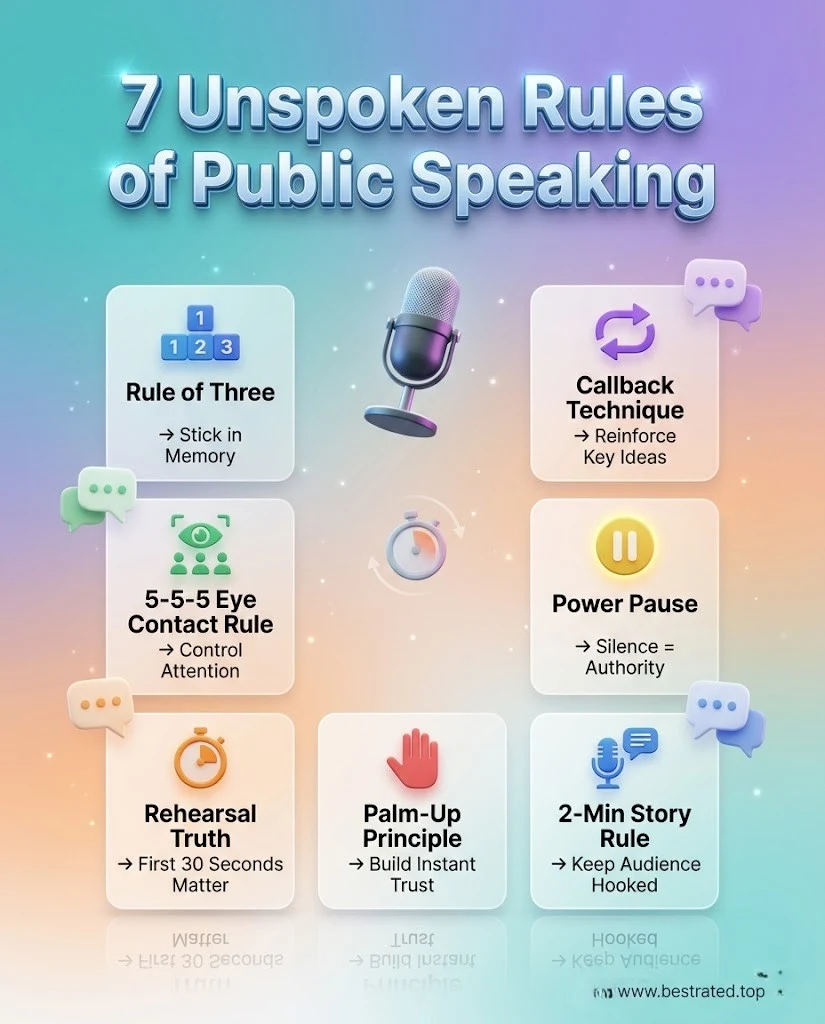
1. The Rule of Three: The Brain’s Favorite Pattern
The human brain is a pattern-seeking machine. When you give an audience ten points to remember, they remember zero. When you give them three, they remember all of them. This is the “Rule of Three.” It is the golden ratio of communication. By structuring your ideas into groups of three, you provide the brain with a digestible cognitive load that feels complete and satisfying.
Think about how you can apply this to your next presentation:
- The Logical Flow: Problem, Solution, Implementation.
- The Narrative Arc: Past (The Struggle), Present (The Pivot), Future (The Vision).
- The Persuasive Hook: The Hook (Grab attention), The Insight (Provide value), The Call to Action (Drive change).
By limiting yourself to three core pillars, you force yourself to be concise and impactful, which is exactly what modern audiences crave.
2. The Callback Technique: Creating Narrative Loops
Have you ever noticed how great comedians or keynote speakers reference a joke or a story from the very beginning of their talk near the end? That is the “Callback.” It is a psychological masterclass in memory reinforcement. When you “call back” to an earlier point, you create a cognitive loop. It signals to the audience that your speech is a cohesive, well-crafted journey rather than a random collection of thoughts.
3. The 5-5-5 Rule: Mastering Visual Engagement
Anxiety in public speaking often comes from feeling like you have to “look at everyone.” This leads to the “lighthouse effect,” where the speaker scans the room nervously. The 5-5-5 rule solves this. Spend 5 seconds of direct, meaningful eye contact with one person or one small section of the room. Then, shift your gaze to another section for 5 seconds. Then, take 5 seconds to pause or reset your posture. This makes your engagement feel intentional, grounded, and deeply personal to every member of the audience.
4. The Power Pause: Silence as a Weapon
Most novice speakers are terrified of silence. They fill every gap with “um,” “ah,” or rapid-fire chatter. But silence is your greatest tool for authority. The “Power Pause” is the deliberate, calculated silence you use before delivering a punchline, after a profound statement, or when transitioning between topics. Silence commands attention. It signals that you are comfortable, confident, and in total control of the room. Don’t fear the void; use it to let your words sink in.
5. The Rehearsal Trap: Focus on the Opening
Most people practice their whole speech from beginning to end, but they fail to realize that the most critical 30 seconds are the first 30. If you don’t hook your audience immediately, you’ve lost them for the duration. Practice your opening until it is reflexive. Your tone, your body language, and your first sentence should be polished, punchy, and purpose-driven.
6. The Palm-Up Principle: The Psychology of Trust
Your hands tell a story before you even speak. Pointing fingers, clenched fists, or hiding your hands in your pockets can signal aggression, defensiveness, or nervousness. The “Palm-Up Principle” is the secret to appearing approachable and authoritative simultaneously. When you gesture with open palms, you are subconsciously telling the audience, “I have nothing to hide, and I am here to share value.” It lowers the audience’s natural defenses and builds immediate trust.
7. Movement with Meaning
Don’t pace like a caged animal. Every move you make on stage (or on camera) should have a purpose. Move forward when you are sharing a crucial insight or a call to action. Stay anchored when you are delivering emotional, heavy content. Shift your position only when you are signaling a transition to a new topic. This creates a visual “chaptering” effect that helps your audience follow the structure of your presentation.
The 2-Minute Story Rule: Master the Micro-Narrative
In an era of short-form video and rapid-fire content, long-winded stories are the fastest way to lose an audience. The “2-Minute Story Rule” is your guardrail against rambling. If you can’t get to the point within 120 seconds, you are losing your listener’s attention. To master this, treat your stories like a screenplay:
- The Setup (30 seconds): Who, where, and what is at stake?
- The Conflict (60 seconds): What was the obstacle? What was the tension?
- The Resolution (30 seconds): What did you learn, and how does it apply to the listener?
By forcing yourself to edit down to the bare essentials, you remove the “fluff” that ruins engagement. Every sentence should either move the plot forward or provide a necessary insight. If it does neither, cut it.
The Synergy of Mastery
True public speaking mastery isn’t about being a “natural.” It’s about building a system. When you combine the structural clarity of the Rule of Three with the psychological gravitas of the Power Pause and the raw, human connection of the 2-Minute Story, you become a force of nature. You stop being a person who is “just presenting” and start being a person who is leading, influencing, and persuading.
Practice these techniques in low-stakes environments—like your next team meeting or a casual conversation with friends. Once you see the shift in how people listen to you, you will realize that these unspoken rules are the foundation of everything you want to achieve. Stop speaking to be heard, and start speaking to be felt, understood, and remembered.