Hey there! Ever feel like you’re navigating a maze of modern challenges, from the office to your personal life, and wish you had a secret map to success? Well, what if I told you that ancient wisdom, specifically from a legendary military strategist named Sun Tzu, holds the keys to winning in today’s world? Yep, we’re talking about The Art of War, a book penned over 2,500 years ago, which, believe it or not, is still incredibly relevant. Think military leaders, top CEOs, savvy entrepreneurs, skilled negotiators, star athletes, and high-achievers – they all tap into these strategic principles.
But let’s clear something up right away: strategic thinking isn’t about being manipulative or looking for fights. It’s all about getting a super deep understanding of any situation, preparing like a pro, being nimble enough to adapt on the fly, and making smart moves that give you a lasting edge. Instead of just reacting based on how you feel, strategic thinkers pause, analyze, and then act. This guide is your cheat sheet to seven of Sun Tzu’s most powerful principles that are still gold for your career, business, education, leadership journey, and even just navigating everyday life.

🌟 Why Being a Strategic Thinker is Your Superpower Today
Let’s face it, the world today is a whirlwind. Technology leaps forward daily, industries are constantly reinventing themselves, markets do a constant tango, and the competition? It’s fiercer than ever. In this fast-paced environment, just reacting isn’t going to cut it. That’s where strategic thinking swoops in like a superhero. It’s your toolkit for:
- Making Smarter Long-Term Decisions: Instead of just focusing on today, you’re building a roadmap for tomorrow.
- Dodging Unnecessary Risks: You see potential pitfalls coming and navigate around them.
- Cracking Complex Problems: You’ve got the skills to untangle even the trickiest situations.
- Boosting Your Leadership & Communication: People naturally look to you for direction and clarity.
- Spotting Opportunities First: You’re the one who sees the opening before anyone else.
- Building Lasting Success: Forget quick fixes; you’re creating something that stands the test of time.
It’s not about hoping for the best; it’s about preparing for all the possibilities and stepping forward with rock-solid confidence. Ready to dive into the strategies?
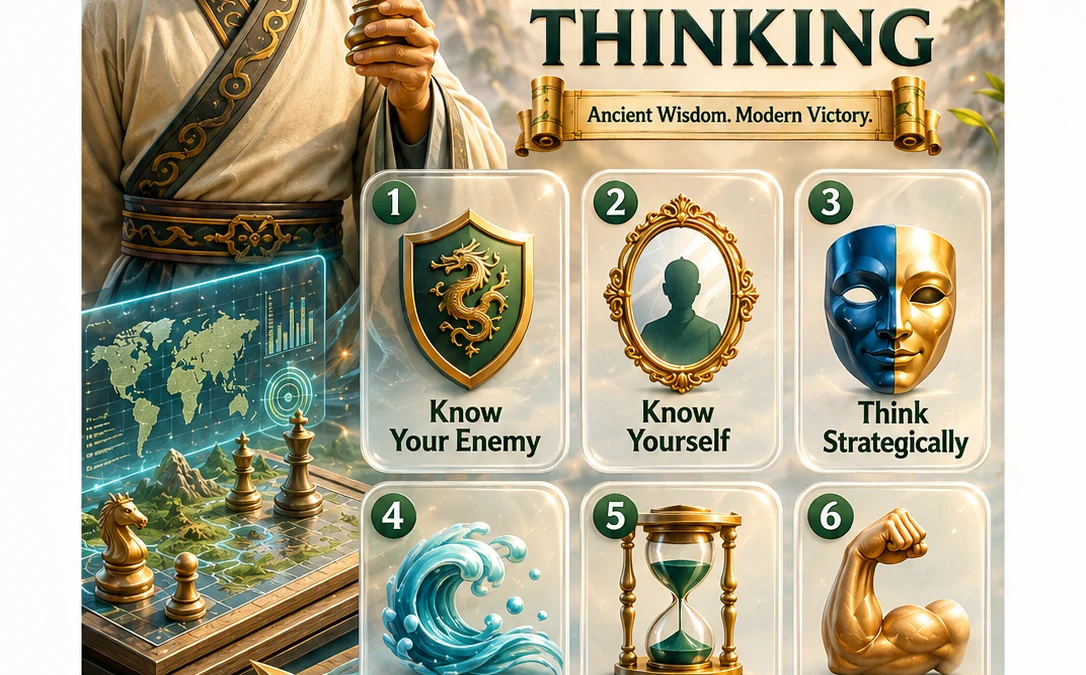
🛡️ Rule 1: Know Your ‘Enemy’ (aka The Situation)
Sun Tzu famously said, “Half of victory lies in understanding your opponent.” In our modern world, this “opponent” isn’t necessarily a person you’re battling. It’s more about understanding the landscape you’re operating in. Think of it as knowing the full context of any challenge you face. This could mean:
- Market Competition: Who are your rivals, what are they doing, and where are they vulnerable?
- Business Challenges: What are the internal and external hurdles your company is facing?
- Personal Obstacles: What roadblocks are you encountering in your career or personal goals?
- Economic Conditions: How do market trends, inflation, or industry shifts affect your plans?
- Skill Gaps: Where are you or your team lacking the expertise to succeed?
- Changing Customer Expectations: What do your clients or customers *really* want, and how is that evolving?
When you truly understand these elements, your planning becomes sharper, and your decisions are far more effective. It’s the difference between shooting in the dark and aiming with precision.
Why This Deep Dive Matters
Making decisions without understanding your environment is like playing chess blindfolded – you’re just guessing. But careful observation and analysis reveal so much:
- Competitor Strengths & Weaknesses: What are they great at? Where do they fall short?
- Industry Trends: What’s happening in your field? What’s next?
- Customer Behavior: Why do people buy? What influences their choices?
- Potential Risks: What could go wrong?
- Emerging Opportunities: What new avenues are opening up?
Knowledge is your ultimate advantage; it dramatically reduces uncertainty.
Putting It Into Action: Practical Steps
Instead of jumping in headfirst, try this:
- 🌍 Research Before You Invest: Whether it’s time, money, or resources, know what you’re getting into.
- 📊 Analyze Competitors Before Launching: Understand the market landscape before introducing your product or service.
- 📚 Study Job Requirements Before Applying: Know exactly what skills and experience are needed.
- 💼 Understand Client Expectations Before Proposing: Tailor your solutions to their specific needs.
This kind of preparation isn’t just about being thorough; it’s about building genuine confidence in your next steps.
🪞 Rule 2: Know Yourself (Your Strengths & Weaknesses)
Self-awareness is arguably one of the most powerful competitive advantages you can cultivate. Sun Tzu stressed that victory isn’t just about knowing the ‘other side’; it’s equally crucial to understand your own capabilities just as clearly.
What does “knowing yourself” really mean in a strategic context? It means having an honest grasp of:
- Your Strengths: What are you exceptionally good at?
- Your Weaknesses: Where do you struggle or need improvement?
- Available Resources: What tools, people, or assets do you have at your disposal?
- Time Limitations: How much time do you realistically have?
- Your Skills & Experience: What expertise do you bring to the table?
- Areas Needing Development: What skills or knowledge are you missing?
This honest self-assessment is the bedrock of realistic, effective planning. Without it, your strategies are built on shaky ground.
How Self-Awareness Fuels Better Strategy
So many plans falter because individuals overestimate what they can do or underestimate the challenges ahead. Strategic thinkers, on the other hand:
- ✨ Build on Their Strengths: They leverage what they’re good at to maximum effect.
- 🎯 Address or Mitigate Weaknesses: They don’t ignore areas where they’re less capable; they find ways to improve or compensate.
- 📈 Set Realistic Goals: They understand what’s achievable based on their capabilities and resources.
- ⚡ Use Resources Efficiently: They know how to get the most out of what they have.
Instead of trying to be a jack-of-all-trades, they focus their energy where it yields the greatest return. This is smart, not lazy!
Real-World Examples of Self-Knowledge in Action
- A student identifies their weaker subjects and dedicates extra time to them before exams.
- A business owner reviews customer feedback to pinpoint areas for improving service.
- A professional recognizes a gap in their technical skills and pursues training before applying for a promotion.
Understanding yourself is the first step toward continuous, meaningful improvement.
🎭 Rule 3: Use Strategic Unpredictability (Not Dishonesty)
This is one of the most commonly misunderstood principles from The Art of War. When Sun Tzu talks about deception, in a modern, ethical context, it doesn’t mean being dishonest or manipulative. Instead, it’s about strategic unpredictability. It’s about keeping your opponents (or competitors) guessing, preventing them from easily anticipating your next move.
Maintaining flexibility and a degree of surprise can be a powerful strategic tool. Think about:
- Protecting Confidential Plans: Keeping your innovative ideas under wraps until they’re ready.
- Launching Innovations Unexpectedly: Releasing a new product or feature when competitors least expect it.
- Negotiating Without Revealing Your Bottom Line: Holding your cards close to your chest until the right moment.
- Avoiding Unnecessary Exposure: Not broadcasting your every move or intention.
The goal here isn’t to trick people unfairly, but to maintain your strategic advantage and keep your options open.
Smart Strategy Is About the Timing of Information
Think about successful companies. They often don’t announce a product until it’s nearly ready for market. Sports teams frequently switch up their strategies mid-game to throw off the opposition. Smart negotiators rarely reveal their absolute final position too early in a discussion.
It highlights a crucial point: strategic communication – knowing what to say, when to say it, and when to stay silent – is often just as vital as strategic action itself.
🌊 Rule 4: Adapt Like Water
This is perhaps Sun Tzu’s most beautiful and enduring metaphor: comparing strategy to water. Water doesn’t crash headfirst into an obstacle. Instead, it flows around it, changes its shape, finds a new path, and keeps moving relentlessly towards its goal.
This is exactly what modern strategic thinking demands: flexibility. Rigid, inflexible plans are brittle. They shatter when circumstances change, which, let’s be honest, they always do. Adaptive plans, on the other hand, are dynamic. They evolve and adjust as the situation evolves.
Why Adaptability is Key to Winning
Unexpected challenges are a constant in every aspect of life:
- Economic Downturns: Markets can shift without warning.
- New Competitors: A disruptive startup can change the game overnight.
- Technological Innovation: New tech can make existing methods obsolete.
- Customer Behavior Shifts: Tastes and preferences change.
- Workplace Restructuring: Internal changes can impact how you work.
- Global Events: Pandemics, political shifts, and more can have far-reaching effects.
Those who cling rigidly to old ways often get left behind. Those who embrace change, who learn to adapt, are the ones who continue to move forward and thrive.
Cultivating an Adaptive Mindset
How do you become more like water? By making these practices a habit:
- 🌱 Continuously Learn New Skills: Stay relevant and capable.
- 📖 Update Your Knowledge: Keep abreast of industry changes and new information.
- 💡 Experiment with Better Solutions: Don’t be afraid to try new approaches.
- 🔄 Regularly Review Past Decisions: What worked? What didn’t? Why?
- 🎯 Adjust Long-Term Plans When Necessary: Be willing to pivot when the evidence suggests it.
Adaptability isn’t a sign of weakness; it’s a hallmark of intelligent resilience and strategic foresight.
🚀 Strategic Thinking: It’s Not Just for Generals and CEOs!
Let’s reinforce this: strategic thinking isn’t some exclusive club for military masterminds or corner-office executives. It’s a practical, learnable skill that benefits absolutely anyone who needs to make decisions, solve problems, or work towards meaningful goals. The first four principles we’ve covered highlight a powerful pattern:
- Understand your environment before you leap.
- Know yourself – your capabilities and limitations.
- Protect your strategic advantages and don’t reveal everything at once.
- Stay flexible and adaptable as circumstances shift.
Mastering these habits leads to more robust planning, smarter choices, and a greater sense of confidence, especially when navigating uncertain waters.
⏳ Rule 5: Master the Power of Timing
One of the most significant advantages in strategic thinking is knowing when to act. A brilliant plan, executed at the wrong moment – too soon or too late – can easily fall flat. Sun Tzu understood this deeply, emphasizing that patience is not a passive trait but a powerful strategic asset.
Waiting for the opportune moment allows for better preparation, clearer opportunities to emerge, and significantly increases your chances of success. Instead of rushing into action driven by impatience or urgency, strategic thinkers observe, evaluate, and then act decisively when conditions are most favorable.
Why Perfect Timing is Crucial
Getting the timing right helps you:
- Maximize Opportunities: Capitalize when the stars align.
- Reduce Unnecessary Risks: Avoid acting when the situation is volatile or unfavorable.
- Improve Decision-Making: Act with the benefit of more information and clearer context.
- Conserve Valuable Resources: Don’t waste energy or money on premature or ill-timed actions.
- Increase the Likelihood of Success: Simply put, you’re more likely to achieve your desired outcome.
Top leaders understand that effective action is the result of thoughtful preparation, not impulsive reaction.
Timing in Action: Everyday Examples
- 📈 Launching a Product: Wait until you have a clear understanding of market demand and have refined the offering.
- 💼 Applying for Promotions: Do so when your accomplishments clearly demonstrate your readiness and value.
- 🤝 Negotiating Agreements: Engage when both parties are genuinely open to finding common ground and reaching a resolution.
- 📊 Making Investments: Act only after thorough research, rather than chasing fleeting short-term trends.
Strategic patience often yields far stronger, more sustainable results than impulsive, hasty actions.
💪 Rule 6: Use Your Strengths Against Weakness
Sun Tzu’s wisdom extends to leveraging your greatest strengths where they can have the most impact. The core idea? Don’t waste energy confronting an opponent’s strongest position. Instead, strategically identify and attack the areas where you hold a clear advantage.
In the context of modern life, this principle is a powerful reminder to focus on smarter resource allocation. It’s about working more effectively, not just harder, by directing your efforts where they matter most.
Focus on Your Unique Competitive Advantage
Every individual, team, and organization possesses unique strengths. These could be:
- Technical Expertise: Deep knowledge in a specific field.
- Exceptional Communication Skills: The ability to articulate ideas clearly and persuasively.
- Creativity & Innovation: The capacity to generate novel ideas and solutions.
- Strong Leadership Qualities: Inspiring and guiding others effectively.
- Customer Relationships: Building loyalty and trust with clients.
- Specialized Knowledge: Information or insights not widely held.
By concentrating your energy and resources on these areas where you excel, you can often achieve superior outcomes compared to trying to compete equally across the board.
Strategic Decision-Making in Practice
Successful organizations often apply this principle by:
- 🚀 Investing heavily in their most successful products or services.
- 🎯 Targeting audiences who stand to benefit most from their core expertise.
- 📚 Continuously developing and refining their key competencies.
- ⚙️ Streamlining operations to maximize efficiency in their strong areas.
Similarly, as individuals, we can achieve greater success by focusing our efforts on the domains where we can deliver exceptional value, rather than spreading ourselves too thin across too many areas.
🕊️ Rule 7: Win Without Fighting
This is perhaps the most profound and often overlooked lesson from The Art of War: the highest form of victory is achieved without engaging in unnecessary conflict. Winning without fighting means skillfully resolving issues through meticulous preparation, clear communication, smart negotiation, collaboration, and intelligent planning.
Instead of escalating disputes or seeking confrontation, true strategic thinkers look for solutions that create mutual benefit whenever possible. It’s about finding the win-win.
Modern Applications of Peaceful Resolution
This principle plays out constantly in professional settings:
- 🤝 Negotiating agreements before disagreements escalate into full-blown conflicts.
- 💬 Resolving workplace disagreements through open and honest communication.
- 🌍 Building strategic partnerships and alliances rather than engaging in cutthroat, destructive competition.
- 📈 Strengthening customer relationships by focusing on trust, value, and mutual understanding.
Smart strategy aims to minimize losses (of time, resources, relationships) while maximizing long-term gains.
Why This Principle is More Important Than Ever
Conflict is incredibly costly. It drains time, money, and emotional energy. Peaceful, strategic resolution, on the other hand, often leads to:
- 🔹 Stronger, more resilient relationships.
- 🔹 Enhanced collaboration and teamwork.
- 🔹 More sustainable and equitable growth.
- 🔹 An improved reputation for fairness and wisdom.
- 🔹 Greater long-term success and stability.
Ultimately, true strategic mastery isn’t measured by how many battles you win, but by how many unnecessary battles you skillfully avoid.
🌟 Weaving the Seven Principles into Your Life
It’s truly remarkable how these ancient principles, born thousands of years ago on ancient battlefields, remain so incredibly relevant in our fast-paced, modern world. When you look at them together, they form a comprehensive framework for truly effective strategic thinking:
- Understand your environment deeply before making any significant moves.
- Know yourself – your unique strengths and limitations are your foundation.
- Protect critical information and plans until the optimal moment.
- Stay adaptable and flexible as situations inevitably evolve.
- Exercise patience and choose your timing wisely.
- Focus your strengths where they can create the greatest positive impact.
- Seek intelligent solutions that minimize unnecessary conflict and maximize mutual benefit.
These principles encourage a mindset of thoughtful, deliberate planning over impulsive, emotional reactions. They equip individuals and organizations to navigate complexity and uncertainty with significantly greater confidence and clarity.
🎯 Key Takeaways for Your Strategic Toolkit
The good news? Strategic thinking isn’t an innate talent; it’s a skill. And like any skill, it can be developed and honed through consistent learning, keen observation, and deliberate practice. Sun Tzu’s seven principles offer a practical, actionable roadmap for enhancing your leadership, decision-making, problem-solving abilities, communication effectiveness, and long-term planning.
Remember, success is rarely a matter of sheer speed alone. It’s the result of understanding situations thoroughly, preparing meticulously, adapting gracefully when needed, and acting with clear intention and purpose. Whether you’re applying these ideas to your business ventures, your education, your personal growth, your career path, or your leadership roles, these timeless lessons offer invaluable insights for achieving meaningful and lasting success.
🏁 The Enduring Power of Sun Tzu’s Strategy
Sun Tzu’s wisdom has stood the test of time precisely because it focuses on fundamental principles rather than fleeting circumstances. While technology, industries, and societies will continue to transform, the core tenets of strategic thinking remain one of the most valuable assets anyone can cultivate.
By consistently understanding challenges before acting, recognizing and leveraging personal strengths, remaining adaptable in the face of change, exercising strategic patience, making deliberate decisions, and resolving conflicts intelligently, you build a foundation for enduring success.
The real power of strategy isn’t about overpowering others; it’s about making wiser choices that unlock opportunities, mitigate unnecessary risks, and build stronger, more favorable outcomes over time. Individuals and organizations that proactively think ahead, rather than simply reacting to events, are far better equipped to navigate change, overcome obstacles, and achieve their goals with unwavering confidence and clarity.