🚀 8 Powerful Habits That Keep Your Mind Sharp, Focused & Built for Growth
In today’s world, where distractions are everywhere, keeping your mind sharp, focused, and ready for continuous personal growth isn’t just a nice-to-have—it’s a serious competitive advantage. Think about it: in a sea of notifications, endless scrolling, and constant demands on our attention, the ability to concentrate, think deeply, and learn effectively sets you apart. This article dives deep into eight powerful daily habits that are scientifically proven to help you sharpen your focus, boost your cognitive performance, and build serious long-term mental resilience. We’ll cover everything from the power of diving into long-form reading and optimizing your sleep to the surprising benefits of scheduled silence and using AI with intention. Get ready to discover why multitasking is actually sabotaging your productivity, how tackling difficult tasks builds incredible mental toughness, and why your evening routine is a hidden superpower for tomorrow’s success. We’ll also shed light on how overstimulation, poor recovery, and passive consumption of technology can silently chip away at your focus and decision-making abilities. Whether you’re an ambitious entrepreneur, a dedicated student, a creative visionary, or a driven professional, these habits are designed to give you an edge. They’ll help you improve concentration, gain clarity, spark creativity, and accelerate your personal growth journey. It’s time to build a sharper mind, forge stronger habits, and cultivate a more intentional life, one powerful daily decision at a time.

🧠 Why Having a Sharp Mind Is Your Ultimate Competitive Edge
Let’s face it, modern life is a constant battle for our attention. Everywhere we turn, there are notifications pinging, short-form content vying for our eyeballs, the siren song of multitasking, endless social media scrolling, and a general digital overload that’s making our focus spans shrink faster than ever. In this hyper-distracted world, the ability to think clearly, maintain unwavering focus, and make truly intentional decisions has become a superpower, a rare and valuable skill that truly differentiates you.
But here’s the good news: mental sharpness isn’t some fixed trait you’re either born with or not. It’s something you actively build, fiercely protect through discipline, and consistently strengthen with your daily choices. High performers, successful entrepreneurs, innovative creators, effective leaders, and anyone truly committed to personal growth often share one profound secret: they guard their mind like the precious asset it is.
Ready to unlock your cognitive potential? The following eight habits can dramatically transform your focus, clarity, creativity, discipline, and overall long-term cognitive performance. Let’s get started on building a mind that’s truly built for growth and success.
📚 Habit 1: Dive into Long-Form Reading to Cultivate Deep Thinking
Are you aware that the constant stream of short-form content is actually training your brain for speed, not for depth? Think about it: scrolling through quick videos, endlessly flipping through social media feeds, and consuming bite-sized pieces of information conditions your mind to constantly crave immediate stimulation. Over time, this habit erodes your attention span and severely diminishes your ability to concentrate on complex ideas or sustained thought.
Long-form reading, on the other hand, does the exact opposite. When you immerse yourself in books, detailed research papers, in-depth essays, or any thoughtful, extended content, you’re essentially giving your brain a powerful workout. This practice forces your mind to slow down, meticulously analyze information, forge connections between ideas, and engage in critical thinking. It’s the mental equivalent of lifting weights for your brain.
📖 Why Getting Lost in Long-Form Reading is Crucial
- Boosts Concentration and Attention Span: Regularly engaging with longer texts trains your brain to stay focused for extended periods, combating the effects of constant digital distraction.
- Enhances Analytical Thinking: Following complex narratives or arguments hones your ability to break down information, identify patterns, and understand intricate relationships.
- Expands Vocabulary and Communication Skills: Exposure to diverse language and sophisticated sentence structures naturally improves your word choice and your ability to articulate ideas clearly.
- Strengthens Memory Retention: The process of absorbing and recalling information from longer texts reinforces neural pathways, leading to better long-term memory.
- Encourages Creativity and Imagination: Immersive reading allows your mind to wander, visualize, and connect disparate concepts, sparking new ideas and fostering a richer imagination.
Don’t underestimate the power of consistent practice. Even dedicating just 20–30 minutes each day to deep reading can make a significant difference in your mental endurance and cognitive flexibility over time. It’s a foundational habit for anyone serious about intellectual growth.
📌 Top Reading Topics for Supercharging Your Personal Growth
To maximize the benefits, consider focusing your long-form reading on subjects that directly contribute to your development:
- Psychology: Understand human behavior, motivation, and the mind.
- Leadership: Learn how to inspire, guide, and manage effectively.
- Productivity: Discover strategies to optimize your time and output.
- Business Strategy: Gain insights into market dynamics and growth.
- Communication: Master the art of conveying ideas and building relationships.
- Philosophy: Explore fundamental questions about existence, knowledge, and ethics.
- Health and Performance: Learn how to optimize your physical and mental well-being for peak performance.
- Financial Intelligence: Develop a deeper understanding of money management and wealth creation.
Think of deep reading as your brain’s gym. Just as physical exercise builds a strong body, consistent deep reading builds a resilient, sharp, and capable mind. It’s an investment that pays dividends in clarity, insight, and overall cognitive power.
😴 Habit 2: Optimize Your Sleep for Peak Cognitive Performance
It’s time to reframe how we think about sleep. Sleep isn’t just downtime; it’s essential biological recovery. During those precious hours of rest, your brain is incredibly busy. It’s actively repairing neural pathways, consolidating and processing the information you’ve absorbed throughout the day, organizing your memories, regulating your emotions, and restoring vital cognitive energy for the challenges ahead.
When your sleep is compromised, it has a domino effect, impacting virtually every facet of your performance. You’ll likely notice deficits in:
- Decision-making: Impaired judgment and increased impulsivity.
- Focus: Difficulty concentrating and maintaining attention.
- Emotional control: Increased irritability and mood swings.
- Memory: Trouble recalling information and learning new things.
- Creativity: Reduced ability to generate novel ideas.
- Learning ability: Slower processing and comprehension.
- Productivity: Lower output and increased errors.
🌙 Why Sleep Quality Trumps Mere Quantity
Many people fixate solely on the number of hours they sleep, believing that’s the only metric that matters. However, the quality of your sleep is equally, if not more, important than the quantity. Optimized sleep isn’t just about logging hours; it’s about ensuring your sleep is restorative and efficient.
What does optimized sleep look like? It involves cultivating habits that promote deep, uninterrupted rest:
- Maintain a Consistent Sleep Schedule: Go to bed and wake up around the same time every day, even on weekends, to regulate your body’s natural sleep-wake cycle.
- Minimize Screen Exposure Before Bed: The blue light emitted from phones, tablets, and computers can interfere with melatonin production, making it harder to fall asleep. Aim to power down devices at least an hour before bed.
- Create a Cool, Dark, and Quiet Sleeping Environment: Your bedroom should be a sanctuary for rest. Keep the temperature slightly cool, ensure darkness, and minimize noise disturbances.
- Moderate Caffeine Intake: Avoid consuming caffeine in the afternoon and evening, as its stimulating effects can linger for hours and disrupt sleep architecture.
- Reduce Mental Stimulation Before Sleeping: Wind down with calming activities rather than engaging in stressful work, intense debates, or overly stimulating entertainment right before bed.
⚡ Red Flags: Are You Experiencing Signs of Poor Cognitive Recovery?
If you’re consistently struggling with your mental performance, take a look at your sleep habits. Common signs that indicate your brain isn’t recovering properly include:
- Brain Fog: A persistent feeling of mental cloudiness or difficulty thinking clearly.
- Low Motivation: A lack of drive or enthusiasm for tasks and activities.
- Slow Thinking: Feeling like your mental processing speed has decreased.
- Irritability: Increased impatience, frustration, or short temper.
- Lack of Focus: Constant distractibility and an inability to concentrate.
- Poor Memory Recall: Difficulty remembering recent events or information.
Prioritizing and protecting your sleep is one of the most impactful, high-return investments you can make in your mental clarity, overall well-being, and long-term capacity for growth. Treat your sleep as the crucial performance enhancer it is.
🎯 Habit 3: Embrace Single-Screening for Enhanced Focus and Productivity
Let’s be honest, the human brain simply isn’t wired for the constant juggling act of multitasking. When you’re trying to use multiple screens simultaneously, rapidly switching between browser tabs, or attempting to handle several tasks at once, you’re inevitably dividing your attention and significantly weakening your concentration. It feels like you’re doing more, but the reality is often the opposite.
While the illusion of multitasking might make you feel incredibly productive, extensive research consistently shows that it actually diminishes your efficiency, increases the likelihood of errors, and leads to greater mental fatigue. Your brain pays a heavy price for this constant context-switching.
🖥️ What Exactly is Single-Screening?
Single-screening is a powerful antidote to the multitasking epidemic. It’s a simple yet profound practice that involves:
- One Screen: Dedicate your visual attention to a single device or monitor at a time.
- One Task: Focus your mental energy on completing a single, defined task before moving on to the next.
- Full Attention: Commit to giving that one task your undivided focus and concentration.
By adopting this approach, you’re actively training your brain to achieve deeper levels of focus and develop superior cognitive control. It’s about quality of attention over quantity of activity.
🔥 The Undeniable Benefits of Single-Task Focus
Committing to single-tasking unlocks a cascade of benefits that directly impact your effectiveness and well-being:
- Faster Task Completion: When you’re not constantly switching gears, you can complete tasks more efficiently and with fewer interruptions.
- Higher Quality Work: Undivided attention allows for more thoroughness, accuracy, and a better overall outcome in your work.
- Reduced Stress: Juggling multiple demands can be overwhelming. Single-tasking simplifies your workflow and lowers stress levels.
- Improved Memory Retention: Focusing on one thing at a time helps your brain encode information more effectively, leading to better recall.
- Stronger Concentration Ability: Regularly practicing single-tasking builds your capacity to concentrate for longer periods, enhancing your overall mental stamina.
True deep work, the kind that produces significant results and fosters innovation, becomes nearly impossible when your attention is constantly fragmented across multiple inputs. In a world that thrives on distraction, actively protecting your focus is not just beneficial—it’s essential for high performance and meaningful progress.
🔇 Habit 4: Harness Scheduled Silence to Unlock Breakthrough Ideas
Are you constantly bombarded with input? If you’re always consuming information—music, podcasts, notifications, videos, social media, conversations—your brain simply doesn’t have the space it needs for reflection and processing. This relentless stream of external stimuli can leave you feeling mentally cluttered and drained, hindering your ability to think clearly and generate original ideas.
The brain, much like a computer, needs periods of low activity to process data, consolidate information, and perform essential background tasks. Scheduled silence provides this crucial downtime, allowing your mind to organize thoughts, reduce overstimulation, and foster a state of clarity.
🧘 Why Embracing Silence Enhances Mental Clarity
Intentionally carving out periods of silence in your day offers profound benefits for your cognitive function:
- Organize Ideas: Without constant external input, your mind can sift through thoughts, connect concepts, and structure information more effectively.
- Reduce Overstimulation: Silence provides a much-needed break from the sensory overload of modern life, calming the nervous system.
- Improve Emotional Regulation: Stepping away from noise and activity allows for greater self-awareness and better management of emotions.
- Enhance Creativity: Many groundbreaking ideas emerge not during periods of intense activity, but in moments of quiet contemplation and mental spaciousness.
- Process Deeper Thinking: Silence creates the mental bandwidth necessary for introspection, problem-solving, and developing nuanced perspectives.
It’s often in these quiet moments—during a silent walk, while meditating, or simply sitting without distractions—that our most profound insights and creative solutions surface. Don’t mistake silence for emptiness; it’s actually a fertile ground for clarity and innovation.
⏳ Simple Yet Powerful Ways to Practice Silence
Incorporating silence into your routine doesn’t require elaborate setups. Start with these accessible practices:
- Morning Quiet Time: Dedicate the first 10-15 minutes of your day to quiet reflection, meditation, or simply being present without any input.
- Silent Walks: Take a walk without listening to music or podcasts, allowing yourself to observe your surroundings and your inner thoughts.
- Meditation: Even short, regular meditation sessions can train your mind to find calm and focus amidst potential distractions.
- Journaling: Writing down your thoughts and reflections can be a form of active silence, helping to process and organize your internal world.
- Device-Free Breaks: Intentionally step away from all screens and digital devices for short periods throughout the day.
- No-Input Evenings: Designate certain evenings or parts of your evenings as screen-free and media-free zones.
Silence isn’t just the absence of noise; it’s the presence of mental space. By intentionally creating these pockets of quiet, you cultivate a sharper, more focused, and more creative mind, ready to tackle challenges with renewed clarity and insight.
🌙 Habit 5: Establish a Daily Wind-Down Routine to Reset Your Mind
The way you end your day has a direct and significant impact on how you begin the next. Many of us fall into the trap of ending our nights feeling overstimulated, mentally exhausted, and cluttered with unresolved thoughts. This not only leads to poor sleep quality but also sets you up for a morning where you lack mental energy and clarity.
A structured, intentional evening routine acts as a crucial transition period, signaling to your brain that it’s time to shift gears from the demands of the day into a state of recovery and rest. This gentle winding down is essential for optimal cognitive function and overall well-being.
🛌 The Remarkable Benefits of a Consistent Wind-Down Routine
Implementing a regular evening ritual offers a powerful pathway to improved sleep and enhanced daytime performance:
- Faster Sleep Onset: By calming your mind and body, a wind-down routine helps you fall asleep more quickly and easily.
- Reduced Stress and Anxiety: Transitioning away from work and digital stimulation lowers cortisol levels and promotes a sense of peace.
- Improved Emotional Balance: A relaxed state before bed contributes to greater emotional stability throughout the following day.
- Better Cognitive Recovery: Allowing your brain to properly wind down facilitates more effective memory consolidation and neural repair during sleep.
- Increased Morning Focus: Waking up after a night of quality rest means you start your day with higher levels of alertness and concentration.
📋 Crafting Your Ideal Healthy Evening Habits
Here are some effective practices to incorporate into your nightly wind-down routine:
- Minimize Blue Light Exposure: Dim the lights in your home and avoid screens (phones, tablets, computers, TV) for at least 60-90 minutes before bed. If you must use screens, consider blue light filtering glasses or software.
- Avoid Intense Work or Stimulating Conversations: Steer clear of high-pressure tasks, stressful discussions, or emotionally charged content right before sleep.
- Journal Your Thoughts and Priorities: Writing down lingering thoughts, worries, or tasks for the next day can help clear your mind and reduce rumination.
- Engage in Calming Reading: Choose light fiction, poetry, or a non-stressful non-fiction book. Avoid work-related materials or anything that might trigger anxiety.
- Practice Gentle Stretching or Relaxation Techniques: Light stretching, deep breathing exercises, or a warm bath can help release physical tension and promote relaxation.
- Prepare for Tomorrow Intentionally: Lay out your clothes, pack your bag, or do other simple preparations that reduce morning stress and create a sense of order.
A tired mind that never gets a proper reset is essentially starting each day already behind. By prioritizing a consistent wind-down routine, you ensure your brain and body are adequately prepared for restorative sleep, setting the stage for peak performance and clarity tomorrow.
⚠️ Habit 6: Maintain Chemical Balance for Optimal Mental Clarity
What you consume—both in terms of food and substances—has a profound impact on how your brain functions, especially during periods of rest and recovery. Many common stimulants and sedatives can significantly interfere with cognitive performance, particularly when consumed in the evening, disrupting the natural processes your body needs to prepare for sleep.
Excessive caffeine, energy drinks, nicotine, alcohol, and even certain late-night sugary snacks can throw your delicate biological systems out of balance. These substances can disrupt crucial sleep cycles, heighten anxiety levels, impair cognitive function, and ultimately reduce your overall mental sharpness.
🧪 Why What You Consume in the Evening Matters Most
Our bodies operate on intricate circadian rhythms. After around 6 PM, your brain naturally begins to shift into a recovery and preparation mode for sleep. Introducing various chemicals during this critical window can disrupt several vital processes:
- Sleep Quality: Stimulants can prevent you from falling asleep or cause fragmented, non-restorative sleep. Sedatives might make you drowsy but can also disrupt the deeper stages of sleep.
- Hormone Balance: Certain substances can interfere with the production and regulation of hormones crucial for sleep, stress management, and overall mood.
- Emotional Stability: The ‘highs’ and ‘lows’ associated with certain substances can lead to increased irritability, anxiety, or mood swings, impacting your emotional resilience.
- Focus and Cognitive Function: Even after the immediate effects wear off, residual impacts from stimulants or sedatives can impair your ability to concentrate and think clearly the next day.
- Biological Recovery Processes: Sleep is when significant cellular repair and detoxification occur. Interfering with sleep directly hinders these essential recovery mechanisms.
🥤 Common Disruptors of Mental Performance
Be mindful of these common culprits that can negatively affect your brain’s performance, especially in the latter half of the day:
- Excess Caffeine: Found not only in coffee but also tea, chocolate, and some sodas.
- High Sugar Intake: Sugary foods and drinks can cause energy spikes and crashes, disrupting sleep.
- Alcohol: While it may induce drowsiness, alcohol significantly disrupts sleep architecture and quality.
- Energy Drinks: Often loaded with caffeine and sugar, they provide a potent mix for disrupting sleep.
- Nicotine: A stimulant that can interfere with sleep and increase anxiety.
- Overeating Late at Night: Digesting heavy meals can disrupt sleep and lead to discomfort.
Your mental clarity is intrinsically linked to your body’s ability to recover and maintain a balanced nervous system. Protecting your brain’s peak performance often begins with safeguarding your biological recovery processes. Making conscious choices about what you consume, particularly in the hours leading up to bedtime, is a powerful step toward maintaining a sharp, focused, and resilient mind.
💪 Habit 7: Embrace Doing Hard Things to Build Unshakeable Mental Strength
Comfort zones are cozy, but they are also where growth goes to die. True mental strength, resilience, and discipline are forged not in ease, but in resistance. When your mind consistently faces challenges, learns to navigate discomfort, and adapts under pressure, it develops an incredible capacity to handle adversity.
Actively seeking out and engaging with difficult tasks on a regular basis is a potent training ground. It builds not only your resilience but also your emotional control and overall mental toughness. It trains you to push through perceived limitations and develop a stronger, more capable mindset.
🔥 How Embracing Difficulty Fuels Personal Growth
When you intentionally step outside your comfort zone and tackle challenging endeavors, your brain is compelled to:
- Focus Deeper: Difficult tasks demand sustained attention and the ability to filter out distractions, strengthening your concentration muscles.
- Solve Problems Creatively: Facing obstacles often requires innovative thinking and finding new approaches, enhancing your problem-solving skills.
- Build Confidence: Successfully navigating a challenge, no matter how small, provides a powerful boost to your self-efficacy and belief in your abilities.
- Increase Discipline: Pushing through resistance requires self-control and commitment, reinforcing your ability to stick with difficult pursuits.
- Expand Mental Capacity: Each challenge overcome stretches your mental boundaries, increasing your capacity to handle more complex and demanding situations in the future.
Conversely, consistently avoiding difficulty keeps your growth potential severely limited. You remain trapped within your current capabilities, missing out on the opportunities for development that lie just beyond your comfort zone.
🏋️ Examples of Productive Difficulty You Can Incorporate
Integrating productive difficulty into your life doesn’t necessarily mean undertaking extreme feats. It’s about consistently choosing the path that requires effort and growth:
- Engage in Intense Workouts: Pushing your physical limits during exercise builds both physical and mental endurance.
- Practice Public Speaking: Facing the fear of speaking in front of others is a powerful way to build confidence and communication skills.
- Commit to Deep Work Sessions: Dedicate uninterrupted blocks of time to cognitively demanding tasks without distraction.
- Learn a Difficult New Skill: Whether it’s a language, an instrument, or a complex software, the learning process itself is challenging and rewarding.
- Experiment with Cold Exposure: Brief exposure to cold (e.g., cold showers) can build mental resilience and discipline.
- Tackle Complex Business Challenges: Strategizing, problem-solving, and executing in a business context inherently involves overcoming obstacles.
- Have Difficult Conversations: Addressing sensitive topics directly and constructively builds emotional intelligence and communication strength.
Just as muscles grow stronger through resistance training, your mental fortitude expands through challenge. Growth inherently requires stepping into discomfort. By consistently choosing to do hard things, you build a mind that is not only sharp and focused but also incredibly resilient and capable of achieving remarkable things.
🤖 Habit 8: Use AI Intentionally, Don’t Become Dependent on It
Artificial intelligence is undeniably a game-changer, offering incredible tools to enhance productivity and efficiency. However, there’s a crucial distinction to be made: using AI as a supportive tool versus becoming passively dependent on it. Over-reliance on AI for tasks that require critical thinking can inadvertently weaken your own cognitive abilities over time.
The goal should always be to leverage AI to automate or assist with repetitive, time-consuming tasks, thereby freeing up your mental energy. Crucially, you must continue to actively engage your own creativity, strategic thinking, analytical skills, and decision-making capabilities. AI should amplify your intelligence, not replace it.
⚡ Smart and Strategic Ways to Leverage AI
When used thoughtfully, AI can be an invaluable partner in your quest for productivity and growth:
- Brainstorming and Idea Generation: Use AI as a sounding board to explore different angles and possibilities for projects or content.
- Improving Efficiency: Automate routine tasks like scheduling, data entry, or drafting basic communications.
- Research Support: Utilize AI to quickly gather information, summarize complex topics, or identify key sources, but always verify and critically evaluate the output.
- Content Enhancement: Employ AI tools to refine grammar, improve sentence structure, or suggest alternative phrasing in your writing.
- Organization and Planning: Leverage AI for task management, project breakdown, or creating initial outlines.
🚨 The Hidden Risks of Passive AI Dependency
Relying on AI to handle tasks that require cognitive effort can lead to a decline in your own mental prowess:
- Reduced Problem-Solving Ability: If AI always provides the solution, you miss opportunities to develop your own critical thinking and troubleshooting skills.
- Stifled Creativity: Over-reliance can lead to generic outputs and a diminished capacity for original thought and innovative ideas.
- Weakened Deep Thinking: Delegating complex analysis to AI prevents you from engaging in the rigorous mental processes required for profound understanding.
- Diminished Independent Analysis: You may lose the ability to critically evaluate information and form your own well-reasoned conclusions.
- Lowered Cognitive Resilience: Your brain’s ability to adapt and perform under pressure may weaken if it’s not regularly challenged.
Technology, including AI, should serve as a tool to augment human intelligence, not supplant it. The individuals and organizations that will thrive in the future are those who master the art of using AI intentionally. They harness its power to enhance their own capabilities while continuing to rigorously sharpen their unique human skills—creativity, critical thinking, emotional intelligence, and strategic foresight.
🧠 Final Thoughts: Treat Your Mind Like the High-Value Asset It Is
Mental sharpness, focus, and clarity don’t typically vanish overnight. Instead, they erode gradually, often subtly, through a steady diet of digital distractions, constant overstimulation, inadequate recovery, and a lack of intentional, growth-oriented habits. It’s a slow drip that can leave you feeling mentally duller than you’d like.
But here’s the incredibly empowering news: focus, clarity, discipline, and overall cognitive strength are not fixed traits. They are skills that can be consistently improved and significantly enhanced. The key lies in recognizing that small, consistent daily habits compound over time to produce massive, long-term results.
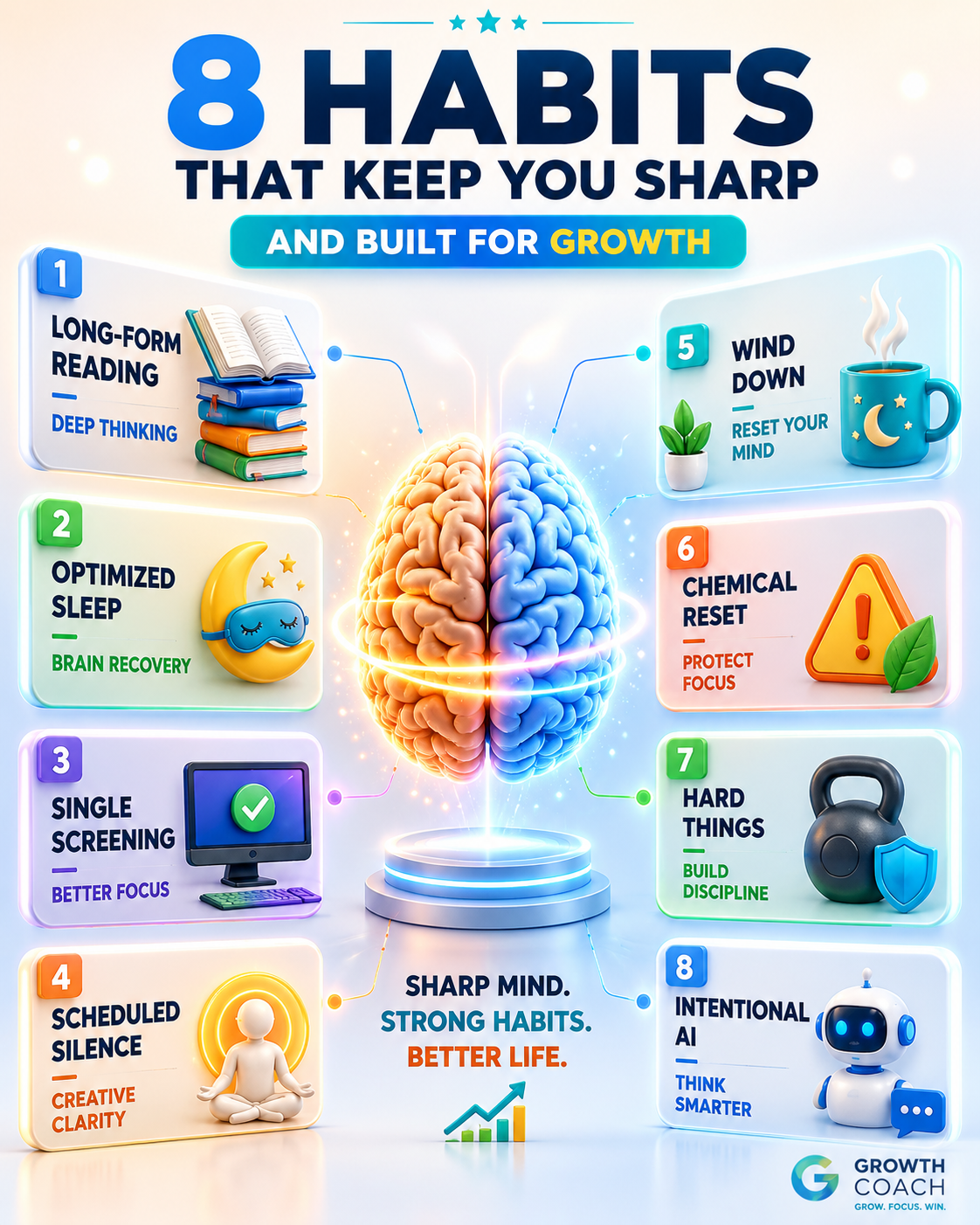
🚀 The 8 Habits That Are Your Blueprint for a Sharper Mind
To recap, here are the powerful habits we’ve explored, forming your action plan for a more focused and capable mind:
- Long-Form Reading: Cultivates deep thinking and expands cognitive endurance.
- Optimized Sleep: Essential for memory consolidation, emotional regulation, and peak cognitive function.
- Single-Task Focus: Trains your brain for concentration and boosts productivity by eliminating context-switching.
- Scheduled Silence: Creates mental space for reflection, creativity, and deeper processing.
- Daily Wind-Down Routine: Prepares your mind and body for restorative sleep, improving next-day performance.
- Chemical Awareness: Protects cognitive function and sleep quality by minding your intake, especially in the evening.
- Doing Hard Things: Builds mental resilience, discipline, and confidence through productive discomfort.
- Intentional AI Usage: Leverages technology to enhance, not replace, your own critical thinking and creativity.
Investing in these habits is investing in your future. A sharper mind translates directly into better decision-making, stronger personal discipline, enhanced productivity, and accelerated long-term personal growth. In the modern landscape, the ability to maintain focus and clarity while others are succumbing to distraction is the ultimate differentiator—the true competitive advantage that will propel you forward.