Ever feel like you’re stuck on a hamster wheel, chasing goals but never quite reaching them? You’re not alone. So many of us rely on fleeting motivation, waiting for that magical spark to ignite our actions. But what if I told you there’s a much more powerful, sustainable way to achieve lasting success? It all starts with a fundamental shift: changing who you believe you are. Forget chasing motivation; it’s time to build your future self through identity-based habits. This guide dives deep into why your self-perception is the ultimate driver of consistent action, how small, daily wins sculpt your identity, and why your environment plays a massive role in your decisions. We’ll uncover practical strategies to break free from autopilot, silence that nagging negative self-talk, minimize distractions, and cultivate routines that effortlessly propel you toward your aspirations. Get ready to master a simple, three-phase framework for identity transformation, turning awareness, intentional action, and unwavering consistency into your greatest assets. Whether you’re aiming for peak productivity, better health, accelerated learning, career advancement, or enhanced personal discipline, this article is packed with actionable insights grounded in behavioral psychology. Every positive step you take is a vote for the person you’re becoming, proving that true, meaningful change stems from your core beliefs about yourself, not just temporary bursts of inspiration.
🚀
Lasting success isn’t built on motivation, it begins with identity.
This guide explains why changing the way you see yourself creates stronger
habits than relying on temporary inspiration. Discover how repeated actions
shape self-image, why small daily wins matter more than dramatic
transformations, and how your environment influences every decision you make. 🌱 Learn practical strategies to break autopilot behavior, overcome negative
self-talk, reduce distractions, and build routines that naturally support your
goals. Through a simple three-phase identity-shifting framework, you’ll
understand how awareness, intentional action, and consistency gradually
transform your behavior into lasting success. 💡 Whether you want to improve
productivity, health, learning, career growth, or personal discipline, this
article offers actionable techniques backed by behavioral psychology
principles. Every positive action strengthens the identity you want to become,
proving that meaningful change starts with who you believe you are—not simply
what you feel motivated to do.

How Can You Become Your Future Self and Build Lasting Habits?
Let’s be honest, how many times have you waited for that perfect burst of motivation to kickstart a new habit or tackle a daunting task? We often postpone action, hoping for the stars to align, for inspiration to strike, or for the ‘right mood’ to magically appear. The truth is, motivation is a fickle friend. It’s like a tide – it ebbs and flows, heavily influenced by our emotions, energy levels, and the circumstances we find ourselves in. Relying solely on motivation for long-term personal growth is like building a house on sand; it’s bound to crumble when the storm hits.
But here’s the game-changer: lasting personal growth operates on a completely different principle.
Instead of constantly asking yourself, “How can I find the motivation to do this?”, try flipping the script. A far more powerful question that unlocks genuine, sustainable change is this:
“Who do I want to become?”
Seriously, pause and think about that. The answer to this question isn’t just an aspiration; it’s a blueprint for your transformation. When you focus on the identity you wish to embody, your habits start to align naturally. Your actions become consistent because they are expressions of who you believe you are, not just things you feel compelled to do in a moment of inspiration. This shift makes success feel less like a constant uphill battle and more like a natural outcome of your being.
🌟 Why Identity Trumps Motivation Every Single Time
Let’s break down the core difference. Motivation often leads us to ask:
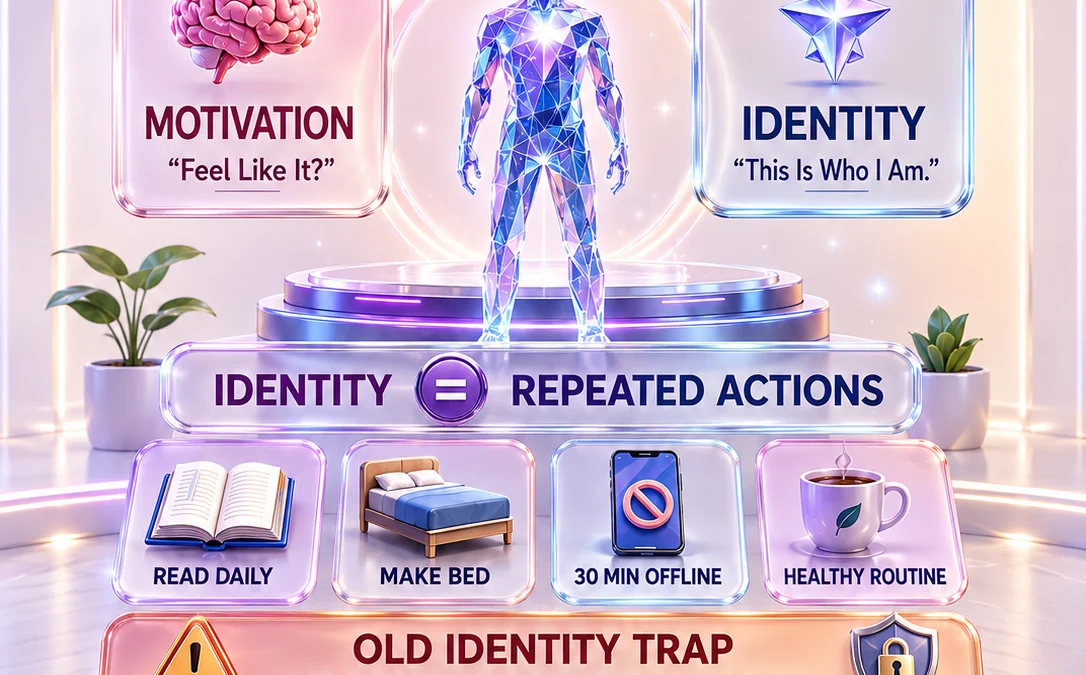
“Do I feel like doing this today?”
But identity-based habits prompt a deeper, more powerful question:
“Is this what someone like me does?”
See the subtle, yet profound, difference? This shift from feeling to being is what truly transforms behavior. Motivation is tethered to your current feelings – your energy, your mood, your immediate desires. If you’re tired, unmotivated, or stressed, your motivation to exercise might vanish. But identity? Identity is rooted in your values and your self-concept. If you identify as someone who values health and well-being, then exercising isn’t a matter of ‘feeling like it’; it’s simply a natural part of who you are. This perspective powerfully bypasses the endless internal negotiations that fuel procrastination. Instead of debating with yourself every morning about whether to hit the gym or start that important project, your habits become ingrained, automatic expressions of your desired identity. It’s about becoming the type of person who naturally does these things, not just someone who forces themselves to do them occasionally.
🎯 Your Identity is Forged Through Consistent Action
Here’s a crucial point: your identity isn’t some fixed trait you’re born with. It’s a dynamic construct, continuously shaped and reinforced by the evidence you provide yourself through your actions. Think of every action you take as sending a clear message to your brain about the kind of person you are and are becoming. That one page you read from a non-fiction book? It’s a vote for “I am someone who learns and grows.” Completing that challenging workout, even when you didn’t feel like it? That’s evidence for “I am someone who takes care of my body and prioritizes my health.” Finishing that crucial task on your to-do list, especially one you’ve been avoiding? That sends a powerful signal: “I am someone who keeps promises to myself and follows through.” These actions might seem minuscule in isolation, almost insignificant. But here’s the magic: they accumulate. Over time, they build a compelling case, constantly updating your self-image. The more consistent evidence you gather, the stronger and more solidified your chosen identity becomes. It’s a snowball effect, where each positive action reinforces the belief that you are, indeed, that person you aspire to be.
💪 Why Relying on Willpower Is a Losing Game
Many of us are conditioned to believe that discipline boils down to sheer willpower. We think we just need to ‘try harder’ or ‘be stronger.’ And yes, willpower can be a useful tool, especially in the initial stages of habit formation. It can help you push through those first few challenging moments. However, willpower is a finite resource. It’s like a muscle that gets fatigued with overuse. Stress, a poor night’s sleep, emotional turmoil, unexpected life events, or even just a long, demanding day can significantly deplete your willpower reserves. When your habits are solely dependent on this dwindling resource, they are destined to falter, especially during difficult times. This is precisely where identity-based habits shine. When a behavior becomes an integral part of who you are – when it’s tied to your identity – it requires far less conscious effort and mental energy. You’re no longer fighting against yourself daily. Instead, your identity acts as a powerful internal engine, propelling the habit forward. This is why sustainable personal growth strategies emphasize becoming the person who naturally performs the desired action, rather than simply trying to force the action itself. It’s about aligning your actions with your core self, making the ‘doing’ feel less like a chore and more like an expression of who you are.
🔄 The Inescapable Identity Loop: How Habits Reinforce Beliefs
Human behavior operates in a surprisingly predictable, repeating cycle. Understanding this loop is key to breaking negative patterns and building positive ones. It typically unfolds like this:
🧩 Thought
Everything starts with a thought. It might be an idea, a desire, a worry, or a plan. This initial thought is the seed from which action grows.
🎯 Action
Your thoughts directly influence your decisions and subsequent actions. You act based on what you’re thinking and feeling.
✅ Proof
Every single action you take, big or small, provides evidence. Completing a task, making a healthy choice, or even procrastinating – it all serves as proof to your brain about your capabilities and tendencies.
🧠 Belief
This accumulated evidence then shapes and strengthens your beliefs about yourself. If you consistently act in a certain way, you start to believe that you *are* that kind of person. For example, consistently finishing tasks reinforces the belief, “I am a reliable person.” Conversely, consistently avoiding challenges might reinforce, “I’m not good at difficult things.”
🔁 New Thought
Crucially, your strengthened beliefs then influence your future thoughts. If you believe you’re a disciplined person, your future thoughts will likely reflect that, making disciplined actions feel more natural. If you believe you’re lazy, your thoughts will tend to align with that, making laziness feel like the default. This cycle repeats, day after day, reinforcing either positive or negative patterns.
The power of this loop lies in recognizing that positive actions reinforce positive beliefs, and negative actions reinforce limiting beliefs. To break a negative cycle, you often need to change your *actions* first, even if your beliefs haven’t fully caught up yet. The actions provide the new evidence that will eventually shift your beliefs. You can’t wait for your beliefs to change before you act; you act to change your beliefs.
🌱 Every Tiny Victory is a Powerful Vote for Your Future Self
We tend to get caught up in the idea that significant change requires grand gestures or dramatic overhauls. We overlook the profound impact of tiny, seemingly insignificant victories. Think about these small actions: reading just five pages of a book, making your bed first thing in the morning, consciously putting your phone away for thirty minutes to focus, choosing to drink an extra glass of water, or taking a brisk ten-minute walk. On their own, these actions might appear trivial. They don’t feel like monumental achievements. But when viewed through the lens of identity building, they are incredibly powerful. Each small success is a vote cast for the person you aspire to become. It’s a piece of evidence that strengthens your new identity. No single push-up will transform your physique, and no single healthy meal will revolutionize your health. But thousands of these consistent, small actions? They are the bedrock upon which lasting change is built. They are the quiet, consistent votes that tally up to a completely transformed identity and, ultimately, a transformed life.
🚧 The Subtle Danger of Clinging to Your Old Identity
One of the biggest hurdles to personal growth is our unconscious tendency to protect an outdated version of ourselves. We often get comfortable with our familiar narratives, even if they are limiting. Have you ever caught yourself saying things like:
- “I’m just naturally lazy.”
- “I’m terrible at managing my time; it’s just how I am.”
- “I never seem to finish anything I start.”
- “I’m just not a disciplined person.”
These kinds of self-labels aren’t just descriptions; they are powerful identity statements that become self-fulfilling prophecies. Your brain is incredibly adept at seeking out and highlighting evidence that confirms your existing beliefs. If you tell yourself you’re always lazy, your mind will actively look for instances that support this, while conveniently ignoring times you were productive. As long as you continue to repeat and believe these old identity narratives, your behavior will naturally gravitate towards reinforcing them. To truly change your life, you must actively challenge and replace these internal labels with actions that build and support a *new*, more empowering identity. It’s about consciously choosing evidence that aligns with the person you *want* to be, not the person you *used* to be or *think* you are.
🌄 The Step-by-Step Identity Shifting Protocol
Transforming your life and building habits that stick isn’t about a sudden, magical overhaul. It’s a process, a journey that unfolds through distinct phases. This structured approach ensures that the changes you make are not only profound but also deeply ingrained and sustainable. Let’s walk through the three core phases:
🌱 Phase One: Cultivate Deep Awareness
Before you can effectively change your behavior, you need to understand your current patterns. This phase is all about shining a light on your unconscious habits and thought processes.
🔹 Break Free from Autopilot Decisions
So much of our day is run on autopilot. Think about mindlessly scrolling through social media, procrastinating on important tasks, or reacting emotionally without thinking. The first, most crucial step toward change is simply noticing these patterns. Awareness is the antidote to automatic behavior. When you catch yourself about to fall into an old habit, pause. Acknowledge it. This conscious interruption is the beginning of regaining control.
🔹 Reframe Negative Self-Talk
The internal dialogue you have with yourself significantly impacts your actions and self-perception. Those constant, critical thoughts can sabotage your efforts before you even begin. Instead of allowing phrases like “I can’t do this” or “I’m not good enough” to dominate your inner monologue, consciously reframe them. Try shifting to “I’m learning how to do this” or “I’m developing the skill of [task].” Even small linguistic adjustments can gradually reshape your self-image and open the door to new possibilities.
🔹 Embrace Regular Journaling
Writing down your thoughts, feelings, and experiences is an incredibly powerful tool for self-discovery. Journaling helps you identify recurring patterns in your behavior, pinpoint emotional triggers that lead to undesirable actions, and track your progress over time. It creates a level of clarity and insight that is often difficult to achieve through mere introspection. Seeing your patterns laid out on paper can be a profound wake-up call and a source of motivation for change.
🔹 Observe Your Impulses Without Acting
Not every urge or impulse needs to be acted upon. Learning to observe your desires – the urge to snack, to procrastinate, to react defensively – without immediately giving in is a critical skill. This practice of pausing and observing builds emotional regulation and self-control. Over time, this ability to resist impulsive actions significantly strengthens your discipline and reinforces the identity of someone who is in command of their reactions.
🏡 Phase Two: Engineer Your Environment for Success
Relying solely on willpower and self-control is exhausting and often ineffective. A more powerful strategy is to design your environment so that good decisions are the easiest decisions. Your surroundings have a profound, often underestimated, influence on your behavior.
🔹 Minimize Distractions Ruthlessly
In our hyper-connected world, distractions are everywhere. Take control of your digital environment by turning off non-essential notifications. Declutter your workspace, both physical and digital, to create an atmosphere that promotes focus. Designate specific times and spaces for deep work. Even small changes in your environment, like putting your phone in another room while you work, can lead to surprisingly significant improvements in your productivity and focus.
🔹 Surround Yourself with Growth-Minded People
We are social creatures, and human behavior is remarkably contagious. The people you spend time with, their habits, their standards, and their expectations inevitably influence your own. Actively seek out environments and individuals who are focused on learning, taking responsibility, and continuous improvement. Being around people who embody the qualities you aspire to cultivate can be a powerful catalyst for your own growth.
🔹 Embody Your Future Self in Decisions
This is a powerful mental reframing technique. Before making a decision, big or small, ask yourself a simple, yet profound question: “What would my future self do?” Imagine the person you want to become – the one who has achieved your goals. What choices would *that* person make in this situation? This question immediately shifts your focus away from short-term gratification or comfort and directs it toward long-term success and well-being. It helps you act in alignment with your desired future identity.
🚀 Phase Three: Solidify Your New Identity
This is where the real magic happens – where temporary changes become permanent shifts. This phase is about actively installing your new identity through consistent, deliberate action.
🔹 Show Up, Even When You Don’t Feel Like It
Consistency trumps intensity every time when it comes to habit formation. It’s far more effective to do a short workout than skip it entirely because you didn’t feel motivated. Reading one page is better than abandoning the book altogether. Progress is preserved through sheer consistency. Showing up, even imperfectly, reinforces the identity of someone who is committed and follows through, regardless of their mood.
🔹 Honor Your Commitments to Yourself
Every time you make a promise to yourself – whether it’s to exercise, eat healthily, or finish a project – and you keep it, you build self-trust. Conversely, every time you break a promise to yourself, you chip away at your confidence and reinforce the belief that you can’t rely on yourself. True integrity begins with honoring your own commitments. Make small promises you know you can keep, and then keep them. This builds a solid foundation of self-belief.
🔹 Commit to Finishing What You Start
The act of completing tasks, especially those that require effort or focus, trains your brain. It helps you associate effort with the satisfaction of completion, rather than with avoidance or frustration. When you consistently finish what you start, the habit of completion becomes more automatic. This reinforces the identity of someone who is capable, diligent, and sees things through to the end.
🔹 Be Unflinchingly Precise with Your Goals
Vague intentions lead to vague results. Simply saying “I’ll exercise more” or “I’ll eat healthier” lacks the clarity needed for consistent action. Instead, be incredibly specific. For instance, instead of “I’ll exercise more,” commit to “I will walk for twenty minutes after dinner every weekday.” Instead of “I’ll eat healthier,” decide “I will pack a healthy lunch for work every Monday, Wednesday, and Friday.” Specific, actionable steps create measurable progress and make it much easier to track your success and reinforce your new identity.
📈 The Astonishing Compounding Effect of Consistency
True, deep transformation rarely happens with a bang. It’s not usually a sudden, dramatic event. Instead, it unfolds quietly, steadily, and powerfully. One positive decision leads to another. One small habit seamlessly supports the next. Each minor improvement builds a little more confidence. That increased confidence then fuels more action. More action further strengthens your emerging identity. And as your identity solidifies, it naturally influences your behavior, leading to more positive choices. This continuous loop is how your future is fundamentally reshaped. Those small improvements might seem almost invisible day-to-day. You might not notice them week after week. But months down the line, their cumulative effect becomes undeniable. They compound, just like interest in a savings account, leading to results that are impossible to ignore. That, my friend, is the quiet, incredible power of compounding consistency.
🎯 Craft a Future That Authentically Reflects Your Evolving Identity
The path to success isn’t paved with endless motivation or sheer luck. It’s built by individuals who consistently act in alignment with the person they are actively choosing to become. Every task you complete, every healthy choice you make, every promise you keep to yourself, and every distraction you consciously avoid is another brick laid in the foundation of your future identity. You don’t need to achieve overnight transformation. The journey is far more forgiving and effective. All you need to do is cast one more vote today for the person you want to become tomorrow. Because in the grand scheme of things, your life is sculpted less by the extraordinary things you occasionally achieve and far more by the consistent identity you choose to build, day by day, action by action.