Feeling that sinking feeling when your bills pile up and your bank account looks empty? 😬 You’re not alone. It’s incredibly stressful when your monthly expenses start to outpace your income, leaving you paralyzed, wondering which bill to tackle first. It’s easy to feel overwhelmed, but ignoring the problem or letting anxiety take over will only make things more expensive and complicated in the long run. ⏳ The good news? Taking smart, proactive steps before deadlines pass can protect your essential needs, keep your housing secure, and safeguard your credit score. 🛡️
So, what exactly should you do when you find yourself unable to pay your monthly bills? The immediate priority is to secure your survival essentials: housing, food, and utilities. Next, get ahead of the game by contacting your creditors and utility providers before you miss a payment to explore hardship deferrals or payment plans. Don’t forget to look into local community assistance programs – dialing 211 is a great first step. And if there are any subscription services or non-essential apps you can pause, do it now! ✂️
At Growth Coach, we’re all about empowering you with practical strategies to navigate life’s challenges and regain control. 🚀 Let’s break down the exact steps you can take today to ease the pressure and protect your financial future. 🎯
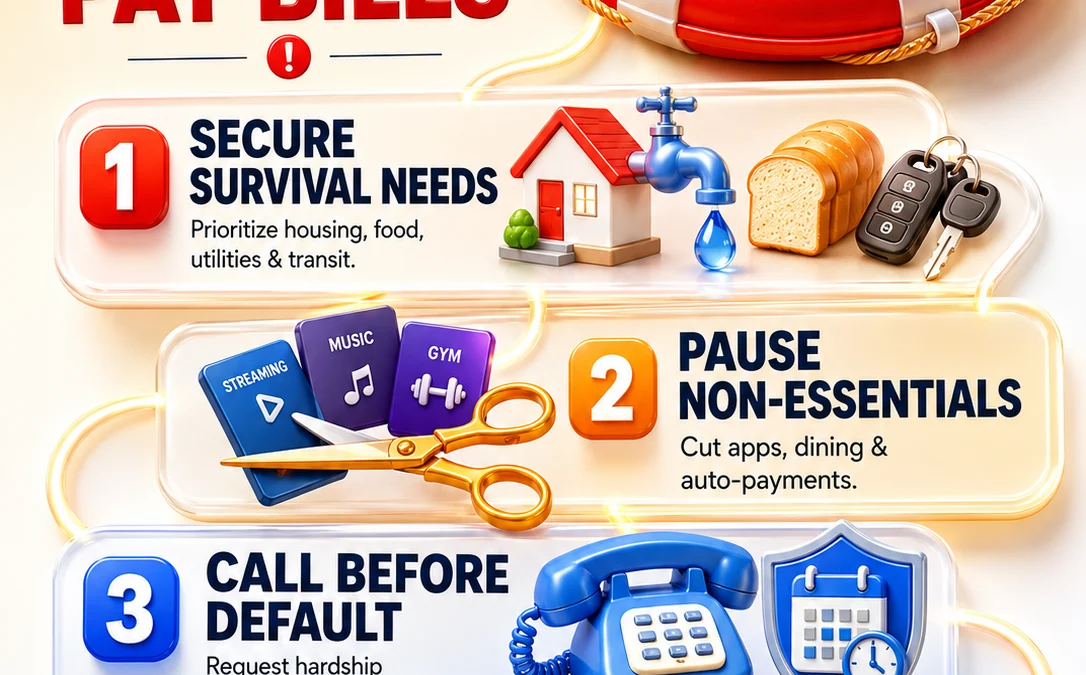
🛡️ Step 1: Prioritize Your Four Essential Survival Needs First 🏠
When your income takes a hit, trying to pay every single bill equally is a recipe for disaster. 🛑 The first and most crucial step is to clearly categorize your expenses. You need to distinguish between what’s absolutely essential for your survival and what’s a non-essential obligation. This might seem obvious, but in a panic, it’s easy to lose sight of the real priorities. 📊
🏠 1. Housing Costs: Your rent or mortgage payment needs to be at the absolute top of your list. Maintaining stable shelter is paramount. Without a roof over your head, everything else becomes infinitely more difficult.
💡 2. Basic Utilities: Keeping the lights on, the water running, and the heat (or cooling, depending on the season) going is vital. This means prioritizing electricity, water, and essential heating/cooling. You can always pause premium cable packages or extra streaming service subscriptions for a while.
🛒 3. Food & Groceries: Feeding your household with basic, nutritious food must come before paying off unsecured debts. Focus on affordable, staple groceries that can sustain your family.
🚗 4. Essential Transportation: If you rely on a vehicle to get to work, maintaining your car payment or public transit pass is crucial. Reliable transportation ensures you can continue earning income.
Think of it this way: Unsecured debts like credit card balances, personal loans, or store accounts, while important, can generally wait when your basic survival needs are at risk. 💳 A late fee on a credit card is frustrating, but losing your electricity or facing eviction has immediate and severe consequences. 🚨
📌 Key Takeaway
Always ensure your housing, basic utilities, food, and transportation to work are covered first. Unsecured debts and non-urgent medical bills can be addressed once your core household needs are stable.
Once you’ve secured these four essential pillars, it’s time to look at where your money is going. Identifying and temporarily cutting non-essential expenses can free up much-needed cash and give you some breathing room. 🌬️ Let’s explore how simple budget adjustments can make an immediate impact. ✂️
✂️ Step 2: Trim Non-Essential Expenses and Triage Your Cash 💵
During a financial crunch, pausing discretionary spending is one of the fastest ways to create a temporary cash buffer. 💸 Take a close look at your recent bank and credit card statements. You’ll likely find several flexible expenses that can be put on hold without jeopardizing your safety or essential needs. 🔍
📱 Pause All Subscriptions: This is a big one. Go through your recurring charges and immediately cancel or pause anything non-essential. Think gym memberships you aren’t using, multiple streaming services, software trials you forgot about, monthly subscription boxes, or even app subscriptions.
🍳 Halt Dining Out: Eating out, ordering takeout, and those daily coffee runs add up incredibly fast. Shift to home-cooked meals using groceries. This is a significant area where you can save money quickly.
📞 Lower Fixed Service Plans: Review your mobile phone plan, internet service, and even cable TV. Can you temporarily downgrade your data plan? Switch to a cheaper provider? Bundle services? Even small reductions can free up cash.
Every dollar you save by pausing these non-essential items buys you valuable time and reduces the amount you might be short on your critical bills. ⏳ Remember, these cuts are temporary emergency measures. They are not necessarily permanent lifestyle changes. 🌿
💡 Quick Tip
Log into your online banking right now and disable auto-pay for any non-essential subscriptions or unsecured credit cards *before* their due dates. This is a proactive step that can prevent unexpected overdraft fees from draining your primary checking account when you least expect it!
Taking back control of your outgoing cash flow gives you the stability and confidence you need to communicate effectively with your service providers. 📞 Reaching out proactively before you miss a payment can open up a surprising number of flexible options. 🤝
📞 Step 3: Negotiate Directly with Creditors and Utility Companies 🗣️
It might feel intimidating, but most utility companies, lenders, and credit card issuers have dedicated departments or representatives trained to help customers facing temporary financial hardship. 🏢 The key is to contact them *before* you miss a deadline. This puts you in a much stronger negotiating position. 💬
⚡ Request Utility Deferrals: Your electricity, gas, and water providers often have programs in place. They might offer payment extensions, allow you to spread your balance over several months (balanced billing), or provide protection against shut-offs, especially during certain times of the year.
💳 Ask for Forbearance Plans: Credit card companies can be surprisingly flexible. They may be able to temporarily freeze your interest rate (APR), waive late fees you’ve already incurred, or reduce your minimum payment requirement for a set period.
🚗 Modify Auto Loan Terms: If you have an auto loan, lenders often understand that unexpected events happen. They may allow you to defer a payment, typically adding it to the end of your loan term, especially if you can document a period of hardship.
Remember, these companies generally prefer to work with you to receive modified or delayed payments rather than dealing with a full account default, collections, or legal action. 📄 Approaching these conversations with honesty, transparency, and a clear understanding of your situation can lead to surprisingly helpful outcomes. 🤝
🏆 Best Practice
Before you make that call, jot down a few key points: a brief, honest explanation of your hardship, your current monthly income and essential expenses, and a realistic date when you anticipate your financial situation will improve. This preparation will make your conversation much more productive!
Knowing what specific options you can ask for during these calls will make the negotiation process smoother and more effective. 📝 Below, we’ve outlined a comparison of common financial hardship arrangements you might be able to negotiate. 📊
📊 Comparing Common Financial Hardship Options ⚖️
Understanding the nuances of different hardship programs will help you choose the most suitable relief strategy for your unique circumstances. 🧭
| Hardship Program | Primary Feature | Best For |
|---|---|---|
| Payment Extension | Pushes your due date back by 15–30 days. 🗓️ | Short-term paycheck delays or unexpected one-off expenses. |
| Forbearance / Deferral | Allows you to pause payments for a period of 1–3 months. ⏸️ | Significant events like job loss, medical emergencies, or natural disasters. |
| Income-Driven Plan | Lowers your monthly payment based on your reported income. 📉 | Often available for student loans and some major utility bills. |
| Interest Rate Freeze | Temporarily drops your Annual Percentage Rate (APR) to near 0%. 🧊 | Targeting high-interest credit card debt when you can still afford minimum payments. |
⚠️ Common Mistake
A word of caution: Avoid turning to high-interest payday loans, title loans, or predatory cash advances to cover your regular bills. These are often described as ‘short-term solutions,’ but they can quickly trap you in a cycle of debt that multiplies your original problem exponentially, turning a minor crisis into a long-term financial quagmire!
Sometimes, even after cutting expenses and negotiating with creditors, you might still face a gap. This is where connecting with local community support networks can be a lifesaver. 🌐 Help is often closer and more accessible than you think. 🤝
🌐 Step 4: Access Community Resources and Emergency Assistance 🤝
Did you know there are numerous non-profit organizations, government initiatives, and community charities dedicated to helping individuals and families navigate temporary financial crises? 🏛️ Reaching out to these local support networks can provide immediate relief for critical needs like food, housing, and utilities. 🍲
📞 Dial 211 (United Way): This is an invaluable resource. Dialing 211 connects you with a comprehensive directory of local community aid services. You can find information on rental assistance grants, local food pantries, utility assistance programs, and much more.
🍲 Visit Local Food Pantries: If your grocery budget is stretched thin, utilizing local food banks or community kitchens can significantly reduce your weekly food expenditure, potentially bringing it down to zero for a period.
⛪ Contact Local Non-Profits: Organizations like The Salvation Army, St. Vincent de Paul, and various faith-based charities often offer emergency micro-grants to help cover immediate needs like rent payments or utility bills to prevent shut-offs.
Leveraging these community resources is a smart, responsible, and proactive step to protect your family while you work to rebuild your financial stability. 🌿 These safety nets are specifically designed to help hardworking people get back on their feet during unexpected hardship. 🛡️
🧠 Expert Insight
By utilizing a local food pantry for just one or two months, you could free up anywhere from $300 to $600 in your budget. This freed-up cash can then be directly allocated towards keeping your electricity on or catching up on essential rent payments!
Having clear, concise communication prepared can make those important calls to service providers much easier. 📝 Here are some word-for-word scripts you can adapt to request hardship relief effectively. 🗣️
📝 Word-for-Word Scripts to Request Hardship Relief 🗣️
When you call your service providers, maintaining a polite, clear, and proactive tone can encourage customer service representatives to work with you to find flexible solutions for your account. 🛡️
Script 1: Negotiating Utility or Service Due Dates
“Hello, I am calling regarding my upcoming bill for [Service, e.g., electricity, internet] which is due on [Date]. I am currently experiencing a temporary reduction in my household income due to an unexpected circumstance [briefly mention if comfortable, e.g., ‘a temporary layoff,’ ‘a medical issue’]. 🛠️ My priority is to keep my account in good standing. Is it possible to place my account on a 30-day payment extension, or could we arrange a temporary payment plan to split this balance over the next month or two?”
Script 2: Requesting Credit Card Hardship Assistance
“Hi, I’m calling today about my credit card account ending in [Last 4 digits]. 📞 I am reaching out proactively before my due date because I’m facing a temporary financial hardship and am concerned I won’t be able to make the full minimum payment this month. Does your institution offer an internal hardship program? I’m hoping we could explore options like temporarily freezing my interest rate or deferring this month’s payment while I work to stabilize my cash flow.”
Taking this proactive, communicative approach clearly demonstrates your commitment to resolving the balance responsibly. 💡 Customer service representatives are generally more willing to help when they receive upfront communication rather than dealing with unexpected defaults and collections. 🤝
📌 Key Takeaways for Managing Financial Hardship 💡
⭐ Prioritize Survival: Always focus on your four essential survival needs first: secure housing, basic utilities, sufficient food, and reliable transportation to work.
⭐ Cut Non-Essentials: Temporarily pause all non-essential subscriptions and turn off automatic payments for unsecured credit accounts to free up cash.
⭐ Communicate Early: Contact your creditors and utility providers *before* due dates pass to discuss and request formal hardship options available to you.
⭐ Seek Local Aid: Don’t hesitate to dial 211 or connect with local non-profit organizations to access emergency grants for rent, food, and utility assistance.
⭐ Avoid Predatory Loans: Steer clear of high-interest payday or title loans, as they can quickly turn short-term financial tight spots into long-term, debilitating debt cycles.
🌟 Final Thoughts: Focus on Rebuilding Your Foundation Step-by-Step 🚀
Experiencing a tight month or an unexpected financial emergency is undoubtedly challenging, but remember, it is often a temporary situation that you can navigate successfully. 🌿 By focusing on your core survival priorities, communicating proactively with your lenders and service providers, and leveraging the available local resources, you can protect your family’s immediate security while diligently working toward long-term financial stability.
The most important thing is to take action. 🎯 Identify one concrete step you can take today. Whether it’s prioritizing your bill list, pausing a recurring discretionary expense, or making that crucial call to a utility provider to discuss payment options, small, intentional actions build momentum. They create a pathway toward lasting financial peace and security. 🏆
Are you looking for more personalized guidance to optimize your budget, explore ways to rebuild your income streams, and master long-term financial resilience? 🚀 Connect with our expert team at Growth Coach today to access actionable strategies tailored specifically to your unique goals! 💥