Hey there! Ever feel like you’re standing at a crossroads, unsure which path to take? Whether it’s about your career, your wallet, your relationships, or just growing as a person, every single choice we make is like a little nudge steering our future. Learning to make better decisions isn’t about having a crystal ball; it’s about equipping yourself with smart thinking tools that help you dodge those pesky mistakes and boost your confidence. 🚀
In this guide, we’re diving deep into four seriously powerful decision-making frameworks that top leaders and strategic thinkers swear by. We’re talking about the genius of the Two-Way Door Framework, the structured approach of the WRAP Method, the insightful perspective-shifting of the Six Thinking Hats, and the far-reaching vision of Second-Order Thinking. As we explore these, I’ll share practical tips to help you hit the pause button when you need to, really question your gut feelings, think through the long-term ripple effects of your choices, and even test the waters before you fully commit. 🌟 No matter if you’re staring down a life-altering opportunity or just deciding what to have for lunch, these evidence-based methods are designed to sharpen your thinking, help you sidestep common decision pitfalls, and build rock-solid confidence. Ready to level up your critical thinking and make choices your future self will actually thank you for? Let’s get started!
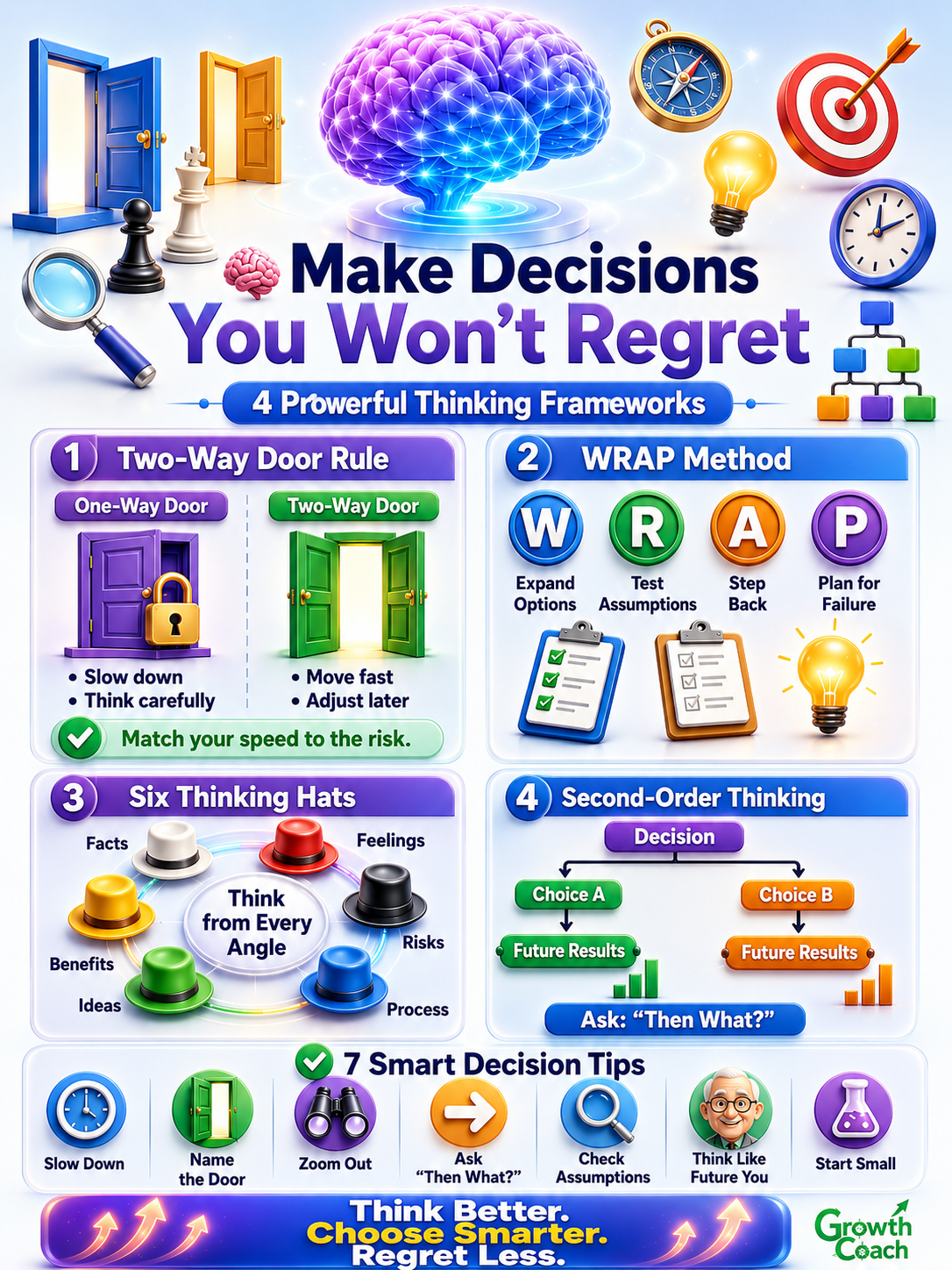
So, How Can You Actually Make Better Decisions and Dodge Future Regret?
Let’s be real, making decisions is one of those fundamental life skills, right? We do it constantly. Every single day, we’re faced with choices that can steer our careers, our finances, our health, our relationships, and our personal journeys. Some of these choices lead to awesome outcomes, while others? Well, they become those valuable, sometimes painful, lessons. The magic behind the good outcomes often isn’t about being a genius; it’s usually about *how* we go about making the decision itself.
The super encouraging news is that you can totally learn to make better decisions. By consciously applying structured thinking frameworks, you can get way better at looking at your options objectively, dial down those pesky emotional biases that can cloud your judgment, and ultimately improve your long-term results. Think of these frameworks as your decision-making toolkit!
This guide is all about breaking down four super practical decision-making frameworks. They’re designed to help anyone think more strategically and feel way more confident about the choices they make. Let’s unpack them!
🎯 Why Nailing Your Decisions is a Game-Changer
When you get good at making decisions, it genuinely impacts almost every part of your life in a positive way. It’s not just about avoiding bad choices; it’s about actively creating better opportunities and outcomes.
Instead of just reacting on impulse or rushing into things, people who are great at making decisions usually have systems in place. These systems encourage them to really think things through, analyze options carefully, and consider the long game. This thoughtful approach makes a huge difference.
What are the perks of getting your decision-making skills dialed in? Let me count the ways:
- 🌱 Greater Confidence: You’ll feel much more sure of yourself when facing those big, important decisions. No more second-guessing yourself endlessly!
- 💼 Boosted Career & Business Success: Smart choices lead to better opportunities, smoother projects, and overall professional growth.
- 💰 Smarter Financial Planning: From saving to investing, making sound financial decisions can set you up for long-term security.
- 🤝 Stronger Relationships: Good decisions in how you communicate, commit, and interact can significantly improve your personal and professional connections.
- 📈 Continuous Personal Growth: Every well-made decision is a step forward, helping you learn, evolve, and become a better version of yourself.
Now, let’s be clear: no framework is a magic wand that guarantees every single decision will be perfect. Life is full of variables! But seriously, adopting structured thinking methods dramatically improves the quality and consistency of your decisions over time. It’s about making *better* decisions, more often.
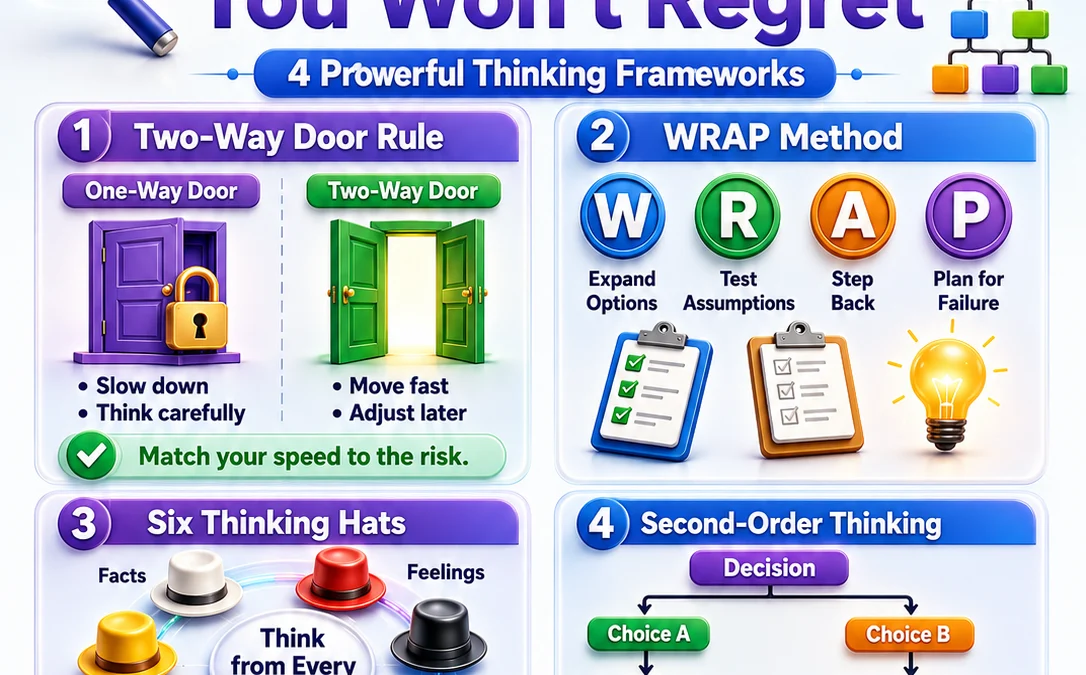
🚪 Framework 1: The Two-Way Door Framework – Speed Up or Slow Down?
Ever heard of Jeff Bezos? He’s the mastermind behind the Two-Way Door Framework, a super simple yet incredibly effective way to figure out just how quickly you need to make a decision. It’s all about assessing the true reversibility of a choice.
The core question is elegantly straightforward:
“Can this decision be reversed?”
Here’s the golden rule: If the answer is YES, you should probably move quickly. If the answer is NO, it’s time to pump the brakes and slow down.
Think of It Like Doors: One-Way vs. Two-Way
🚪 One-Way Doors: The Irreversible Paths
These are the biggies. One-way doors represent decisions that are tough, if not impossible, to undo once you’ve made them. Changing course can be incredibly difficult, expensive, or just plain impractical. Because of this, these decisions deserve a serious amount of your time and attention.
Examples of decisions that often act like one-way doors include:
- 🌍 Relocating: Moving to a different country or even a distant city.
- 💼 Career Commitments: Accepting a high-level, long-term executive position with significant responsibilities.
- 🏠 Major Property Purchases: Buying a house or significant real estate.
- 💍 Life-Altering Commitments: Things like marriage or starting a family.
For these kinds of choices, you need to do your homework. That means thorough research, talking to trusted advisors, consulting with those affected, and really giving it some deep, thoughtful planning. You can’t just easily backtrack on these.
🚪 Two-Way Doors: The Flexible Options
On the flip side, we have two-way doors. These represent decisions that are reversible. If you make the choice and it doesn’t work out, you can usually change your mind or pivot without facing major consequences or huge costs.
Think about these examples:
- 💡 Testing a New Business Idea: Launching a small pilot program or a minimum viable product (MVP).
- 📱 Trying New Software: Implementing a new productivity tool or app.
- 🎨 Learning a New Skill: Taking up a new hobby or creative pursuit.
- 📚 Enrolling in a Course: Signing up for an online workshop or a short-term class.
With two-way door decisions, spending ages agonizing over every tiny detail often just leads to unnecessary delays and analysis paralysis. The key here is often to act, learn, and adjust as you go. It’s much more efficient to make a quick decision and iterate than to get stuck trying to perfect it upfront.
The Big Takeaway from the Two-Way Door Framework
The core lesson is simple but profound: Match your decision-making speed to the actual level of risk involved.
For those high-impact, potentially irreversible choices (one-way doors), patience and thoroughness are your best friends. Take your time, gather information, and think it through.
For those low-risk, easily reversible choices (two-way doors), speed and action are often more beneficial. Don’t let perfection be the enemy of progress. Embrace experimentation and continuous learning.
🧩 Framework 2: The WRAP Method – Avoiding Those Pesky Thinking Traps
Ever feel like your own brain is playing tricks on you when you’re trying to make a decision? You’re not alone! Chip and Dan Heath, brilliant authors and thinkers, developed the WRAP Framework to help us navigate and avoid some of the most common cognitive biases and decision-making pitfalls.
WRAP is a neat acronym for four practical steps that guide you through a more robust decision process:
🌟 W — Widen Your Options
One of the biggest mistakes we make is falling into the trap of “false dichotomies” – thinking we only have two choices when, in reality, there are many more. We often frame decisions as a simple “A or B” scenario.
Instead of asking yourself:
“Should I choose A or B?”
Try broadening your perspective and ask:
“What other possibilities exist? What could C, D, or even Z look like?”
Actively seeking out and considering a wider range of options can often uncover much better, more innovative solutions that you might have completely overlooked if you’d stuck to the initial, limited choices.
🔍 R — Reality-Test Your Assumptions
Here’s a psychological quirk: we humans naturally tend to look for and favor information that confirms what we *already* believe. This is called confirmation bias, and it can seriously skew our judgment. To make better decisions, you need to actively fight this tendency.
Instead of just seeking validation, deliberately search for evidence that challenges your assumptions and beliefs. Ask yourself tough questions:
- 🔹 What facts or data contradict my current opinion or preferred choice?
- 🔹 What would someone who strongly disagrees with me say? What are their arguments?
- 🔹 What evidence am I perhaps ignoring or downplaying because it doesn’t fit my narrative?
This process of rigorously reality-testing your assumptions leads to much stronger, more balanced, and well-supported decisions.
🧘 A — Attain Distance
Emotions are powerful, and while they give richness to life, they can also temporarily distort our judgment, especially when we’re feeling intense stress, excitement, or fear. Making a big decision when you’re emotionally charged is rarely a good idea.
Creating a bit of psychological distance can bring much-needed clarity. Here are some tried-and-true techniques to help you gain perspective:
- ✨ The 24-Hour Rule: For significant purchases or decisions, wait at least 24 hours before committing. This often allows initial emotional intensity to fade.
- ✨ Take a Walk: Physical movement can help clear your head and shift your perspective.
- ✨ Pros and Cons List (with a Twist): Don’t just list them; try to objectively weigh them. Or, imagine you’re advising a close friend in the same situation.
- ✨ The “Wise Friend” Perspective: How would you advise a friend facing this exact same dilemma? Often, we can be more objective and rational when advising others.
A calmer, more detached mind is far better equipped to make rational and sound decisions.
🛡 P — Prepare to Be Wrong
This might sound a bit pessimistic, but it’s actually incredibly practical. Even the best-laid plans and most well-thought-out decisions can sometimes go awry. Circumstances change, unforeseen events happen, or maybe your initial assessment wasn’t quite right.
Instead of assuming everything will go perfectly, shift your mindset and ask:
“What could go wrong with this decision? What are the potential risks and downsides?”
By proactively thinking about what might go wrong, you can develop contingency plans, create backup strategies, or at least be mentally prepared to adapt if things don’t go as planned. This foresight reduces stress, builds resilience, and makes you much better equipped to handle setbacks.
🎩 Framework 3: The Six Thinking Hats – Seeing Through Different Lenses
This is a fantastic framework from Edward de Bono, a pioneer in the field of creative thinking. The Six Thinking Hats method is all about deliberately stepping outside your usual way of thinking and exploring a decision from multiple, distinct perspectives. It’s a way to ensure you don’t get stuck in a single mode of thought and miss crucial aspects of the situation.
Instead of trying to do everything at once, you metaphorically put on different colored hats, each representing a different type of thinking. This structured approach ensures a more comprehensive and balanced examination of any issue or decision.
Let’s Break Down Each Hat:
⚪ White Hat – The Facts and Figures
This hat is all about objective information. When you’re wearing the White Hat, you focus purely on the data, facts, and figures available. It’s about asking:
- What information do we have right now?
- What are the known facts?
- What information is missing, and how can we get it?
This hat helps ground the decision in reality, ensuring you’re not operating on assumptions alone.
🔴 Red Hat – The Feelings and Intuition
The Red Hat is where you acknowledge emotions, gut feelings, and intuition. Importantly, you express these feelings without needing to justify them logically. It’s a space to say:
- How do I *feel* about this decision?
- What is my gut instinct telling me?
- Do I have any emotional reactions (positive or negative) to this?
This hat allows for the emotional component of decision-making to be recognized and considered, without letting it completely take over rational thought.
⚫ Black Hat – The Cautious and Critical View
This is the hat of caution, risk assessment, and critical judgment. The Black Hat helps you identify potential problems, dangers, and downsides. You ask:
- What could go wrong?
- What are the risks involved?
- What are the potential obstacles or negative consequences?
- Why might this *not* work?
This hat is crucial for identifying potential pitfalls and preparing for them, preventing unpleasant surprises down the line.
🟡 Yellow Hat – The Optimistic and Beneficial View
The Yellow Hat is all about optimism, benefits, and positive outcomes. It encourages you to look for the good in a situation, the advantages, and the potential value. You explore:
- What are the potential benefits and advantages?
- What are the positive outcomes we can expect?
- Why is this a good idea?
- What opportunities does this present?
This hat helps ensure you don’t miss out on potential upsides due to excessive caution.
🟢 Green Hat – The Creative and Innovative Spark
This is the hat of creativity, new ideas, and alternatives. The Green Hat encourages brainstorming, looking for different possibilities, and thinking outside the box. Ask:
- What are some alternative solutions?
- Can we approach this differently?
- What new ideas can we generate?
- Are there any other options we haven’t considered?
This hat is vital for innovation and finding novel solutions.
🔵 Blue Hat – The Process Manager
The Blue Hat is the conductor of the orchestra. It oversees the thinking process itself. The person wearing the Blue Hat is responsible for setting the agenda, defining the problem, ensuring all the other hats are used effectively, and summarizing the outcomes. They ask:
- What is our objective?
- Which hat should we use now?
- Are we staying on track?
- Have all perspectives been considered?
- What have we concluded?
By systematically using these six hats, either individually or in a group setting, you can minimize blind spots, ensure a thorough evaluation, and arrive at more balanced and well-rounded decisions.
🌊 Framework 4: Second-Order Thinking – What Happens *After* What Happens Next?
Many people make decisions based on the immediate, obvious consequences. They ask, “What happens next?” and feel satisfied with the answer. But truly wise decision-making involves looking much further down the road. This is where Second-Order Thinking comes in.
Instead of just asking:
“What happens next?”
The critical question becomes:
“Okay, and *after* that happens, what happens? And then what?”
You continue to ask “and then what?” until you can trace the potential chain of consequences far enough into the future to understand the true, long-term impact of your decision. This helps you avoid choices that look good in the short term but have detrimental long-term effects.
Let’s Use a Concrete Example: A Job Offer
Imagine you receive a fantastic job offer. Let’s trace the thinking:
- ✅ First-Order Consequence (Immediate): Higher salary! This is the immediate, attractive benefit. Yay!
But what happens *after* accepting the job? This is where Second-Order Thinking kicks in:
- 📍 Second-Order Considerations (Potential Consequences):
- Longer Commute: That higher salary might come with a much longer drive each day.
- Less Family Time: The new role might demand longer hours, reducing precious time with loved ones.
- Increased Stress: More responsibility or a demanding work environment could lead to higher stress levels.
- New Learning Opportunities: The role might offer chances to develop new skills and grow professionally.
- Expanded Network: You’ll meet new colleagues and industry contacts.
- Future Career Advancement: This role could be a stepping stone to even bigger opportunities down the line.
By thinking through these subsequent layers of consequences, you get a much richer, more realistic picture. A decision that initially seemed like a clear win (higher salary) might reveal significant downsides (less family time, more stress) upon deeper second-order analysis. This deeper thinking often leads you to a different, and ultimately better, decision.
🚀 7 Practical Tips for Making Smarter Decisions, Starting Today!
Beyond these frameworks, successful decision-makers often cultivate certain habits and adopt practical approaches. Integrating these into your routine can significantly sharpen your decision-making prowess:
🐢 1. Don’t Rush the Big Stuff: Slow Down
It sounds obvious, but it’s crucial. Important decisions, especially those with significant long-term implications, deserve your focused attention and time. Avoid making life-altering choices when you’re feeling pressured, stressed, or rushed. Give yourself the space to think.
🚪 2. Know Your Doors: Name Them!
Revisit the Two-Way Door Framework. Before diving deep into analysis, ask yourself: “Is this decision reversible?” The answer dictates your pace. If it’s a two-way door, you can afford to be quicker. If it’s a one-way door, slow down and be deliberate.
🔭 3. Zoom Out: Think Long-Term
Train yourself to look beyond the immediate future. How will this decision impact you in one year? Five years? Ten years? Considering the long-term trajectory helps align your choices with your ultimate goals and values, preventing short-sighted decisions that you might later regret.
🔄 4. Keep Asking “Then What?”: Embrace Second-Order Thinking
Actively practice tracing the consequences of your decisions. Don’t stop at the first outcome. Keep asking “And then what happens?” This helps uncover hidden costs, unintended side effects, and the true long-term implications that often make a seemingly good decision a poor one.
🔍 5. Be Your Own Skeptic: Challenge Your Assumptions
We all have biases. Make it a habit to question your own beliefs and assumptions. Actively seek out information and perspectives that challenge your initial thoughts. Verify facts before you act. This critical self-examination is key to objective decision-making.
👴 6. Consult Your Future Self
This is a powerful mental exercise. Imagine yourself looking back on this decision from decades in the future. Would your future self see this choice as wise, brave, and aligned with your core values? This perspective can help you prioritize what truly matters in the long run and make choices you’ll be proud of.
🧪 7. Test the Waters: Start Small Whenever Possible
Before making a huge commitment, see if you can test the waters. Can you run a small pilot project? Can you try a feature on a trial basis? Can you conduct a small experiment? Whenever feasible, testing ideas on a smaller scale reduces uncertainty, provides valuable real-world feedback, and minimizes the risk of a large-scale failure.
🌟 Common Decision-Making Mistakes to Sidestep
Even the most experienced and intelligent individuals can sometimes fall into predictable decision-making traps. Being aware of these common pitfalls is the first step to avoiding them:
- ❌ Acting Purely on Emotion: Letting immediate feelings (anger, excitement, fear) drive your choices without rational consideration.
- ❌ Overthinking Reversible Decisions: Spending excessive time and energy on choices that are easily undone, leading to delays and missed opportunities (applying the one-way door logic to a two-way door).
- ❌ Ignoring Long-Term Consequences: Focusing only on immediate benefits or drawbacks, without considering the future ripple effects.
- ❌ Seeking Only Confirming Evidence: Falling prey to confirmation bias by only looking for information that supports your pre-existing beliefs or desired outcome.
- ❌ Refusing to Consider Alternative Options: Getting stuck in a binary choice (A or B) and failing to explore other, potentially better, possibilities.
- ❌ Fearing Small Failures: Being so afraid of making a mistake that you avoid making any decision at all, or avoiding experiments that could provide valuable learning opportunities.
Recognizing these patterns in your own thinking and behavior is a huge step toward making consistently better choices.
🎯 The Bottom Line: Make Decisions You Won’t Regret
Every significant decision you make is a building block for your future. It shapes the opportunities that come your way and the person you become.
While we can never completely eliminate uncertainty from life, employing thoughtful, structured frameworks can dramatically improve your judgment and significantly reduce the likelihood of future regret. Let’s recap the powerhouses we’ve discussed:
- The Two-Way Door Framework teaches us to choose the right speed for our decisions – fast for reversible, slow for irreversible.
- The WRAP Framework is your shield against common cognitive biases, helping you broaden options, test assumptions, gain distance, and prepare for the unexpected.
- The Six Thinking Hats offer a panoramic view, ensuring you consider every angle – facts, feelings, risks, benefits, creativity, and process – for a truly balanced perspective.
- Second-Order Thinking is your long-term vision lens, helping you see beyond the immediate outcome to understand the deeper, future consequences.
When you combine these powerful frameworks with practical habits like deliberately slowing down for important choices, challenging your own assumptions, consistently thinking about the long-term impact, and testing ideas before going all-in, you create an incredibly robust foundation for making better decisions.
Remember, the ultimate goal isn’t to achieve a mythical state of making perfect decisions 100% of the time. The real aim is to make thoughtful, informed decisions that are genuinely aligned with your long-term goals and core values. By consistently applying these strategies, you’ll build unshakeable confidence, sharpen your critical thinking skills, and ultimately, lead a life marked by wiser, more fulfilling choices across the board. Your future self will definitely thank you!