Hey there, business enthusiasts! Ever wondered who’s raking in the most cash globally? The landscape of the world’s largest companies by revenue has seen some pretty dramatic shifts between 2020 and 2026. We’re talking about major players moving up, down, and even disappearing from the elite top 10. Retail, healthcare, and tech are definitely making waves, while some of the energy giants that used to dominate are finding themselves further down the list. 📈
The biggest headline? It’s got to be Amazon’s incredible ascent! This e-commerce and cloud computing powerhouse has rocketed from the ninth spot back in 2020 all the way to number one in 2026, just barely nudging out the long-standing champion, Walmart. This monumental shift really gives us a fantastic insight into how the scale of business and economic power has transformed across the global economy. It’s a testament to how quickly things can change! 🌎
So, Who’s Actually Bringing Home the Biggest Bucks in 2026?
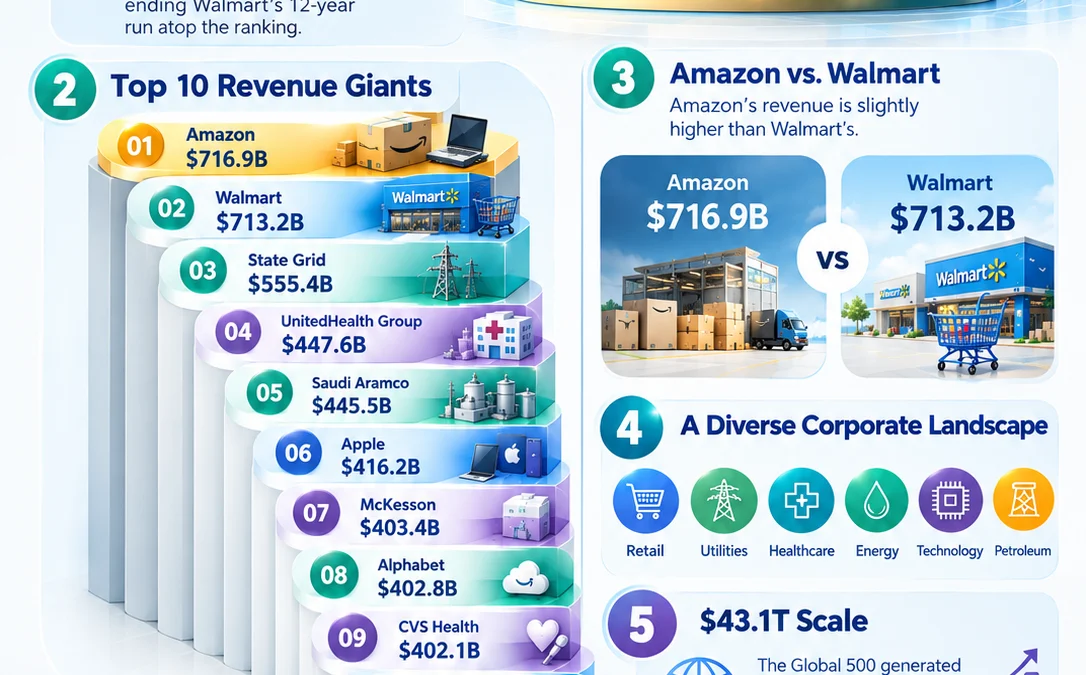
Let’s dive straight into the juicy details! In 2026, Amazon is officially crowned the king of global revenue, pulling in a staggering approximately $717 billion. Hot on its heels is Walmart, a very close second with about $713 billion. Following them, we have State Grid holding strong in third place. Rounding out the top 10 are a mix of powerhouses: UnitedHealth Group, Saudi Aramco, Apple, McKesson, Alphabet, CVS Health, and PetroChina. It’s a diverse and dynamic group, showcasing different sectors of the global economy.

🏆 The Top 10 Largest Companies by Revenue in 2026: Who Made the Cut? 💰
Looking at the 2026 rankings, it’s clear that the competition at the very top is incredibly fierce. Amazon and Walmart are practically neck-and-neck, separated by just a sliver in their massive revenues. It’s also noteworthy that State Grid remains the undisputed leader among non-U.S. companies, securing a solid third place. This top tier is a fascinating mix, showing a global economic picture that’s constantly evolving. 📊
| Rank | Company | 2026 Revenue |
|---|---|---|
| 1 | Amazon | $717 billion |
| 2 | Walmart | $713 billion |
| 3 | State Grid | $555 billion |
| 4 | UnitedHealth Group | $448 billion |
| 5 | Saudi Aramco | $446 billion |
| 6 | Apple | $416 billion |
| 7 | McKesson | $403 billion |
| 8 | Alphabet | $403 billion |
| 9 | CVS Health | $402 billion |
| 10 | PetroChina | $402 billion |
Note: Revenue figures are based on the latest available Fortune Global 500 data and correspond to the relevant fiscal years.
💡 Quick Tip for Smart Investors:
It’s super important to remember that a revenue ranking is all about the sheer scale of sales and business activity. It doesn’t automatically tell you which company is the most profitable, the most valuable in terms of market cap, or the best stock to invest in. Always look at multiple metrics!
📈 Amazon’s Meteoric Rise: From #9 to the Pinnacle of Global Revenue 🚀
Amazon’s journey up this prestigious list is undeniably one of the most significant transformations we’ve seen between 2020 and 2026. Back in 2020, Amazon was a formidable player, generating about $281 billion in revenue and securing the ninth spot globally. Fast forward to 2026, and its revenue has exploded to roughly $717 billion! That’s an astonishing leap. 📦
This wasn’t an overnight success, of course. Amazon climbed steadily, hitting third place in 2021 and second in 2022. It held that strong second position for a couple of years before finally making its triumphant move into the number one spot in 2026. This consistent growth is a testament to its strategic expansion and adaptability.
What’s fascinating is that Amazon’s dominance isn’t just tied to its e-commerce roots anymore. The company has masterfully diversified its revenue streams. Think Amazon Web Services (AWS) powering a huge chunk of the internet, a booming digital advertising business, and various other ventures. This multi-faceted approach creates robust and resilient sources of both revenue and profit, making it a true giant in the modern economy. ☁️
🧠 Expert Insight on Business Evolution:
Amazon’s spectacular rise is a perfect case study. It brilliantly illustrates why revenue rankings can reveal so much more than just a company’s size. They often act as a barometer, showing how shifts in consumer behavior, rapid technological advancements, and innovative business models are completely reshaping the competitive landscape. Keep an eye on these trends!
🛒 Amazon vs. Walmart: A Battle for Supremacy at the Very Top ⚖️
While Amazon has claimed the top spot, it’s crucial to understand that Walmart hasn’t exactly stumbled. The gap between these two retail titans is remarkably narrow in 2026. We’re talking only about a few billion dollars separating them when you look at the rounded figures commonly used in these rankings. It’s a testament to Walmart’s enduring strength and strategic adaptations.
Walmart had proudly held the number one position for over a decade, making Amazon’s climb to the summit a truly significant shift in the global revenue hierarchy. This rivalry is more than just numbers; it’s a fascinating study in contrasting yet highly successful business strategies. 🏪
What makes this comparison so compelling is the difference in their core strengths. Walmart has built its empire on the sheer scale and efficiency of its physical retail operations, complemented by its rapidly growing digital presence. Amazon, on the other hand, has masterfully blended its e-commerce prowess with significant contributions from cloud computing, advertising, and a host of other innovative ventures. Both are giants, but they got there through slightly different paths, showcasing the diverse ways to achieve massive scale.
⛽ The Shifting Tides: From Energy Dominance to Retail, Healthcare, and Tech 🔄
The story of the 2026 rankings isn’t just about Amazon dethroning Walmart. Perhaps even more telling is the significant change in the composition of the top 10 list itself compared to 2020. The industries represented at the very top have diversified considerably.
Let’s rewind to 2020. In that year, a whopping five of the world’s 10 largest companies by annual revenue were energy giants. Sinopec led that energy-heavy pack with around $407 billion in revenue. State Grid and PetroChina were also very high up, alongside Saudi Aramco and BP, demonstrating the immense financial power of the oil and gas sector. ⚡
Fast forward to 2026, and the picture is dramatically different. Notably, no privately-owned energy company makes it into the world’s top 10. While Saudi Aramco still holds a strong position at fifth place, the landscape is now much more populated by companies from the retail, healthcare, and technology sectors. This shift signals a major rebalancing of global economic influence.
⚠️ Avoid This Common Misinterpretation:
It’s easy to look at changing rankings and think one industry has simply ‘won’ over another. However, this is a simplification. Revenue figures reflect business scale, but different industries have fundamentally different operating models, profit margins, and capital investment requirements. Don’t read too much into a simple industry win/loss narrative.
🏥 The Ascendancy of Healthcare: A Growing Force in the Global Economy 📊
Healthcare is another sector that has seen a remarkable surge in influence and revenue, significantly altering the top company rankings. In 2026, UnitedHealth Group has climbed to an impressive fourth place, boasting roughly $448 billion in annual revenue. Not far behind, CVS Health has secured the ninth spot with approximately $402 billion.
What’s truly striking is that neither of these healthcare behemoths were even in the world’s top 10 by revenue back in 2020. Their dramatic rise highlights the increasing economic significance of the healthcare industry, especially in major markets like the United States, where healthcare spending continues to be a substantial part of the economy. 🧬
This trend is absolutely crucial to watch. Company rankings can and do shift as consumer demand evolves, demographic changes occur, healthcare spending patterns fluctuate, and the very structure of healthcare businesses transforms. It’s a dynamic sector with a growing impact on the global economic stage.
🇺🇸 Why U.S. Companies Are Making Such a Strong Showing in the 2026 Top 10 🌎
If you look closely at the top of the 2026 revenue rankings, you’ll notice a particularly strong presence from companies based in the United States. Amazon and Walmart lead the charge at the very top, and then you see UnitedHealth Group, Apple, McKesson, Alphabet, and CVS Health all firmly within the top 10. That’s a significant chunk of the list!
This concentration is a clear indicator of the sheer scale and economic power of the U.S. consumer market, its thriving technology sector, and its vast healthcare industry. However, it’s equally important to acknowledge that the global economic landscape is far from being dominated by a single nation. Companies like China’s State Grid and Saudi Arabia’s Saudi Aramco powerfully demonstrate that the world’s largest businesses are geographically diverse and span multiple critical industries.
🏆 Best Practice for Global Business Analysis:
When you’re comparing global companies, don’t just stop at their rank. Always dig deeper. Consider a range of factors including their revenue, the industry they operate in, their geographic reach, their specific business model, and their profitability. Only then can you truly understand which companies are genuinely leading their respective markets.
🔎 Unpacking the 2020–2026 Rankings: Key Insights into the Evolving Business World 🌐
Taking a step back and looking at the period between 2020 and 2026 as a whole offers some incredibly valuable insights into major business trends and how the global economy is shifting. Here are some key takeaways:
📈 Retail’s Enduring Might: The fact that Amazon and Walmart, two retail giants (albeit with diversified operations), occupy the top two spots in 2026 underscores the immense and ongoing scale of the retail sector. It remains a foundational pillar of the global economy.
☁️ Technology’s Expanding Influence: With Apple and Alphabet (Google’s parent company) comfortably within the top 10 by revenue, it’s evident that the technology sector’s economic footprint continues to grow. Tech companies are not just innovative; they are massive revenue generators.
🏥 Healthcare’s Significant Gains: The rise of UnitedHealth Group and CVS Health into the global top tier is a clear signal of the healthcare industry’s increasing economic weight. Factors like aging populations and advancements in medical care contribute to this growth.
⛽ Energy’s Diminished Dominance (in the Top 10): While energy remains a critical global industry, its representation in the absolute top 10 by revenue has notably decreased compared to 2020. This reflects shifts in global energy markets and the rise of other sectors.
🌍 Persistent Global Competition: The presence of companies from the U.S., China, and Saudi Arabia in the highest echelons of the revenue rankings demonstrates that global economic leadership is diverse and highly competitive. No single country or region holds a monopoly.
💭 Does Being the Largest Company by Revenue Automatically Mean Being the ‘Best’? 🤔
This is a really important question to ask! The short answer is: not necessarily. Revenue is a critical metric – it tells us how much money a company is bringing in from its sales and operations. It’s a fantastic indicator of a company’s sheer scale and market presence. But it’s only one piece of the puzzle.
Imagine a different ranking based on profitability (how much profit they keep after expenses), market capitalization (the total value of all their shares), brand value (how much their brand is worth), growth rate (how fast they are expanding), shareholder returns (what they give back to investors), or even customer satisfaction. Any of these metrics could produce a vastly different list of top companies! 📌
So, for anyone looking to truly understand and compare businesses, it’s wise to view revenue rankings as an excellent starting point for analysis, rather than the definitive final word on a company’s overall success or quality.
📌 Key Takeaway for Understanding Market Dynamics:
The 2020 to 2026 revenue rankings powerfully illustrate just how rapidly corporate leadership can change in today’s dynamic global economy. Amazon’s impressive climb to the top, Walmart’s incredibly close second-place finish, and the notable rise of healthcare and technology companies all point towards a business landscape that is in constant flux. Adaptation and innovation are key!
🌟 Key Takeaways From the World’s Biggest Revenue Generators 🚀
🏆 Amazon Reigns Supreme: Amazon officially holds the top spot globally in terms of revenue for 2026.
🛒 Walmart’s Strong Contention: Walmart remains a formidable competitor, trailing closely behind Amazon.
🌏 Global Representation: State Grid stands out as the highest-ranked non-U.S. company, currently at third place.
🏥 Healthcare’s Growing Clout: The significant presence of UnitedHealth Group and CVS Health highlights the expanding economic power of the healthcare sector.
💻 Tech Titans Endure: Apple and Alphabet continue to demonstrate the immense financial strength and market dominance of major technology companies.
⛽ Energy Sector’s Shifting Role: The top 10 revenue list in 2026 features fewer energy companies compared to 2020, reflecting broader economic trends.
🔍 Revenue vs. Overall Value: Remember, revenue measures business scale, but it’s not the sole determinant of a company’s overall health, value, or success.
🌟 Final Thoughts: The Global Revenue Race Is More Dynamic Than Ever! 📈
The list of the world’s largest companies by revenue offers a compelling snapshot of where global economic power resides at any given moment. The transformation we’ve observed between 2020 and 2026 is particularly striking. We’ve seen a clear evolution from an energy-dominated top tier to one now led by a more diverse mix of retail, healthcare, technology, and large-scale infrastructure businesses.
Amazon’s remarkable climb from ninth to first place is perhaps the most dramatic illustration of this ongoing transformation. However, Walmart’s razor-thin margin, the sheer scale of State Grid, and the impressive rise of healthcare companies show that there isn’t one single, magical formula for reaching the pinnacle of global revenue. It’s a complex interplay of strategy, market conditions, and innovation. 🌍
For anyone keenly following the world of business, the most insightful question isn’t simply ‘Who is number one?’ Instead, it’s ‘Why did the rankings change?’ Understanding the ‘why’ behind these shifts can unlock much deeper insights into market dynamics, evolving consumer behaviors, and the strategic moves of the companies that are actively shaping the future of the global economy.
What are your predictions? Which company do you think will be leading the global revenue rankings in the next few years? 🏆 Keep exploring Top Best Rated for more insightful rankings, detailed comparisons, and data-driven discoveries designed to help you make more informed decisions!