In times of economic turbulence and global uncertainty, seasoned investors and central bankers alike turn to a timeless asset for unwavering security: gold. 🏛️ It’s no secret that central banks around the world maintain substantial holdings of physical gold bullion, often stored in highly secure, underground vaults. 🔐 Understanding the motivations behind these massive gold reserves offers a fascinating glimpse into the core principles of global economics and national financial strategy. This deep dive will not only reveal who owns the most gold but also explore the strategic ‘why’ behind these decisions and how you can leverage these insights for your own financial well-being.
Recent data paints a striking picture of how different nations approach reserve management. 📈 While some economic powerhouses anchor a significant portion of their national wealth in physical gold – sometimes up to 80% of their total reserves – others maintain surprisingly low gold allocations. 🌍 Let’s unravel the strategic thinking that drives these choices and explore how these lessons can be adapted to fortify your personal wealth strategy.
Why Do Central Banks Hoard Gold? The Pillars of Reserve Strategy
Central banks strategically hold vast gold reserves for several critical reasons: capital preservation, hedging against inflation in fiat currencies, mitigating geopolitical risks, and diversifying national balance sheets. The unique nature of physical gold means it carries zero counterparty default risk. This makes it the ultimate safe-haven asset, providing a steadfast store of value during periods of banking crises, currency devaluation, and broad international economic volatility. It’s a tangible asset that stands resilient when paper promises falter.

The Global Gold Reserve Landscape: A Tale of Two Strategies
The way central banks allocate their reserves reveals distinct financial philosophies and historical contexts. 🌐 Examining both the sheer tonnage of gold held and its percentage of total reserves offers a compelling narrative about national economic confidence and risk management. These balance sheet compositions are the result of decades of evolving monetary policy and strategic foresight.
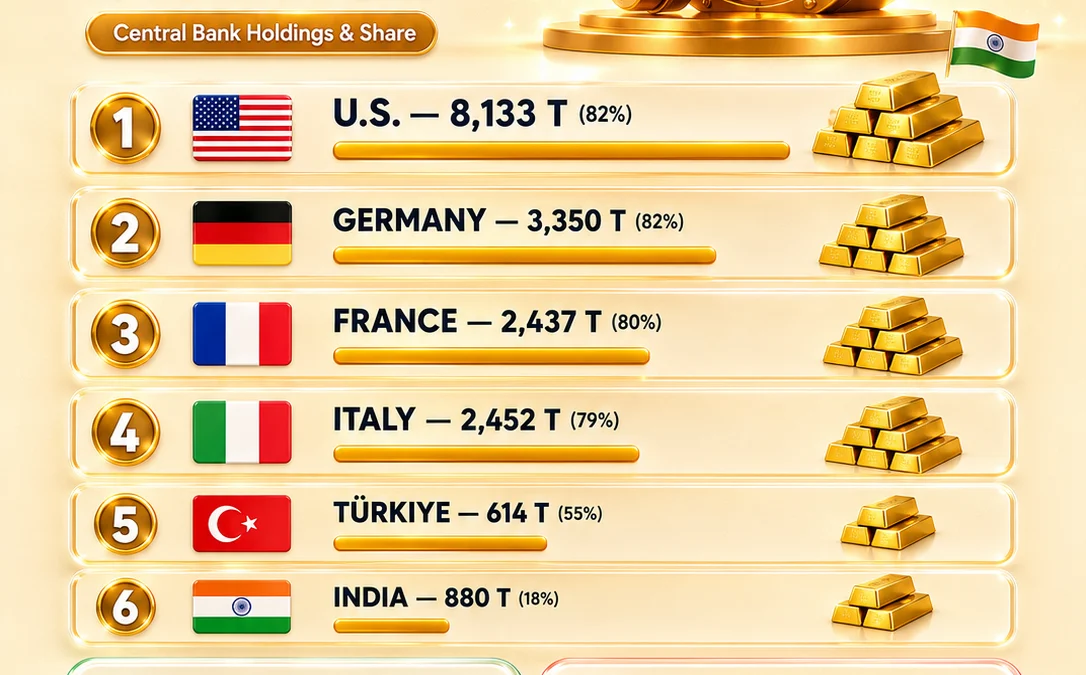
The sheer volume of gold residing in official bank vaults worldwide tells a fascinating story about global economic perceptions and stability. 🏦 Let’s dissect these crucial figures, based on recent international reserve reporting, to understand the global distribution of this precious metal:
| Country / Region | Gold Reserves (Tonnes) | Share of Total Reserves (%) |
|---|---|---|
| United States 🇺🇸 | 8,133 Tonnes | 82% |
| Germany 🇩🇪 | 3,350 Tonnes | 82% |
| France 🇫🇷 | 2,437 Tonnes | 80% |
| Italy 🇮🇹 | 2,452 Tonnes | 79% |
| Türkiye 🇹🇷 | 614 Tonnes | 55% |
| United Kingdom 🇬🇧 | 310 Tonnes | 20% |
| India 🇮🇳 | 880 Tonnes | 18% |
| Canada 🇨🇦 | 0 Tonnes | 0% |
Established Western economies often maintain substantial physical gold reserves as a bedrock for their monetary credibility, especially during periods of potential currency transition or instability. 🏛️ In contrast, many rapidly growing economies in Asia tend to hold larger volumes of foreign currency reserves, while steadily accumulating physical gold over time. This divergence highlights different approaches to managing national financial stability and currency risk.
💡 Quick Tip: Observe the striking consistency among major Western economies, where gold typically constitutes 75% to 80% of their official reserves. This high allocation serves as a robust solvency buffer, offering critical protection when national fiat currencies face the threat of systemic inflation or devaluation.
Decoding the West’s High Gold Allocation: History Meets Modern Risk Management
The significant gold holdings in countries like the United States, Germany, France, and Italy are deeply rooted in historical precedent and sophisticated risk management strategies. ⏳ Even after the global shift away from historical gold standards, these nations have consciously retained substantial physical bullion as the ultimate safety net for their central bank balance sheets. 🏛️ The unparalleled advantage of physical gold is its inherent lack of default risk – it cannot go bankrupt or fail to meet its obligations.
While fiat currencies depend entirely on the stability of government and the trust of the public, physical gold offers tangible advantages that paper assets simply cannot replicate:
- 🛡️ Zero Default Risk: Gold held in secure vaults is an autonomous asset. It is impervious to corporate failures, sovereign debt defaults, or interest payment cessations, providing absolute security.
- 🌊 Universal Liquidity: In times of severe economic crisis, physical gold can be swiftly traded or pledged for liquid foreign currency virtually anywhere in the world, offering unparalleled flexibility.
- 🔥 Inflation Hedge: Historically, over multi-decade periods, physical precious metals have consistently maintained their real purchasing power, acting as a powerful hedge against the steady erosion of value inherent in fiat currencies.
Maintaining robust gold reserves sends a powerful signal of financial strength and stability to international creditors and global currency markets. ⚖️ It assures that, even amidst hyperinflationary pressures or significant sovereign debt restructuring, a nation possesses tangible, universally recognized wealth that transcends the vagaries of paper-based financial systems.
🧠 Expert Insight: Gold stands alone as the only primary financial asset that is not simultaneously a liability of another party. This unique characteristic positions it as the ultimate insurance policy, offering unparalleled protection for both central banks managing national reserves and individual investors safeguarding personal wealth.
The Canadian Enigma: A Gold Producer with Zero Reserves
Perhaps one of the most intriguing paradoxes in modern global finance is Canada’s decision to hold zero official gold reserves. 🇨🇦 Despite ranking among the world’s top gold-producing nations, Canada divested its final official gold holdings in 2016. 📉 This decisive strategic move sets it apart dramatically from nearly all other G7 member nations and presents a unique case study in reserve management.
Canadian monetary authorities opted for a fundamentally different reserve management philosophy, prioritizing income-generating assets. 🇨🇦 Here’s a breakdown of the rationale behind this unconventional approach:
- 💰 Income Generation: Canadian officials favored interest-bearing foreign government bonds over physical gold, which, while secure, does not produce a regular income stream.
- ⛏️ Natural Resource Backing: Policymakers argued that Canada’s vast, untapped gold deposits within its natural terrain provided sufficient intrinsic economic backing, negating the need for costly vault storage.
- 🔄 High Bond Liquidity: By holding highly liquid U.S. sovereign debt, Canadian authorities maintained the flexibility to intervene swiftly in foreign exchange markets when necessary, ensuring currency stability.
While this strategy can yield consistent interest payments during stable economic times, it inherently exposes national reserves to the risks of foreign currency devaluation and fluctuations in the bond market. 🌊 Most other central banks, conversely, view the costs associated with secure vault storage as a prudent investment for ensuring the absolute safety and integrity of their most critical assets.
⚠️ Common Mistake: It’s a misconception to assume that a country with no central bank gold reserves lacks significant precious metal wealth. Canada, despite its zero official holdings, possesses immense gold wealth in its abundant natural resources and active, thriving mining sector.
Translating Central Bank Wisdom to Your Personal Investment Strategy
You don’t need a sovereign wealth fund to adopt the sophisticated risk management principles employed by global central banks. 🧮 By observing how these institutions strategically manage their reserves, individual investors can formulate a practical roadmap for building a resilient and secure personal investment portfolio. 🏰 Protecting your family’s financial future hinges on achieving an optimal balance between growth potential and robust safety.
While central banks exhibit a wide spectrum of gold allocations, ranging from 0% to over 80%, financial advisors generally recommend a more moderate and balanced approach for individual investors. 🎯 Consider these practical guidelines when structuring your own portfolio:
📖 Mini Summary: A Practical Allocation Framework for Individuals
- 🌱 Conservative Defense (5% – 10% Allocation): This allocation serves as a reliable insurance policy against currency inflation and banking system stress. It offers protection without significantly hindering the overall growth potential of your portfolio.
- ⚖️ Balanced Preservation (10% – 15% Allocation): Ideal for individuals nearing retirement or those with a lower risk tolerance, this range prioritizes wealth protection over aggressive speculation in growth assets.
- 🚀 Growth-Focused (2% – 5% Allocation): For investors primarily focused on long-term capital appreciation, a smaller allocation provides a valuable, non-correlated safety net, ensuring that the majority of capital remains invested in productive equity markets.
Incorporating a sensible portion of your net worth into tangible assets like precious metals can create a crucial emotional and financial buffer during periods of market turmoil. 🌊 When stock markets experience significant downturns or volatility, physical precious metals often hold their value or even appreciate, demonstrating their counter-cyclical nature.
🏆 Best Practice: When building the defensive cornerstone of your portfolio, prioritize low-cost, physical gold bullion (coins or bars) or securely allocated storage options. This approach is generally more prudent than investing in speculative gold mining stocks, which carry additional business and operational risks.
Key Takeaways: Mastering Your Investment Strategy with Gold Insights
By distilling the complex strategies of institutional investors, you can refine your personal investment approach. 📝 Utilize these core lessons derived from central bank reserve management to guide your long-term asset allocation decisions:
- 🏛️ The Ultimate Safe Haven: Western central banks allocate up to 82% of their reserves to gold because physical bullion offers zero counterparty default risk, providing unmatched security.
- 🌍 Strategic Diversification: Nations vary their reserve strategies based on economic goals, risk tolerance, and available natural resources, balancing income generation against asset safety.
- 🎯 Balanced Personal Allocation: For individual investors, a modest allocation of 5% to 10% in precious metals provides robust inflation protection without compromising long-term growth objectives.
- 🔐 Long-Term Security: View precious metals as a form of financial insurance – a long-term wealth preservation tool – rather than a short-term speculative play. This mindset ensures your wealth remains secure across all market cycles.
Building Unshakeable Wealth: The Enduring Power of Gold
Central banks dedicate immense resources to analyzing macroeconomic trends, currency stability, and geopolitical risks over decades. 🌟 Their sustained commitment to holding physical gold underscores the timeless and intrinsic value of tangible assets as a crucial complement to paper-based investments.
Take a proactive step today to review your current asset allocation. Ensure your financial foundation is fortified against unexpected market volatility and economic uncertainties. 🚀 Constructing a secure, well-diversified portfolio requires thoughtful planning, unwavering discipline, and the implementation of sound strategic principles. For more expert financial analysis, cutting-edge asset allocation strategies, and insightful market commentary, we invite you to explore our latest guides and resources.