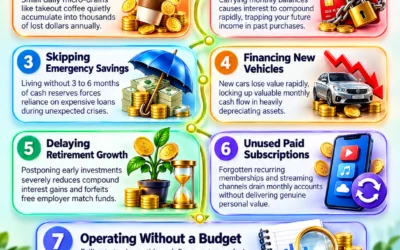
Hey there! Let’s talk about something super important: your finances. Your 20s are an absolutely golden decade for setting yourself up for serious long-term financial success. But here’s the kicker – it’s also a time when many of us, without even realizing it, make some pretty big money blunders. Think of it like this: the small financial habits you build now, whether they’re good or bad, can seriously shape your financial future for *decades* to come. This guide is all about breaking down the biggest financial mistakes people tend to make in their 20s, 30s, 40s, and even 50s. We’ll dive into why these decisions are so critical and, more importantly, how implementing simple, consistent systems can be your secret weapon for building lasting wealth. You’ll discover why things like saving consistently, investing early, budgeting smartly, dodging lifestyle inflation, and cultivating financial discipline are way more powerful than chasing those get-rich-quick schemes. Whether you’re just landing your first job, seeing your income grow, or already thinking about retirement (yes, even now!), this practical roadmap is packed with timeless strategies to boost your financial future. The goal? To build strong habits today so your money starts working *for you* tomorrow, unlocking greater financial freedom, security, and endless opportunities throughout every single stage of your life. 🚀
What Money Mistakes Should You Absolutely Avoid in Your 20s to Build Serious Wealth?
Let’s be real, achieving financial success rarely hinges on snagging the absolute highest salary out there. More often than not, it boils down to the rock-solid habits you start building *long* before your bank account starts looking impressive. While your income has the potential to grow over time, unfortunately, those not-so-great financial decisions can snowball just as quickly if you don’t get them under control. We hear it all the time: “I’ll start saving later.” But here’s the hard truth – time is arguably the most valuable financial asset you possess. Every single year you put off adopting smart financial habits makes reaching those big, long-term goals significantly more challenging. The fantastic news, though? Building wealth doesn’t demand perfection. It thrives on consistency. This guide is designed to walk you through the most common financial slip-ups people encounter at different life stages and, crucially, how establishing simple, effective financial systems early on can pave the way for enduring financial security.
💼 Why Your 20s Are a Game-Changer for Your Financial Future (More Than You Realize!)
Your twenties aren’t just about earning a paycheck; they’re fundamentally about laying down the most critical financial foundations for your entire life. Every single habit you cultivate during this transformative decade has the power to compound exponentially over time. Think about it: those small monthly savings you squirrel away can blossom into significant investments. Developing good budgeting practices now can morph into lifelong financial discipline. Making smart spending choices can unlock true financial freedom down the road. The earlier you can kickstart these habits, the more profound and far-reaching the benefits will be in your later years. Many individuals tend to hyper-focus on simply increasing their income, often overlooking the essential systems needed to manage that money effectively. Remember, income opens doors and creates opportunities, but it’s your financial habits that ultimately determine whether those opportunities translate into lasting success. Your income might create the chances, but your habits ensure they pay off in the long run.
📊 The Absolute Biggest Money Mistakes People Make in Their 20s
💸 Earning a Paycheck Without Actually Building Anything
Landing a salary is just the very first step in your financial journey. Without a clear plan in place, your hard-earned income can easily just evaporate, flowing straight through your fingers to cover monthly expenses. It’s a common scenario: many young professionals earn enough to comfortably save, but they never actually establish a consistent savings routine. Instead, they find themselves living paycheck to paycheck, with every dollar spent before the next one even hits their account. The simple act of building even a modest emergency fund can create a crucial layer of financial stability, significantly reducing stress when unexpected life events inevitably pop up.
🏦 Not Having a Solid Savings System in Place
Let’s distinguish between saving occasionally and, more importantly, saving consistently. Those who achieve true financial success are typically the ones who automate their finances. Instead of saving whatever money happens to be left at the end of the month, they make saving a priority – they save *first*. Establishing automatic transfers from your checking account to your savings account every payday effectively removes emotion from your financial decisions, making it a habit rather than a chore. Remember, consistency is far more impactful than the size of individual deposits. Small, regular contributions add up significantly over time.
📈 Waiting Way Too Long to Start Investing
One of the most significant financial advantages you possess in your twenties is *time*. Investments have decades to grow and compound, turning modest beginnings into substantial sums. Waiting even just five or ten years to start investing can drastically reduce your potential long-term returns because compound growth simply has less time to work its magic. It’s often far more beneficial to start investing with small amounts early on than to wait until you think you have a larger sum to invest. The power of compounding is incredible, but it needs time to work.
⏳ Wasting Your Greatest Asset: Time Itself
Money can often be earned again; it can be lost and recovered. Time, however, is a finite resource that can never be replaced. Every year you postpone crucial financial planning makes your future goals more expensive to achieve. Whether your aspirations include buying a home, launching your own business, or securing a comfortable retirement, taking action early creates invaluable flexibility and breathing room for yourself later in life. Don’t let time slip through your fingers without a plan.
🌟 Navigating Financial Challenges and Opportunities in Your 30s
By the time you hit your 30s, your income often sees a welcome increase. However, this is also a decade where expenses tend to climb right along with your earnings, presenting a unique set of financial challenges.
🛍️ The Sneaky Trap of Lifestyle Inflation
It’s a natural human tendency: as people receive raises and promotions, they often upgrade their lifestyles accordingly. This can manifest as bigger houses, fancier cars, more expensive subscriptions, and generally pricier discretionary purchases. While it’s absolutely important to enjoy the fruits of your labor and celebrate your successes, allowing *every* salary increase to be immediately absorbed by increased spending can severely hinder meaningful wealth creation. The key is to ensure that as your income grows, your savings and investments grow proportionally, not just your expenses.
💰 The Persistence of Inconsistent Saving Habits
A higher income doesn’t automatically equate to greater wealth if you haven’t cultivated disciplined financial habits. Without that underlying structure, larger salaries can easily disappear into a larger pool of expenses, leaving you no better off than before. Maintaining a consistent savings percentage, regardless of income fluctuations, is a powerful strategy to prevent this common pitfall. Treat saving as a non-negotiable expense.
🎯 Understanding That More Income Doesn’t Always Mean More Wealth
True wealth is ultimately defined by what you *keep* after spending, not simply by the amount you earn. It’s a fascinating reality that individuals with moderate incomes who consistently save and invest often end up financially outperforming higher earners who spend every penny they make. Financial independence and long-term security are built on consistent habits and strategic financial management, not solely on the size of your paycheck.
🚀 Dodging Financial Pitfalls and Making Smart Moves in Your 40s
As you enter your forties, your responsibilities typically become significantly greater. You might be juggling mortgages, planning for your children’s education, managing healthcare costs, and facing increasing career demands. These growing responsibilities underscore the even greater importance of robust financial planning during this decade.
🏠 When Loans Start Dictating Your Financial Decisions
Debt, especially significant amounts of it, can quietly but effectively erode your financial flexibility. Large loan repayments, whether for mortgages, cars, or other significant purchases, often delay crucial investments and limit your future financial opportunities. Actively working to reduce unnecessary debt frees up more capital and creates greater capacity for long-term wealth building. Prioritize paying down high-interest debt strategically.
📅 The Ever-Present Danger of “I’ll Invest Later”
This mindset is a persistent one. Many people continue to postpone investing because immediate, pressing expenses always seem to take precedence. Unfortunately, the ‘later’ they promise themselves often stretches into years, sometimes even a decade or more. Delaying investments means you’ll likely need to contribute much larger amounts later in life to achieve the same financial goals you could have met with earlier, consistent contributions. Remember, consistency in investing almost always trumps trying to perfectly time the market.
⚖️ Recognizing That Being Busy Isn’t the Same as Making Financial Progress
Simply working harder or climbing the career ladder doesn’t automatically guarantee improved financial health. Without taking the time to regularly review your spending patterns, investment performance, insurance coverage, retirement planning progress, and savings rates, your financial growth can stagnate, even amidst significant career success. Proactive financial management requires dedicated attention.
🌴 Navigating Common Financial Mistakes in Your 50s
As you reach your fifties, retirement often starts feeling much closer on the horizon. This decade can be a critical period where financial decisions become less forgiving, and the consequences of past choices become more apparent. It’s a time for a serious financial check-up.
💼 When Retirement Savings Are Still Shockingly Small
A common and often sobering realization in the fifties is discovering that retirement savings are significantly less than anticipated. Without adequate and consistent retirement planning throughout your earlier decades, maintaining your desired lifestyle in retirement can become incredibly difficult. Building up retirement savings gradually over several decades is almost always far easier and more sustainable than attempting a frantic catch-up in the final years.
💳 If Your Income Still Primarily Covers Only Daily Expenses
Ideally, by your fifties, your investments should be starting to contribute towards supporting your future living expenses. If, however, every paycheck is still being consumed entirely by current costs without a significant portion being directed towards growing your assets, your retirement options will likely be quite limited. The goal is to build additional income-generating assets that can bolster your long-term financial security and provide a cushion for retirement.
🚪 When Financial Choices Start to Shrink
Time becomes the most significant limiting factor in your fifties and beyond. The ability to recover from major financial setbacks or to make significant course corrections diminishes considerably. This stark reality highlights precisely why early and consistent financial planning offers such profound and compounding long-term advantages. The earlier you start, the more runway you have to recover from inevitable bumps in the road.
🌱 The Simple, Powerful Financial System That Works at Every Single Age
Achieving financial success doesn’t necessitate mastering complex, intricate strategies. Instead, the most effective approach is often to follow a simple, repeatable system that you can stick with consistently. It’s about building a framework for your money.
🌿 Build a Budget: The absolute first step is to gain crystal-clear visibility into exactly where your money is going each month. Understanding your spending is the foundation of control.
💰 Save First: Treat your savings like a non-negotiable monthly bill that *always* gets paid, ideally right after you receive your paycheck. Automate this process to make it effortless.
📈 Invest Consistently: Make regular, consistent investments, and allow the power of long-term growth, driven by patience and discipline, to work its magic. Don’t get swayed by short-term market noise.
🔄 Repeat Every Single Month: The magic truly lies in the repetition. Small, consistent actions performed month after month, year after year, compound to produce truly remarkable long-term results. This is the engine of wealth building.
🎯 Practical, Actionable Habits That Consistently Build Wealth
Here are some concrete habits you can start implementing today to build a more secure financial future:
- 🌟 Track your expenses diligently every single month. Know your numbers!
- 🌟 Build a robust emergency fund that can cover at least 3-6 months of essential living expenses. This is your safety net.
- 🌟 Avoid unnecessary debt like the plague whenever possible. If you must borrow, do so strategically and prioritize paying it off quickly.
- 🌟 Make it a rule to increase your savings rate *whenever* your income increases. Don’t let lifestyle inflation win.
- 🌟 Commit to continuously learning about personal finance. Knowledge is power.
- 🌟 Regularly review and adjust your financial goals as your life circumstances change. Stay adaptable.
- 🌟 Invest consistently and systematically, focusing on long-term growth rather than trying to time the market or making emotional decisions.
- 🌟 Keep your focus firmly on long-term progress and building sustainable wealth, rather than getting caught up in short-term market trends or financial fads.
🧩 The Path to Financial Freedom Is Paved One Habit at a Time
There’s truly no single “perfect” age to start prioritizing and improving your financial life. However, it’s undeniable that every single year you delay taking action significantly diminishes the advantages and opportunities available to you. Building wealth isn’t about finding elusive shortcuts or becoming a market oracle who can predict future trends. It’s fundamentally about cultivating reliable, consistent financial habits that continue to work for you, regardless of your income level or the economic climate. The earlier these habits are established, the more doors they open and the greater the opportunities they create throughout your entire life. Your future financial security hinges far less on the amount of money you earn today and significantly more on the consistent choices you make about what to do with that money. So, start building your personalized financial system today. Save consistently. Invest patiently. And repeat relentlessly. Trust us, years from now, your future self will be incredibly grateful for the wise decisions you make today.