Feeling overwhelmed by debt? You’re not alone. The good news is that getting out of debt doesn’t have to be a mystery. When you transform that daunting problem into a clear, actionable plan, the path to financial freedom becomes much more manageable. Forget just making minimum payments or, worse, adding to your debt with new credit. A structured debt payoff strategy starts with a deep dive into every single balance, interest rate, minimum payment, and who you owe. Once you’ve got that crystal clear picture, you can break the cycle of borrowing, choose a repayment method that actually works for you, potentially slash those high interest rates, trim your expenses, and even boost your income for faster progress. This comprehensive guide will walk you through the popular debt snowball and debt avalanche methods, explore hybrid approaches, and discuss restructuring options, showing you how each can fit your unique financial situation. We’ll also cover how those crucial extra payments can dramatically shorten your payoff timeline, what to really think about before tapping into savings or consolidating, and how to keep your motivation soaring throughout the entire journey. By following a practical, sequential approach—from assessing your debt to preventing new borrowing, prioritizing strategically, accelerating your payments, and planning for a secure future—you can turn debt repayment into a focused, empowering path toward lasting financial stability and significant wealth building. Let’s get started on your journey to a debt-free life!

🎯 How Can You Get Out of Debt Faster and Build a Debt-Free Plan?
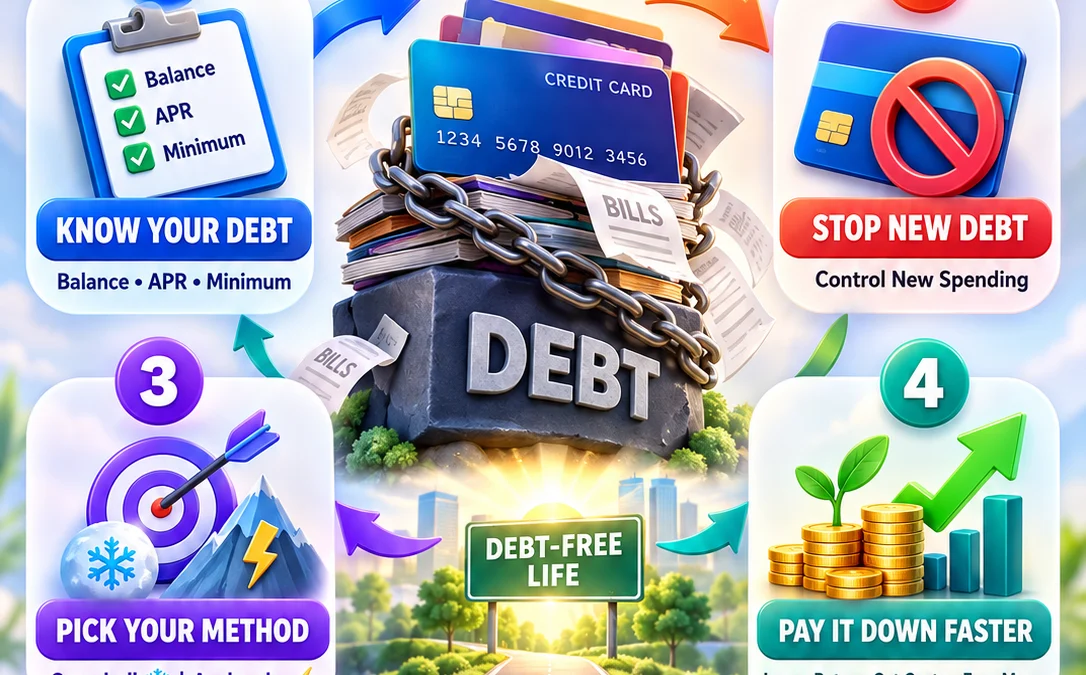
Debt can feel like a heavy weight, especially when you’re juggling multiple balances, trying to keep track of different interest rates, minimum payments, and due dates. It’s easy to feel lost in the shuffle. The truth is, simply trying to ‘pay more’ without a strategy isn’t the most effective way out. A truly successful debt repayment plan hinges on having a crystal-clear understanding of exactly what you owe, adopting a smart strategy for prioritizing your payments, and implementing a system to prevent yourself from falling back into the debt trap. The most powerful approach to tackling your debt can be broken down into four fundamental stages: assess your total debt, stop adding new debt, choose a payoff method that suits you, and then accelerate your repayment efforts. Following these steps will put you firmly in control of your financial future.
🔎 Step 1: Get a Crystal-Clear Picture of Your Total Debt
Before you can even think about how to tackle your debt, the absolute first step is to figure out precisely how much you owe in total. Many people fall into the trap of focusing on just one credit card or loan at a time, without ever calculating their complete financial obligation. This can lead to a skewed perspective and prevent effective planning. Creating a comprehensive debt inventory is essential; it provides a realistic, honest starting point for your debt-free journey.
📋 Create a Complete Debt List: Your Financial Map
To get started, grab a notebook, a spreadsheet, or use a budgeting app, and for *every single debt* you have, meticulously record the following details:
🔹 Creditor or Lender: Who do you owe money to? (e.g., Visa, Chase, your mortgage company, student loan servicer)
🔹 Current Balance: What’s the exact amount you still owe on this debt?
🔹 Annual Percentage Rate (APR): This is crucial! What’s the interest rate you’re being charged annually?
🔹 Minimum Monthly Payment: How much are you required to pay each month just to keep the account current?
🔹 Secured or Unsecured: Is the debt backed by collateral (like a car loan or mortgage), or is it unsecured (like most credit cards or personal loans)?
🔹 Payment Due Date: When is the payment for this debt due each month?
Don’t forget to check your credit reports! They can be invaluable for uncovering any accounts you might have forgotten about or weren’t aware of. Once you’ve gathered all this information, sum up all those current balances to calculate your total debt balance. This single, often eye-opening number will serve as your baseline, the benchmark against which you’ll measure all your progress moving forward.
📊 Understand Your Debt-to-Income (DTI) Position
Another incredibly useful metric to understand your debt situation is your debt-to-income ratio, often abbreviated as DTI. This ratio compares your total required monthly debt payments to your gross monthly income (your income before taxes and other deductions). It gives you a quick snapshot of how much of your income is already committed to debt repayment.
Here’s a simplified way to calculate it:
Debt-to-Income Ratio = (Total Monthly Debt Payments ÷ Gross Monthly Income) × 100
For example, if your total minimum monthly debt payments add up to $1,000 and your gross monthly income is $4,000, your DTI would be 25%. A high DTI ratio, generally considered above 43% by lenders, can signal that your debt payments are consuming a significant chunk of your available income. This makes it even more critical to control new borrowing and actively look for ways to improve your monthly cash flow. The key at this stage is not to judge yourself or your situation. It’s purely about gaining an objective, factual understanding of where you stand financially.
🛑 Step 2: Put the Brakes on New Debt
Imagine trying to bail out a sinking boat while someone is still drilling holes in the hull. That’s essentially what happens when you try to repay debt while simultaneously accumulating more. A debt repayment plan becomes exponentially harder to succeed with when new balances keep piling up. Therefore, your absolute next priority must be to stop the financial “bleeding” and prevent further debt accumulation.
🔒 Reduce Access to Unnecessary Borrowing: Lock It Down!
Depending on your specific situation and temptation levels, this might involve drastic measures like cutting up unused credit cards, freezing them in a block of ice (a popular visual trick!), removing saved payment details from online shopping accounts, or simply establishing a strict personal rule against using credit for any non-essential purchases. The core principle here is straightforward and non-negotiable: New debt should never undermine your debt repayment efforts.
Now, this doesn’t necessarily mean you need to close every single credit account you own. In some circumstances, closing accounts can actually have negative consequences on your credit score. The primary goal is to prevent yourself from taking on *additional* debt while you’re actively working to eliminate the balances you already have. It’s about creating a protective bubble around your debt payoff journey. Importantly, this step also requires creating a realistic spending plan that ensures you can still cover your essential expenses. This includes vital needs like housing, food, transportation, utilities, and any other required financial obligations. You need to live while you’re getting out of debt, but you need to live within your means and without adding to the problem.
🎯 Step 3: Choose the Right Debt Payoff Method for YOU
Once you’ve successfully stopped the inflow of new debt, it’s time to decide on the most effective strategy for tackling the balances you already have. There are two widely recognized and highly effective approaches: the debt snowball method and the debt avalanche method. Understanding how each works is key to picking the one that best aligns with your personality and financial goals.
❄️ The Debt Snowball Method: Building Momentum
The debt snowball method is all about psychological wins. It prioritizes paying off your smallest debt balance first, regardless of the interest rate. Here’s how the process works:
- Make Minimum Payments on Everything: Continue making only the minimum required payment on all of your debts except for the smallest one.
- Attack the Smallest Debt: Throw every extra dollar you can find at the debt with the smallest balance.
- Roll the Payment: Once that smallest debt is completely paid off, take the money you *were* paying on it (its minimum payment PLUS any extra you were adding) and add it to the minimum payment of the *next-smallest* debt.
- Keep Snowballing: Continue this process, rolling the entire payment amount of each debt you eliminate into the payment for the next smallest debt, until all your debts are gone.
The major advantage of the debt snowball is the powerful psychological momentum it builds. Those quick wins, seeing debts disappear one by one, can be incredibly motivating and make the entire process feel much more manageable and less daunting. Each paid-off account also frees up more money to attack the next target, creating a tangible sense of progress.
The trade-off? This method might result in you paying more interest overall compared to an interest-focused strategy, especially if one of your smaller debts happens to have a very high interest rate while a larger debt has a lower rate. It prioritizes motivation over pure mathematical efficiency.
⚡ The Debt Avalanche Method: Maximizing Savings
The debt avalanche method, on the other hand, is purely about mathematical efficiency. It prioritizes paying off debts with the highest interest rates first, regardless of their balance size.
The basic structure is:
💠 Pay Minimums on All Debts: Just like the snowball, continue making the minimum payment on every account except for the one you’re targeting.
💠 Target Highest APR: Direct all your available extra money toward the debt with the highest Annual Percentage Rate (APR).
💠 Eliminate High-Interest Debt: Once that highest-interest debt is paid off, take the entire amount you were paying on it (minimum + extra) and add it to the minimum payment of the debt with the *next-highest* APR.
💠 Continue the Avalanche: Keep working your way down the list of debts from highest APR to lowest, applying the snowballing payment amounts, until you’re debt-free.
The key advantage of the debt avalanche is its financial efficiency. By attacking the debts that are costing you the most in interest first, you can significantly reduce the total amount of interest you accumulate over the life of your repayment plan. This means you’ll likely get out of debt faster *and* pay less money overall.
The potential trade-off? The very first debt you pay off using the avalanche method might take longer to eliminate if that highest-interest balance is also a large one. This can sometimes be discouraging if you’re looking for quick, visible wins to maintain motivation.
🔄 Which Method Is Right for You? The Hybrid Option
So, which strategy should you choose? The honest answer is that neither method is universally the “best” for every single household. The optimal choice truly depends on what motivates you and what your primary financial goal is.
If you find that seeing quick progress and celebrating small victories is what keeps you going, the debt snowball method might be your perfect fit. Its focus on small wins can provide the psychological boost needed to stay committed.
Conversely, if your main objective is to minimize the total amount of interest you pay and get out of debt in the most financially efficient way possible, the debt avalanche method is likely the superior choice.
But what if you want a bit of both? You can absolutely consider a hybrid approach! For instance, if you have several small debts that are relatively close in balance, you might choose to pay off one or two of the smallest ones first just to gain some quick momentum (a mini-snowball). Then, once you’ve had those initial wins, you could switch to focusing on the highest-interest debts (an avalanche) to maximize your interest savings. This can create a practical and motivating compromise that plays to the strengths of both methods.
🧩 Consider Debt Restructuring When It Makes Sense
Sometimes, the best way to improve your debt repayment situation is to restructure your existing debt. This can be particularly beneficial if you can secure a lower fixed interest rate or negotiate more favorable repayment terms. Restructuring isn’t about eliminating debt magically; it’s about making the process of paying it off more manageable and less costly.
Here are some potential restructuring options to explore:
🔸 Lower-Interest Refinancing: This involves taking out a new loan with a lower interest rate to pay off existing higher-interest debts. This is common for mortgages, auto loans, and sometimes personal loans.
🔸 Balance-Transfer Opportunities: Many credit card companies offer balance transfer cards with 0% introductory APRs for a limited time. This can give you a window to pay down a significant chunk of debt without accruing interest, but be very mindful of transfer fees and the interest rate after the promotional period ends.
🔸 Debt Consolidation Loans: This is a single loan taken out to pay off multiple other debts. The goal is to simplify your payments into one monthly bill, ideally at a lower overall interest rate than what you were paying across all the individual debts.
🔸 Negotiated Repayment Arrangements: If you’re struggling to make payments, you can contact your creditors directly to see if they’re willing to negotiate a modified payment plan, a temporary interest rate reduction, or other hardship arrangements. This is often a last resort before more serious interventions.
It’s crucial to understand that debt consolidation, in particular, should not be viewed as an automatic ticket to debt freedom. Simply combining multiple balances into one new payment doesn’t reduce the underlying debt amount unless the new arrangement genuinely offers a better financial position (like a lower interest rate or a more manageable payment term). Always be wary of promotional rates; pay close attention to their expiration dates, any associated fees, eligibility requirements, and, most importantly, the interest rate that kicks in *after* the promotional period concludes. A seemingly good deal can quickly turn sour if you’re not paying attention to the fine print.
🚀 Step 4: Accelerate Your Debt Payoff Journey
Once you have your chosen repayment strategy in place (snowball, avalanche, or hybrid) and you’ve stopped adding new debt, the next logical step is to focus intensely on increasing the amount of money you’re applying towards your debt each month. The faster you can pay down the principal, the quicker you’ll be debt-free and the less interest you’ll ultimately pay. There are three primary levers you can pull to accelerate your debt payoff:
📉 1. Negotiate Lower Interest Rates
Don’t be afraid to pick up the phone and call your creditors! Many people assume their interest rate is set in stone, but it’s often negotiable, especially if you have a good payment history. Approach the conversation professionally and politely. Explain your situation and ask directly if a lower interest rate (APR) is available for your account. Ask them what options they might have based on your account’s history and your current circumstances. Even a modest reduction in your APR can make a significant difference over time, as more of your payment will go towards the principal balance rather than just servicing interest. This makes your repayment efforts far more efficient.
💰 2. Reduce Your Expenses
Take a hard look at your monthly budget. Where is your money actually going? Identify areas where you can temporarily trim spending. This doesn’t mean you have to live like a monk forever, but for a focused period, cutting back on non-essential expenses can free up a surprising amount of cash. Potential areas to explore include:
🏠 Subscriptions: Review all your streaming services, gym memberships, subscription boxes, and software subscriptions. Cancel anything you don’t use regularly or truly value.
🍔 Dining Out & Takeout: Eating at restaurants or ordering delivery frequently adds up quickly. Try cooking more meals at home.
🛍️ Non-Essential Shopping: Postpone or cancel purchases of clothes, electronics, home decor, or gadgets that aren’t absolutely necessary.
🎮 Entertainment: Look for free or low-cost entertainment options instead of expensive outings.
🚗 Discretionary Transportation Expenses: Can you carpool, use public transport more often, or combine errands to save on gas?
The ultimate goal here isn’t necessarily permanent extreme frugality. It’s about strategically creating additional cash flow that can be immediately redirected to pay down your debt faster.
📈 3. Increase Your Income
While reducing expenses is vital, it does have a natural limit – you can only cut back so much before you start impacting essential needs. Income, however, has much greater potential for expansion. Think creatively about how you can bring in more money:
💻 Freelancing: Leverage your existing skills by offering freelance services in your spare time (writing, graphic design, web development, virtual assistance, etc.).
📦 Selling Unused Items: Declutter your home and sell items you no longer need or use through online marketplaces or garage sales.
🚚 Gig Economy Work: Consider driving for a rideshare service or delivering food or packages during your off-hours.
🎓 Online Tutoring or Teaching: If you have expertise in a particular subject, offer online tutoring or create an online course.
⏰ Overtime or Additional Shifts: If possible, pick up extra hours at your current job or seek out a part-time position.
Crucially, any additional income you generate should have a clearly defined purpose: to be applied directly to your debt. Allocating these extra earnings straight toward your targeted debt can dramatically shorten your repayment timeline and save you a significant amount in interest.
📌 The Power of Extra Payments: Why They Matter So Much
Let’s talk about the magic of extra payments. Imagine you have a fixed monthly debt payment, and then you discover an additional source of income, whether it’s from cutting expenses or earning more. If you consistently direct that extra amount straight toward your debt, you can shrink your repayment timeline considerably. This concept is known as payment acceleration.
Here’s how it works in practice: Once you completely eliminate one debt, the money you were using for that debt’s payment (its minimum plus any extra you were adding) shouldn’t just disappear into your general spending. Instead of letting that freed-up cash get absorbed into your lifestyle, you should immediately redirect it to boost the payment on your *next* targeted debt. This creates a powerful compounding effect:
Debt Eliminated → Payment Freed Up → Larger Next Payment → Faster Elimination of Next Debt → Even More Cash Flow Freed → Even Faster Payoff of Subsequent Debts
This cycle is the very engine that drives the debt snowball method, and it can also significantly supercharge your debt avalanche strategy. By consistently rolling over and increasing your payments, you create a snowball effect that gains momentum and speed as you progress, leading to a much faster path to becoming debt-free.
💡 What’s Next? Your Life After Debt Freedom
Achieving debt freedom is an incredible milestone, but it’s not the final destination. It’s the beginning of a new financial chapter. Once you’ve successfully eliminated high-interest consumer debt (like credit cards and personal loans), the monthly cash flow that was previously dedicated to debt repayment can now be strategically redirected toward your long-term financial goals. This is where the real wealth-building begins!
Here are some potential priorities to consider once you’re debt-free:
🏦 Build or Bolster Your Emergency Fund: Aim to have 3-6 months (or even more) of essential living expenses saved in an easily accessible account. This is your safety net against unexpected job loss, medical emergencies, or major home repairs.
📊 Increase Retirement Contributions: Maximize your contributions to retirement accounts like a 401(k) or IRA. The earlier you start or increase contributions, the more time your money has to grow through compounding.
🎓 Save for Education: If you have children or plan on pursuing further education yourself, start saving in dedicated education accounts (like a 529 plan).
🏠 Prepare for Major Purchases: Save up for significant future expenses like a down payment on a house, a new car, or home renovations.
💼 Invest for Long-Term Goals: Once your emergency fund is solid and retirement is on track, consider investing in a diversified portfolio to build long-term wealth.
The most critical step here is to maintain the disciplined financial behaviors that got you out of debt in the first place. If you simply let the debt payment disappear without replacing it with a consistent savings or investment habit, it’s very easy for your spending to gradually expand again, creating new financial pressure and potentially leading you back into debt. The habits you built during your debt-free journey are the foundation for lasting financial security.
❓ Your Burning Debt Payoff Questions Answered
💳 Should You Use Savings to Pay Off Debt?
This is a common dilemma, and the answer isn’t a simple yes or no. It depends heavily on several factors: the interest rate on your debt, the amount of readily available emergency savings you have, the stability of your income, and any significant upcoming financial needs. Draining your entire emergency fund to pay off debt can create a new, dangerous problem. If an unexpected expense arises (like a car repair or medical bill) and you have no savings, you might be forced to take on *new* debt, negating your efforts. A more balanced approach is to compare the cost of carrying high-interest debt against the critical importance of maintaining adequate cash reserves for emergencies. Often, it’s wise to keep a healthy emergency fund and use *extra* income or strategically planned savings (not your entire safety net) to tackle high-interest debt.
🔄 Is Debt Consolidation Always a Good Idea?
Absolutely not. While debt consolidation *can* be a very useful tool, it’s not a magic bullet and is only a good idea when the new terms are genuinely better than your existing ones. Consolidation can simplify multiple payments into one and potentially reduce your overall interest rate, but you must scrutinize the details. Consider all the fees involved (balance transfer fees, loan origination fees), the length of any promotional 0% APR periods, the actual repayment terms of the new loan or card, and, crucially, whether you’ve addressed the spending behaviors that led to the debt in the first place. If you consolidate debt but continue to overspend, you’ll likely end up in a worse situation.
🧾 What If Minimum Payments Are Becoming Difficult?
If you’re finding it challenging to make even the minimum payments, the absolute worst thing you can do is ignore the problem or miss payments. Missing payments can trigger late fees, penalty interest rates, and severe damage to your credit score, making your situation much worse. Instead, proactive communication is key. Contact your creditors *before* you miss a payment. Explain your financial hardship honestly and ask if they offer any hardship programs, modified payment arrangements, temporary interest rate reductions, or other options that could help ease your burden. Many lenders are willing to work with you if you communicate openly and demonstrate a commitment to finding a solution.
❄️ Snowball or Avalanche: Which Is Better?
As we’ve discussed, the debt snowball method prioritizes smaller balances for faster psychological wins and momentum, while the debt avalanche method prioritizes higher-interest debts for maximum mathematical efficiency and interest savings. The “better” method is the one that you can stick with consistently. If you need the motivation of seeing debts disappear quickly, the snowball is likely better for you. If you’re highly disciplined and motivated by saving money and being mathematically efficient, the avalanche might be your choice. Consistency is the ultimate key to success with either strategy.
🧭 Your Debt-Free Action Checklist: A Simple Roadmap
Getting out of debt doesn’t require a complex, overwhelming system. It thrives on clarity, discipline, and a strategic approach. Here’s a straightforward checklist to guide you:
📝 List Every Debt: Create a comprehensive inventory detailing each debt’s balance, APR, and minimum payment. Know exactly what you’re up against.
🛑 Stop Adding New Debt: Implement strict measures to prevent taking on any new balances while you’re in your repayment phase.
🎯 Choose Your Payoff Strategy: Decide whether the debt snowball, debt avalanche, or a carefully considered hybrid approach best suits your personality and goals.
📞 Negotiate Interest Rates: Proactively contact creditors to see if you can secure lower APRs on your existing debts.
✂️ Reduce Unnecessary Expenses: Temporarily cut back on non-essential spending to free up extra cash for debt repayment.
💼 Increase Your Income: Explore legitimate ways to earn additional money and apply it directly to your debt.
💰 Apply Extra Money Strategically: Funnel all available extra funds directly toward your chosen target debt according to your selected payoff method.
🔁 Roll Eliminated Payments Forward: Once a debt is paid off, immediately redirect its entire payment amount (minimum + extra) to the next debt in your plan.
🏦 Build Savings Post-Debt: After tackling high-interest debt, prioritize building a robust emergency fund.
📈 Redirect Cash to Long-Term Goals: Once your financial foundation is secure, use your freed-up cash flow to invest and build wealth for the future.
The central idea is beautifully simple: know precisely what you owe, commit to not adding to it, prioritize your repayment efforts strategically, and consistently increase the amount of money going toward paying down your debt principal.
Debt repayment doesn’t need to be complicated. It requires accurate information, disciplined cash-flow management, and a strategy that you can realistically maintain over time. By following these steps, you’ll be well on your way to achieving financial freedom and building a secure, prosperous future.