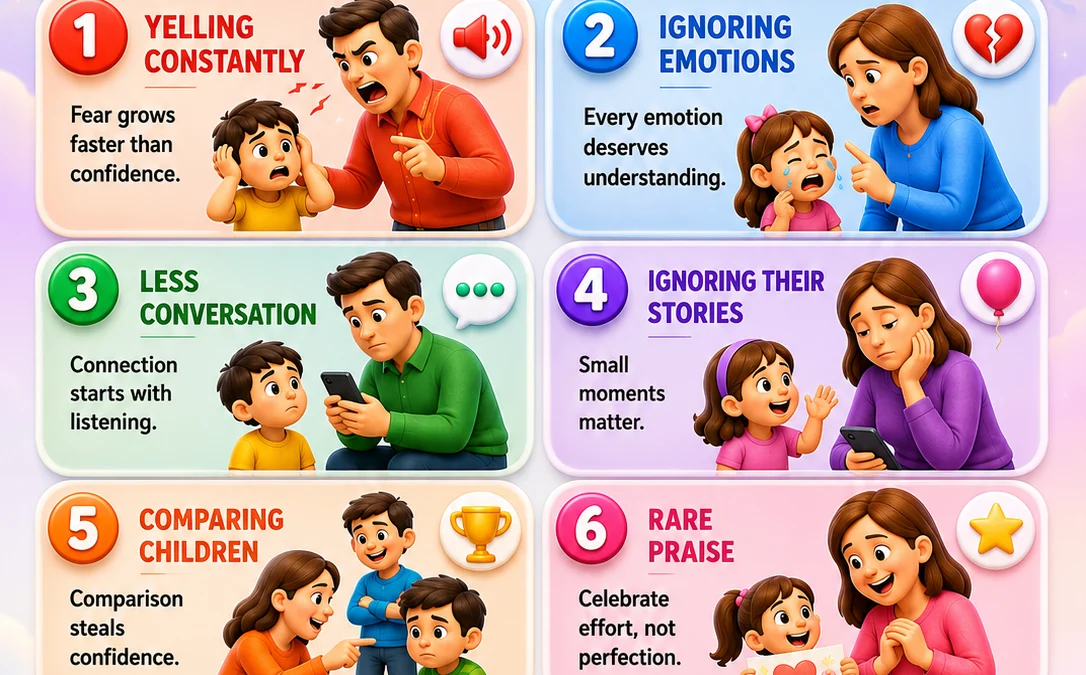
As parents, we all want to give our kids the absolute best start in life. We dream of them growing into confident, happy, and well-adjusted adults. But sometimes, without even realizing it, certain everyday parenting habits can cast a shadow over their emotional development and future well-being. It’s not about being a perfect parent – because let’s be honest, who is? – but it is about being a mindful one. This guide dives deep into eight common parenting habits that, while often unintentional, can quietly harm your child’s confidence, emotional intelligence, communication skills, creativity, and overall mental health. 🌱 We’ll explore how things like constant yelling, dismissing their feelings, comparing them to others, or punishing every little mistake can shape how they see themselves and the world. But don’t worry, this isn’t just about pointing out problems! We’ll also provide practical, healthier alternatives that foster trust, resilience, self-esteem, and a crucial sense of emotional safety. Parents, caregivers, and educators alike will find actionable tips to strengthen family bonds through better communication, genuine appreciation, active listening, and supportive discipline. ✨ Remember, building emotionally secure children is a journey, not a destination. It’s built on consistency, empathy, patience, and a whole lot of understanding. Ready to make some small changes that can lead to a happier home and help your children blossom into the confident, compassionate, and capable individuals they are meant to be? Let’s get started! 💙
🌟 Unpacking the 8 Toxic Parenting Habits That Can Leave Lasting Scars
Think about it: our children learn who they are, how relationships work, and how to navigate the world primarily through us, their parents. Every single interaction, every reaction, every quiet moment or loud outburst plays a role in shaping their developing minds and hearts. While the idea of ‘perfect parenting’ is a myth, becoming aware of potentially unhealthy patterns is one of the most powerful steps we can take to cultivate a home environment that feels safe, supportive, and emotionally nurturing.
Many of these habits aren’t born out of malice. They often creep in unintentionally, perhaps due to stress, the relentless demands of modern life, or simply because we’re repeating patterns we ourselves experienced growing up. However, when these behaviors become consistent, they can subtly but surely chip away at a child’s confidence, hinder their ability to communicate effectively, disrupt their emotional regulation, and even impact their capacity to form healthy relationships later in life.
This comprehensive guide aims to shed light on eight specific parenting behaviors that child development experts frequently link to negative emotional outcomes. More importantly, we’ll equip you with practical, positive alternatives designed to build a foundation of trust, resilience, and lasting well-being for your child.
🌟 Why Your Parenting Habits Are So Crucial
Children are like sponges, constantly absorbing not just the lessons we explicitly teach, but also everything they witness. Positive parenting practices create a sanctuary where children feel secure enough to express their feelings, ask all their curious questions, learn from their inevitable mistakes, and grow into their unique selves with unwavering confidence.
When we parent positively, we help children cultivate:
- ✨ A strong sense of emotional intelligence – understanding and managing their own emotions, and empathizing with others.
- ✨ Robust communication skills – the ability to express themselves clearly and listen effectively.
- ✨ Deep-seated confidence and self-worth – knowing they are valuable just as they are.
- ✨ Essential problem-solving abilities – tackling challenges head-on.
- ✨ The capacity for healthy, meaningful relationships.
- ✨ Unshakeable resilience – bouncing back from setbacks and navigating difficulties.
Conversely, a consistent pattern of negative interactions can gradually weaken these vital life skills, making it harder for children to thrive. Let’s look at some common pitfalls.
1. The Echo Chamber of Constant Yelling
Sure, there are moments when a parent might raise their voice out of sheer frustration or a sudden emergency. That’s human. But when yelling becomes the default response to everyday situations, it can create a deeply unsettling and emotionally overwhelming environment for children.
Children who are frequently exposed to constant shouting may start to:
- 🌼 Feel a pervasive sense of anxiety or fear, always walking on eggshells.
- 🌼 Experience a significant dip in their confidence, questioning their own worth.
- 🌼 Become hesitant to ask questions, fearing the explosive reaction they might get.
- 🌼 Develop a deep-seated fear of making any kind of mistake, big or small.
Instead of internalizing guidance and learning from it, they often learn a more primal lesson: fear of punishment. The goal shifts from understanding to mere survival.
A Better Approach: The Power of Calm Communication
💙 Speak with a firm, clear, but *calm* voice. Model the tone you want them to adopt.
💙 Clearly articulate your expectations and the reasons behind them. Understanding is key.
💙 When emotions run high – yours or theirs – take a deliberate pause before reacting. A deep breath can work wonders.
Calm, consistent communication is far more effective in fostering long-term positive behavior than the fleeting, damaging impact of repeated shouting.
2. The Dismissal of Tears: “Stop Crying!”
Crying is one of the very first ways babies and young children communicate their needs and feelings. It’s a fundamental human expression. When children are repeatedly told to “Stop crying,” “Don’t be upset,” or “You’re fine,” they can internalize a dangerous message: their emotions are wrong, unacceptable, or a burden.
Over time, this can lead to significant struggles with:
- 🌸 Understanding their own emotions – what are they feeling and why?
- 🌸 Expressing their feelings in healthy, constructive ways.
- 🌸 Developing robust emotional resilience – the ability to cope with difficult feelings.
- 🌸 Seeking help or support when they genuinely need it, fearing judgment or dismissal.
A Better Approach: Validate First, Then Guide
💛 Acknowledge and validate their emotions *before* trying to fix the situation. This is crucial.
Here are some examples:
- “I see you’re feeling really sad right now. I’m here with you.”
- “It sounds like you’re very upset about what happened. That’s understandable.”
- “Tell me more about what’s making you cry. Let’s talk it through together.”
By validating their feelings, you teach them that emotions are normal and manageable, fostering emotional regulation rather than the unhealthy habit of emotional suppression.
3. The Silence of Neglect: Barely Talking to Your Child
In our hyper-connected, yet often disconnected, world, families are frequently juggling demanding careers, busy school schedules, and the ever-present allure of screens. Sadly, this can lead to less meaningful conversation, which can significantly impact a child’s language development, cognitive skills, and, crucially, their emotional connection with their parents.
Regular, engaged daily conversations are vital for children to improve:
- 🌿 Their vocabulary and language comprehension.
- 🌿 Their overall communication abilities.
- 🌿 Their social confidence in interacting with others.
- 🌿 Their critical thinking and reasoning skills.
Beyond skill development, children feel deeply valued and understood when they know their parents are actively listening and engaging with them.
A Better Approach: Prioritize Connection Through Conversation
💚 Make a conscious effort to carve out uninterrupted time for talking each day. Even short, focused conversations make a huge difference.
These meaningful exchanges don’t need grand gestures or expensive outings. Simple chats during mealtimes, while walking the dog, during bedtime routines, or even a quick check-in after school can strengthen family bonds more profoundly than any material possession.
4. Dismissing Their World: Ignoring Their Little Stories
To a child, the experiences they have are often incredibly significant, even if they seem minor or mundane to an adult. Whether they’re bursting with excitement to describe a drawing they made, recount a daring playground adventure, or share a funny anecdote from the classroom, these moments are important to *them*.
When these stories are consistently met with a dismissive attitude – a quick “that’s nice,” a distracted nod, or being cut off – children can begin to feel:
- 💜 Invisible, as if their thoughts and experiences don’t matter.
- 💜 Unimportant, leading to a diminished sense of self-worth.
- 💜 Less willing to share their thoughts and feelings in the future, leading to communication shutdown.
- 💜 Emotionally disconnected from the adults in their lives.
A Better Approach: Be Present and Curious
Give your child your undivided attention for those few minutes they are sharing. Make eye contact, put down your phone, and truly listen. Asking simple, genuine follow-up questions like “Wow, tell me more about that!” or “What did you like best about that?” shows you value their world and helps build a strong foundation of trust.
5. The Comparison Trap: Measuring Your Child Against Others
It’s a common temptation for parents to use comparisons, perhaps thinking it will motivate their child. Statements like, “Why can’t you be more like your sister?” or “Look how well your friend finished their homework,” might seem like a nudge towards improvement, but they often backfire spectacularly, breeding insecurity rather than genuine motivation.
These comparisons can unintentionally:
- Damage a child’s fragile self-esteem, making them feel inadequate.
- Instill a belief that their worth is solely dependent on outperforming others, creating immense pressure.
- Foster resentment towards the sibling or friend being used as a benchmark.
- Discourage effort if they feel they can never measure up.
A Better Approach: Celebrate Individual Growth
🧡 Focus intensely on celebrating your child’s *personal* progress and achievements. Acknowledge how far *they* have come, regardless of anyone else.
Every child is a unique individual with their own timeline for development, their own set of strengths, unique talents, and distinct learning styles. Recognizing and nurturing this individuality is far more beneficial than any comparison.
6. The Unspoken Effort: Never Showing Appreciation
Just like adults, children thrive on positive reinforcement and feeling seen for their efforts. When their attempts, their hard work, and their positive contributions go unnoticed or unacknowledged, they can start to doubt their own capabilities and feel discouraged.
Remember, showing appreciation doesn’t require lavish gifts or grand gestures. Sincere, simple praise can powerfully encourage:
- 💖 Growing confidence in their abilities.
- 💖 Intrinsic motivation to try again.
- 💖 A sense of responsibility for their actions.
- 💖 Developing independence and a willingness to tackle tasks.
A Better Approach: Notice the Effort, Not Just the Outcome
Make a point to acknowledge the *process* and the effort your child puts in, not just the final result. Try saying things like:
- “I saw how hard you worked on that project, and I’m really impressed with your dedication.”
- “You didn’t give up even when it got tough. I’m so proud of your perseverance.”
This kind of positive reinforcement nurtures a healthy growth mindset.
7. Overlooking the Magic: Treating Playtime as Unimportant
In our goal-oriented society, it’s easy to view playtime as mere frivolous entertainment or a luxury we can’t afford time for. However, decades of research consistently highlight that play is not just fun; it’s absolutely fundamental to healthy child development across a multitude of crucial areas.
Through play, children develop essential skills such as:
- 🎨 Creativity and imagination – the ability to think outside the box.
- 🎨 Communication – learning to negotiate, share ideas, and express themselves with peers.
- 🎨 Emotional regulation – practicing managing frustration, excitement, and disappointment in a safe context.
- 🎨 Problem-solving – figuring out how to build that tower, resolve a dispute over a toy, or navigate a make-believe scenario.
- 🎨 Teamwork and cooperation – learning to work with others towards a common goal.
- 🎨 Decision-making – choosing what to play, who to play with, and how to play.
A Better Approach: Champion Playtime Every Day
Make sure to intentionally allow ample time for imaginative, creative, and physical play in your child’s daily routine.
A balanced schedule that includes dedicated playtime ensures children develop these vital life skills naturally while still enjoying the simple, profound joys of childhood.
8. The Fear Factor: Punishing Every Small Mistake
Mistakes aren’t failures; they are invaluable learning opportunities. When children live in an environment where they fear harsh punishment for every minor error, their focus shifts dramatically. Instead of learning from the mistake and seeking to understand, they become preoccupied with hiding it, fearing the consequences.
An overemphasis on punishment for every slip-up can unfortunately lead to:
- ❤️ A pervasive sense of fear and anxiety.
- ❤️ A tendency towards dishonesty to avoid getting into trouble.
- ❤️ Cripplingly low self-confidence, making them afraid to try new things.
- ❤️ Chronic anxiety about performance and judgment.
Healthy discipline should always aim to guide and teach, not to instill fear.
A Better Approach: Guide Through Mistakes with Curiosity
Instead of jumping straight to punishment, guide your child through their mistakes. Ask open-ended questions to encourage reflection and problem-solving:
- “What happened here? Let’s talk about it.”
- “What could we do differently next time to make sure this doesn’t happen?”
- “What did you learn from this experience?”
This approach fosters a sense of responsibility, encourages critical thinking, and teaches valuable problem-solving skills, rather than simply promoting avoidance.
🌈 Embracing the Characteristics of Positive Parenting
Let’s be clear: positive parenting isn’t about achieving an unattainable level of perfection. It’s about a consistent commitment to providing emotional support, fostering respect, and maintaining open, honest communication.
Positive parenting involves cultivating these key qualities:
- 🌟 Listening with genuine patience and attentiveness.
- 🌟 Establishing clear, consistent, and fair boundaries.
- 🌟 Encouraging your child’s natural curiosity and sense of wonder.
- 🌟 Diligently recognizing and appreciating their efforts.
- 🌟 Respecting and validating their emotions, even the difficult ones.
- 🌟 Teaching and guiding, rather than controlling or dictating.
- 🌟 Supporting their growing independence and autonomy.
- 🌟 Building unwavering trust through consistent actions and reliability.
By focusing on small, consistent improvements in our daily interactions, we can create profoundly positive, lifelong effects for our children.
💙 The Lasting Gifts of Healthy Parenting
Children who grow up in emotionally supportive, nurturing environments are significantly more likely to develop into adults who possess:
- ✨ Rock-solid self-confidence and a strong sense of self.
- ✨ Highly developed emotional intelligence, enabling them to navigate complex social situations.
- ✨ The ability to form and maintain healthy, fulfilling friendships.
- ✨ Excellent communication skills, both in expressing themselves and listening to others.
- ✨ A genuine motivation for learning and academic pursuits.
- ✨ Remarkable resilience, equipped to handle life’s inevitable challenges.
- ✨ Effective conflict resolution skills, able to navigate disagreements constructively.
- ✨ Strong, enduring family relationships built on love and respect.
These foundational qualities continue to benefit them immeasurably throughout their adolescence and into every stage of their adult lives.
🎯 Wrapping Up: Your Parenting Journey
Every parent, without exception, will make mistakes. That’s not just okay; it’s part of the human experience. Perfection is neither realistic nor the ultimate goal. What truly matters is our willingness to recognize behaviors that might be unintentionally impacting our child’s emotional well-being and to make a conscious choice to adopt healthier, more supportive alternatives moving forward.
By consciously replacing yelling with calm, reasoned communication, by validating our children’s emotions instead of dismissing them, by truly listening when they speak, by encouraging their unique individuality, by appreciating their efforts, by making space for meaningful play, and by employing discipline that guides rather than punishes – we are actively building a foundation for emotionally secure children.
Our children don’t need flawless parents. They need present, caring adults who are willing to listen, guide with wisdom, encourage with sincerity, and provide a safe, loving environment where they can confidently grow, learn kindness, and develop deep resilience.
When our daily parenting is rooted in empathy, mutual respect, and genuine understanding, we provide our children with the essential emotional toolkit they need to not just survive, but to truly thrive throughout their entire lives.